The perforated ruffle lichen owes its name to an unusual feature: its apothecia, the disc-shaped fruiting structures, often develop a small hole punched through their center. This makes Parmotrema perforatum one of the more distinctive members of its genus at a glance.
Parmotrema perforatum is a foliose lichen in the family Parmeliaceae, first described in 1787 by Nikolaus Joseph von Jacquin and later placed in the genus Parmotrema by Abramo Bartolommeo Massalongo in 1860. It is assessed as Least Concern. Its combination of a gray thallus, cilia-fringed lobes, and perforated apothecia gives it a recognizable look among leafy lichens.
Fruiting Body and Identification
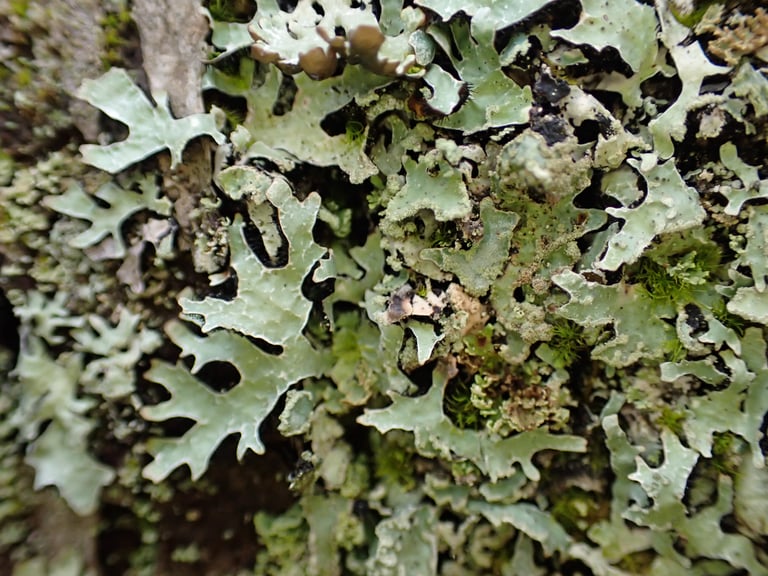
The clearest identifying trait of Parmotrema perforatum is the perforation that often appears at the center of its apothecia, a feature that sets it apart from many related species in the genus. The thallus itself is foliose, meaning it grows as flattened, leaf-like lobes pressed against the substrate rather than standing upright or hanging.
The upper surface of the thallus is gray, lacking the yellow-green cast produced by usnic acid in many other lichens. Along the edges of the lobes grow long, hair-like projections called cilia, a hallmark of the genus Parmotrema. The underside carries a naked, white zone along its margin, another feature typical of this genus.
Unlike many lichens, P. perforatum produces no asexual reproductive structures such as soredia or isidia. Its apothecia, bearing the characteristic central hole, serve as the sole visible means of sexual reproduction on the thallus.
Distribution and Habitat
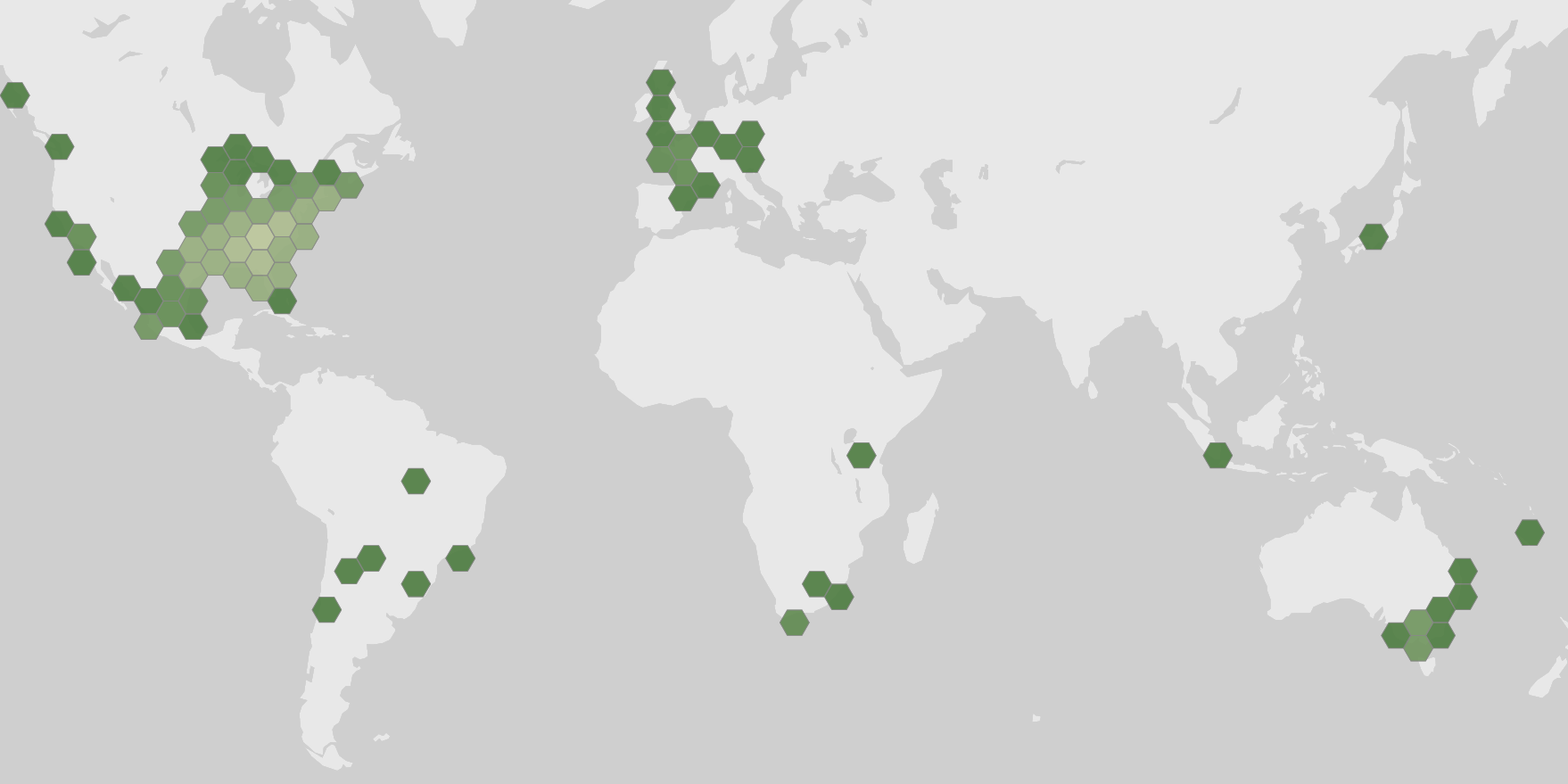
Observation records for Parmotrema perforatum show it recorded across all months of the year, with counts ranging from around 208 to 586 sightings per month. The highest numbers appear in March, April, and December, while the lowest fall around September, suggesting the lichen is encountered somewhat more often in early spring and toward year's end, though these figures reflect presence observations rather than actual abundance or a complete picture of its range.
Because these counts come from occurrence records rather than systematic surveys, they cannot be read as a measure of population size. They do, however, indicate that the species is observed and documented throughout the year rather than appearing only in a narrow season.
Fun Facts
- Parmotrema perforatum was first formally described in 1787 by Nikolaus Joseph von Jacquin, making its scientific recognition more than two centuries old.
- It was later reclassified into the genus Parmotrema in 1860 by the Italian lichenologist Abramo Bartolommeo Massalongo.
- Herbarium specimens of this species, such as those collected by lichenologist Mason E. Hale, have been documented from locations including Wilson, Tennessee, in the United States.
Photos
Photographs from via iNaturalist, licensed under CC0 1.0., by Aimee Lusty via iNaturalist, licensed under CC BY 4.0., by Brandon Corder via iNaturalist, licensed under CC BY 4.0., by Deana Tempest Thomas via iNaturalist, licensed under CC BY 4.0., by Steven Joyner via iNaturalist, licensed under CC BY 4.0., by Rachel Stepek via iNaturalist, licensed under CC BY 4.0., by Melissa Meadows via iNaturalist, licensed under CC BY 4.0., and by willingarden via iNaturalist, licensed under CC BY 4.0., credited on each photo.
Ecology and classification
Classification
- Phylum
- Ascomycota
- Class
- Lecanoromycetes
- Order
- Lecanorales
- Family
- Parmeliaceae
- Genus
- Parmotrema
- Species
- Parmotrema perforatum
Sources
- GBIF Species names and classification
- iNaturalist Photos
- Wikidata Common names and conservation status
- Wikipedia Summary extract