The Patagonian toothfish, widely sold in restaurants as Chilean sea bass, is a large, slow-growing notothen that lives in some of the coldest and deepest waters on Earth, from 45 meters down to 3,850 meters.
It belongs to the family Nototheniidae within the order Perciformes, and it ranges across the southern Atlantic, Pacific, and Indian Oceans as well as the Southern Ocean, concentrated around seamounts and continental shelves near Subantarctic islands. Beyond its value as a seafood species, its scale and reach across some of the planet's most remote waters make it a notable presence in southern ocean ecosystems.
Identification and Appearance
The most distinctive feature of the Patagonian toothfish is its large, canine-like teeth, arranged in two rows in the upper jaw and a spaced single row in the lower jaw, with extra fangs at the jaw joints. Its body is streamlined and fusiform, with a depth that fits into its standard length 5 to 6.4 times, giving it an elongated, torpedo-like shape.
The head is flattened with a wide, flat area between the eyes, and the snout is longer than the eye diameter. The mouth is large, extending past the middle of the eye. Two lateral lines run along the body, an upper one with 88 to 104 tubed scales and a lower one with 61 to 77 scales.
Its fins include a first dorsal fin with 8 to 10 spines, a second dorsal fin with 28 to 30 soft rays, and a similarly sized anal fin. The caudal fin is emarginate, while the pectoral fins are notably large and fan-shaped. Ctenoid scales cover the head and body except for the front of the head.
The species reaches a maximum total length of 215 cm and a maximum published weight of 200 kg, though individuals around 70 cm are more typical. Coloration is brownish-gray with darker blotches across the body.
Distribution and Habitat
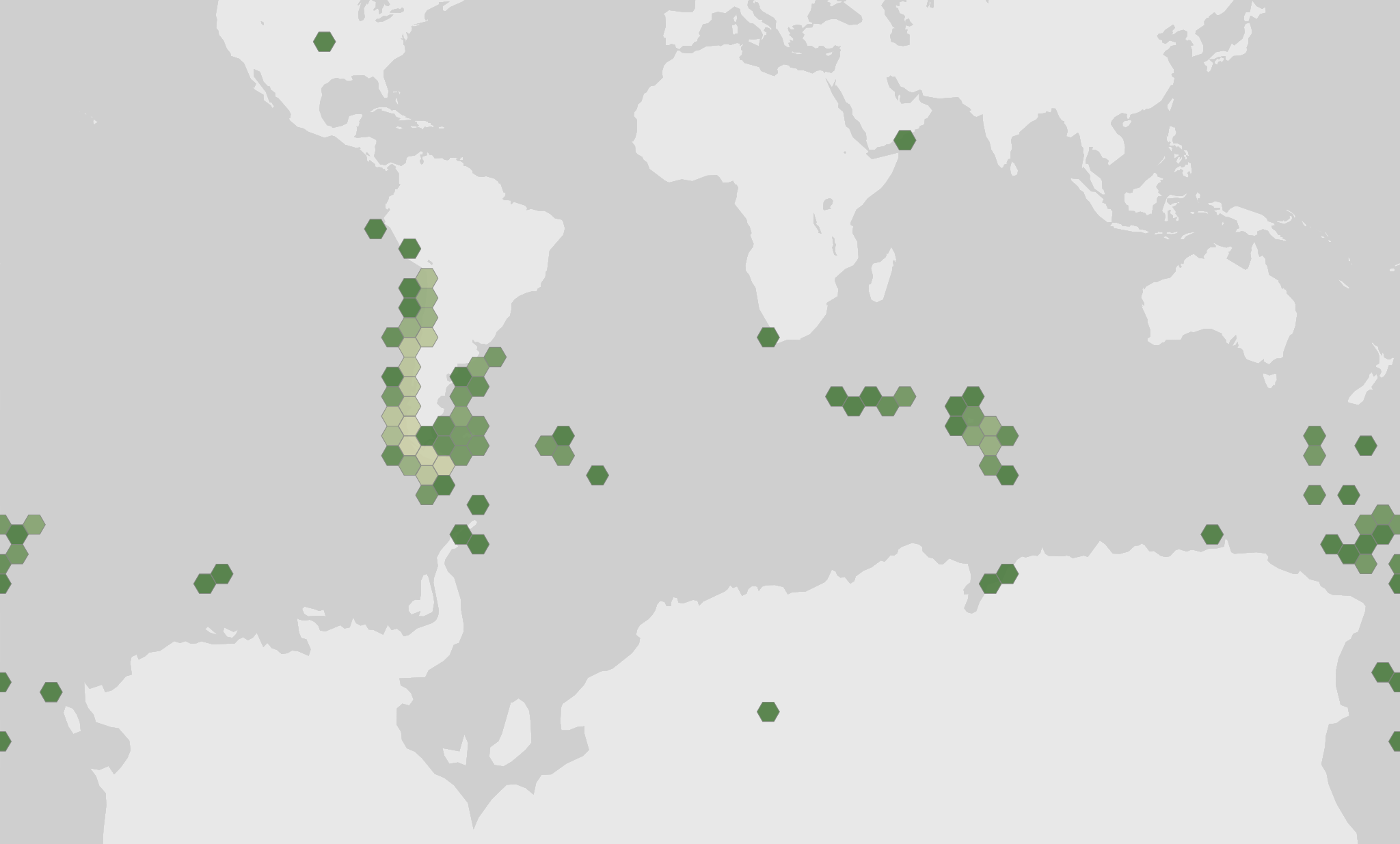
The Patagonian toothfish occurs across the southeastern Pacific and southwestern Atlantic Oceans, including the coast of Chilean Patagonia, Argentina, and the Falkland Islands. It has also been recorded at Macquarie Island in the southwestern Pacific, at South Georgia in the Southern Ocean, and around various sub-Antarctic islands and seamounts of the Indian sector.
A single vagrant record exists from the Davis Strait off Greenland in the northwestern Atlantic, far outside its typical range, believed to reflect a migration of over 10,000 km through deep, cold tropical-transiting waters.
Habitat use shifts markedly with age. Juveniles live a semi-pelagic existence before settling into demersal habitats at depths between 150 and 400 meters, while adults move into much deeper water, typically found below 1,000 meters.
Diet and Nutrition
The Patagonian toothfish is best known not for a documented feeding pattern but for its place in global seafood sustainability assessments. The Monterey Bay Aquarium's Seafood Watch program has rated fisheries that catch this species across a wide range, from Best Choice ratings for fisheries around the Heard Island and McDonald Islands, Macquarie Island, and the Falkland Islands, to Good Alternative ratings for fisheries near South Georgia, the Kerguelen Islands, and the Ross Sea.
Other fisheries, including those near the Prince Edward and Marion Islands, Chile, and the Crozet Islands, have been rated Avoid, while the Argentine fishery remains unrated. Together these rated fisheries account for about 78% of toothfish caught worldwide.
Greenpeace International added the species to its seafood red list in 2010, flagging it among fish commonly sold in supermarkets that carry a high risk of coming from unsustainable fisheries. Greenpeace has not updated that rating since the Seafood Watch review of 2013.
Fun Facts
- The genus name Dissostichus comes from Greek words meaning "twice" and "line" or "row," likely referring to its two lateral lines.
- The species name eleginoides derives from the genus Eleginops, reflecting a resemblance to that related fish.
- In some languages, the species carries alternate common names such as the Antarctic blenny, alongside its more familiar name, Patagonian toothfish.
Photos
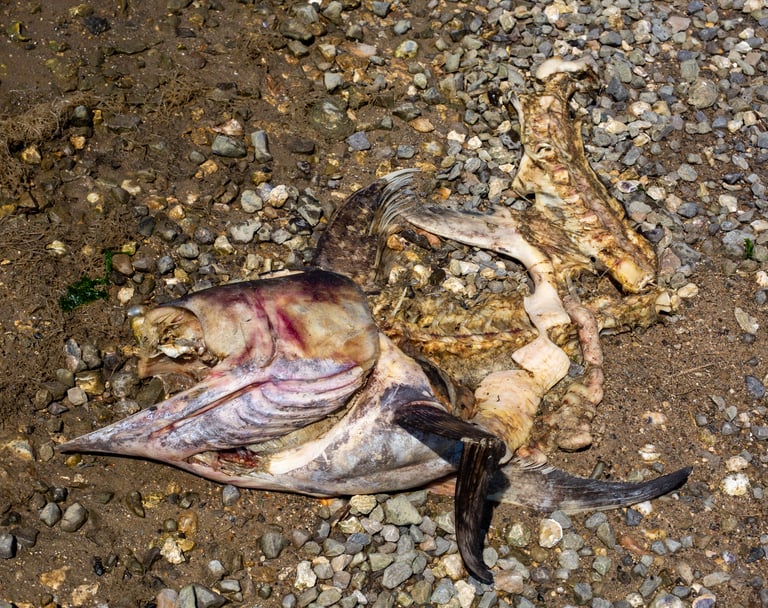
Photographs from by Los Viajes del Cangrejo via Wikimedia Commons, licensed under CC BY 4.0., via Wikimedia Commons, licensed under Public Domain., by Tion2w via Wikimedia Commons, licensed under CC BY-SA 4.0., and by Francis Letourmy via Wikimedia Commons, licensed under CC BY-SA 4.0., credited on each photo.
Ecology and classification
Habitat
Classification
- Phylum
- Chordata
- Order
- Perciformes
- Family
- Nototheniidae
- Genus
- Dissostichus
- Species
- Dissostichus eleginoides
Sources
- GBIF Species names and classification
- Wikidata Common names and conservation status
- Wikipedia Summary extract
- AnAge Longevity
- Wikimedia Commons Photos