The popular image of a swordfish spearing its prey like a rapier is largely myth. Evidence instead suggests the fish slashes at prey with its long bill to weaken it before feeding, rather than impaling it outright.
Xiphias gladius is a large, highly migratory predatory fish and the sole member of the family Xiphiidae within the order Perciformes. It ranges widely through tropical and temperate waters of the Atlantic, Pacific, and Indian Oceans, typically from near the surface down to 550 m (1,800 ft), and is currently assessed as Near Threatened.
Few fish combine raw power, an unusual body plan, and a long history of both sport and controversy quite like the swordfish. Adults lose all their teeth and scales, hunt largely by night, and have become a flashpoint in debates over sustainable fishing.
Identification and Appearance
The long, flat, sword-like bill projecting from the upper jaw is the single most reliable field mark, unmistakable even at a distance and unlike the rounder bills of marlin or sailfish. The body behind it is elongated and round-bodied, and unlike most bony fish, adult swordfish lose all their teeth and scales, leaving smooth, dark skin above fading to a lighter tone below.
Swordfish commonly reach about 3 m (10 ft), with a maximum reported length of 4.55 m (14 ft 11 in) and weight of 682 kg (1,500 lb). The International Game Fish Association's all-tackle record stands at 536 kg (1,182 lb), taken off Chile in 1953. Females grow larger than males, and Pacific swordfish reach greater sizes overall than those from the northwest Atlantic or Mediterranean.
Swordfish reach maturity at 4 to 5 years old, and are believed to live at least 9 years, with the oldest documented individuals a 16-year-old female and a 12-year-old male. Because their otoliths are too small to be useful, biologists instead count annual rings on fin rays to estimate age, a technique described as difficult.
A less visible but striking feature sits behind the eyes: specialized heater cells that warm the eyes and brain to between 10 and 15 °C above the surrounding water. This heating sharpens vision and boosts hunting efficiency, a heat-conservation trick shared by only 22 fish species, including some sharks, tuna, and marlin.
Distribution and Habitat
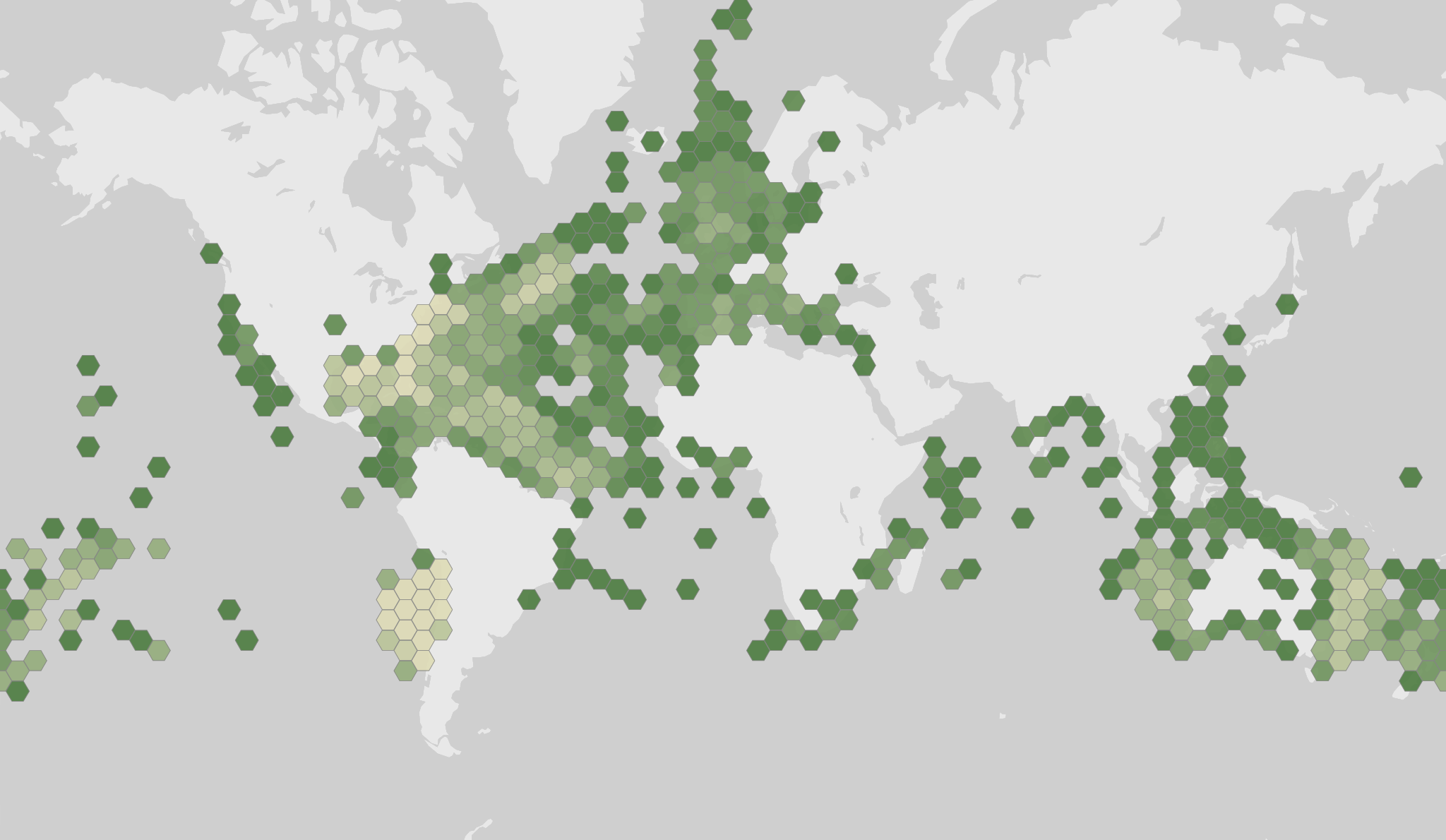
Swordfish occur widely across tropical and temperate parts of the Atlantic, Pacific, and Indian Oceans, making them one of the most broadly distributed large predatory fish in the sea. They typically range from near the surface down to about 550 m (1,800 ft), though individuals have exceptionally been recorded as deep as 2,878 m (9,442 ft).
Monthly presence-observation data show a clear seasonal pattern, with counts rising sharply from a low near 13,000–15,000 in the winter months to a peak of roughly 38,400 in May, before declining again through the second half of the year. These figures come from GBIF occurrence records and reflect where the species has been observed, not its abundance or full native range.
The spring and early-summer peak in sightings lines up with the species' habit of moving toward colder, more productive waters to feed during the warmer months, though the observation data alone cannot confirm population size or density in any given area.
Hunting and Diet
Rather than spearing prey outright, the swordfish relies mainly on speed and agility to close in on its target, using its bill as a slashing weapon that inflicts weakening injuries rather than a spear. The often-cited top speed of 100 km/h (60 mph) lacks reliable support; research on the related marlin points to a more realistic maximum of about 36 km/h (22 mph).
Swordfish are not schooling fish. They swim alone or in loose aggregations spaced as much as 10 m (35 ft) apart, and are frequently seen basking at the surface with the first dorsal fin exposed, or breaching in powerful jumps that may help dislodge parasites such as remoras or lampreys.
The species prefers water between 18 and 22 °C (64–72 °F) but tolerates a wider range than any other billfish, from 5 to 27 °C (41–81 °F). It migrates toward colder regions to feed in summer, and feeds daily, most often at night, rising toward the surface and near-surface waters to hunt; by day it typically stays down to 550 m (1,800 ft).
Adults take a wide range of pelagic fish, including mackerel, barracudinas, silver hake, rockfish, herring, and lanternfishes, along with demersal fish, squid, and crustaceans. A stomach-content survey of 168 individuals in the northwestern Atlantic found squid in 82% of fish and other fish species, such as gadids, scombrids, butterfish, bluefish, and sand lance, in 53%. Large prey is typically slashed with the bill before feeding, while smaller prey is swallowed whole.
Reproduction and Life Cycle
Spawning locations and timing vary by ocean basin. In the North Pacific, batch spawning occurs mainly in water warmer than 24 °C (75 °F) during spring and summer, and year-round in the equatorial Pacific. In the North Atlantic, spawning is known from the Sargasso Sea in water warmer than 23 °C (73 °F) and less than 75 m (246 ft) deep, while off southern Brazil in the South Atlantic it runs from November to February, and in the Caribbean and other warm parts of the western Atlantic it continues year-round.
Larger females carry more eggs, and clutches ranging from 1 million to 29 million eggs have been recorded. The pelagic eggs measure just 1.6 to 1.8 mm across.
Embryonic development begins about two and a half days after fertilization. The larvae that emerge are surface-living and distinctively shaped, measuring only 4 mm at hatching, with the characteristic bill becoming visible once a larva reaches about 1 cm in length.
Conservation and Threats
The swordfish is currently listed as Near Threatened by the IUCN, a status that masks considerable variation between regional stocks. The North Atlantic stock is now considered fully rebuilt, with biomass estimated at 5% above target levels, a rare conservation success story for a heavily fished pelagic species.
Other stocks tell a more troubling story. Overfishing is likely occurring in the Indian Ocean, and fishing mortality in the Mediterranean exceeds the recommended maximum, placing both among the high conservation concern category. The southwestern Pacific stock is a moderate concern due to model uncertainty, rising catches, and declining catch per unit effort, while the status of the northwestern Pacific and South Atlantic stocks remains unknown due to a lack of robust assessments.
Human fishing pressure is the species' dominant threat: the North Atlantic fishery alone reported catching 1.3 million kilograms (2.9 million pounds) in 2019, and Greenpeace International added swordfish to its seafood red list in 2010. The North Atlantic recovery followed the 1998 "Give Swordfish a Break" campaign, which persuaded hundreds of chefs and supermarkets to drop North Atlantic swordfish, led to a proposed U.S. protection plan, and resulted in 343,600 km2 (132,670 sq mi) of the Atlantic being closed to fishing.
Cultural Significance
Along the Strait of Messina, Sicilian fishing tradition treats the swordfish as a seasonal rival, a creature shown holding a blade that tests a fisher's courage and skill in local stories and imagery, rather than simply a catch to be taken.
The scientific name Xiphias draws on the Greek word for sword, echoing the xiphos, a short sword revered in Greek mythology and bound up with the ethos of heroism, a linguistic link between the fish and an ancient symbol of combat.
The swordfish's name has traveled beyond the sea and the page: astronomers have used "Xiphias" as an alternate name for the constellation Dorado, and "Swordfish" has served as a password gag since the 1932 Marx Brothers film Horse Feathers, a bit later echoed across countless films, television shows, books, and video games.
Fun Facts
- Almost 50 species of parasites have been documented in swordfish, including tapeworms, roundworms, and copepods; some Anisakis larvae are distinct enough to act as biological tags separating Atlantic and Mediterranean stocks.
- Shortfin mako sharks, among the fastest sharks in the ocean, sometimes attack swordfish, and dead or dying makos have been found with broken-off swords lodged in their heads.
- Swordfish flesh occasionally takes on an orange tint, reportedly from a diet rich in shrimp, and such fish are sold as "pumpkin swordfish" at a premium price.
- Whether swordfish counts as kosher remains disputed: Orthodox authorities generally say no, while Conservative Judaism considers it kosher, partly based on the claim that young swordfish are born with scales they later shed.
- Early astronomers borrowed the fish's scientific name for the night sky, using "Xiphias" as an alternate name for the constellation Dorado.
- "Swordfish" has been used as a comic password since the 1932 Marx Brothers film Horse Feathers, a running joke since repeated in many later films, television shows, books, and video games.
Photos
Photographs from via iNaturalist, licensed under CC0 1.0., by Emily Turteltaub Nelson via iNaturalist, licensed under CC BY 4.0., by Jason Hill via iNaturalist, licensed under CC BY 4.0., by Jan Ebr & Ivana Ebrová via iNaturalist, licensed under CC BY 4.0., by Daniel Benák via iNaturalist, licensed under CC BY 4.0., by Vsevolod Rudyi via iNaturalist, licensed under CC BY 4.0., by Navin Sasikumar via iNaturalist, licensed under CC BY 4.0., by Ashwit Shetty via iNaturalist, licensed under CC BY 4.0., by Demian Hiß via iNaturalist, licensed under CC BY 4.0., by Ingvild Riska via iNaturalist, licensed under CC BY 4.0., by Mourad Harzallah via iNaturalist, licensed under CC BY 4.0., and by Bobby McCabe via iNaturalist, licensed under CC BY 4.0., credited on each photo.
Ecology and classification
Classification
- Phylum
- Chordata
- Order
- Perciformes
- Family
- Xiphiidae
- Genus
- Xiphias
- Species
- Xiphias gladius
Sources
- GBIF Species names and classification
- iNaturalist Photos
- Wikidata Common names and conservation status
- Wikipedia Summary extract