Patella vulgata, the common limpet or common European limpet, clings to rocky shores across Western Europe, a familiar fixture of the intertidal zone wherever waves meet stone.
It is a true limpet, a marine gastropod mollusc in the family Patellidae, breathing through gills rather than lungs. Unlike many sea snails, it carries no coiled shell, instead wearing a simple conical shell that presses tight against the rock beneath it.
For anyone exploring a European rock pool, this limpet is one of the easiest mollusks to find, and one of the most overlooked, despite its constant presence on the stones underfoot.
Identification and Appearance
The single most useful clue to Patella vulgata is its shape: a low, conical shell with no spiral, sitting like a small volcano on bare rock. This growth form is shared by all true limpets in the family Patellidae, distinguishing them at a glance from coiled sea snails.
The animal itself is a marine gastropod mollusc that breathes with gills, tucked beneath the shell's broad rim where it meets the substrate. The shell's outer surface is typically ridged and weathered, taking on the color of the rock it lives on as camouflage and protection.
Because the shell grows to conform to the exact contour of the patch of rock the limpet occupies, individuals from different microhabitats can look slightly different in shape and hue, even though they belong to the same species.
Distribution and Habitat
Patella vulgata attaches to firm substrates, including rocks and stones, from the high shore down to the edge of the sublittoral zone, a marine region that can reach depths of around 200 meters. Within this broad vertical range, the species is most abundant in areas exposed to strong wave action, where the constant surf keeps competitors and predators in check.
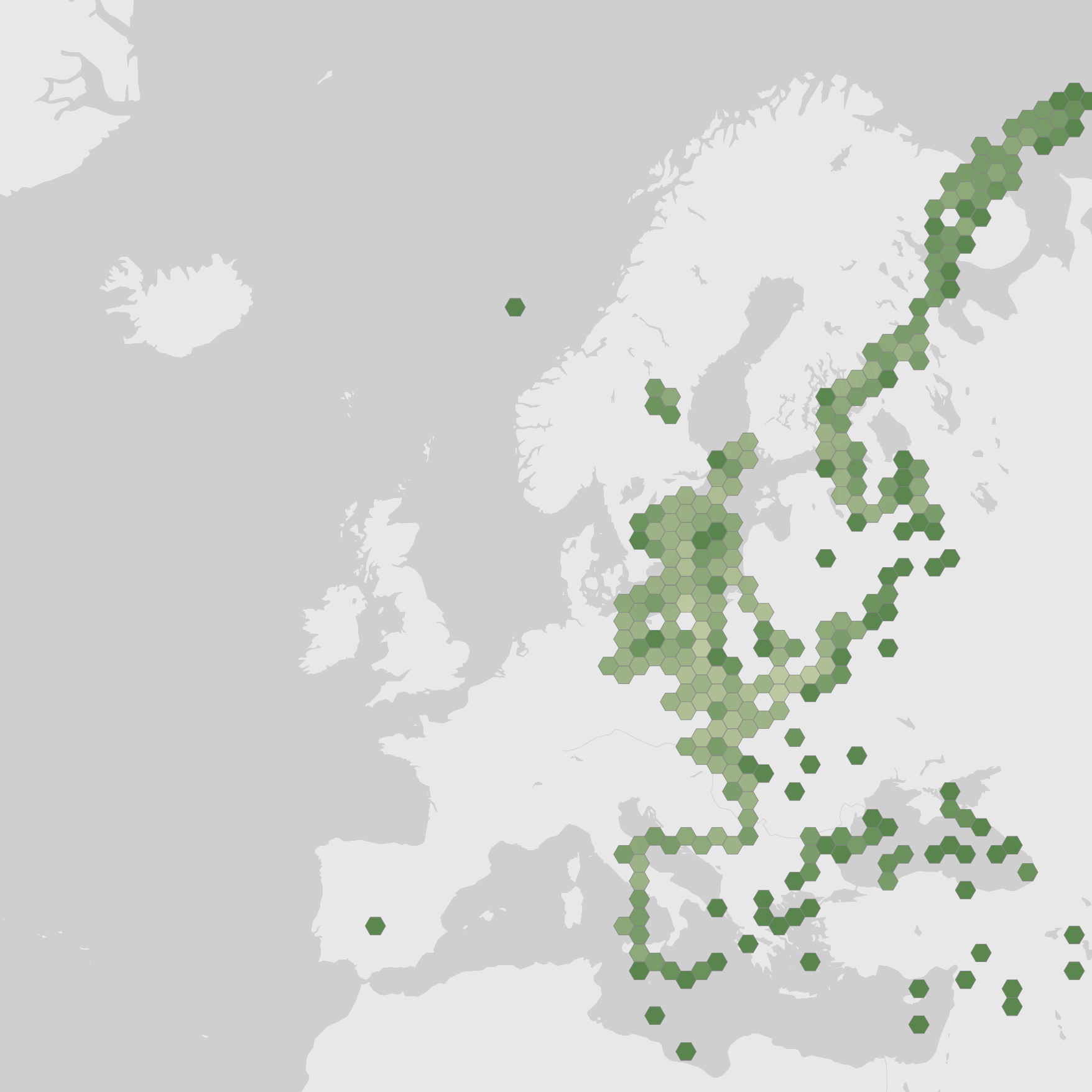
The species occurs in the waters of Western Europe, making rocky coastlines throughout the region its typical home.
Monthly observation counts show a clear seasonal pattern, rising from around 788 in January to a peak of 5,579 in July before falling back to roughly 729 by December. Because these figures reflect presence observations rather than true abundance or a complete range, the summer peak most likely mirrors increased observer activity along the shore rather than a real surge in limpet numbers.
Fun Facts
- The radula of Patella vulgata, its ribbon-like feeding organ, is longer than the animal's own shell.
- That radula carries roughly 1,920 teeth arranged in 160 rows of 12 teeth each.
- Despite being able to live from the high shore down to about 200 meters depth, the species is most common where wave action is strongest.
Ecology
Habitat
- Marine
- Coastal