Ploughman's spikenard was once gathered as a stand-in for true spikenard, or nard, the fragrant root of Nardostachys jatamansi. This aromatic herb, Pentanema squarrosum, belongs to the daisy family and grows across Europe, North Africa and the Near East.
It is a plant of calcareous grassland, where it is usually a biennial or short-lived perennial. Its scattered plants make it easy to overlook, yet it has a distinctive scent and a rich set of insect and fungal partners.
Identification and Appearance
The most useful clue is the scent. The leaves and roots smell faintly spicy, cinnamon or cumin-like, especially in spring and summer. The plant is softly hairy and can reach about 130 cm tall, with a much-branched, often purplish stem and an irregularly thickened taproot.
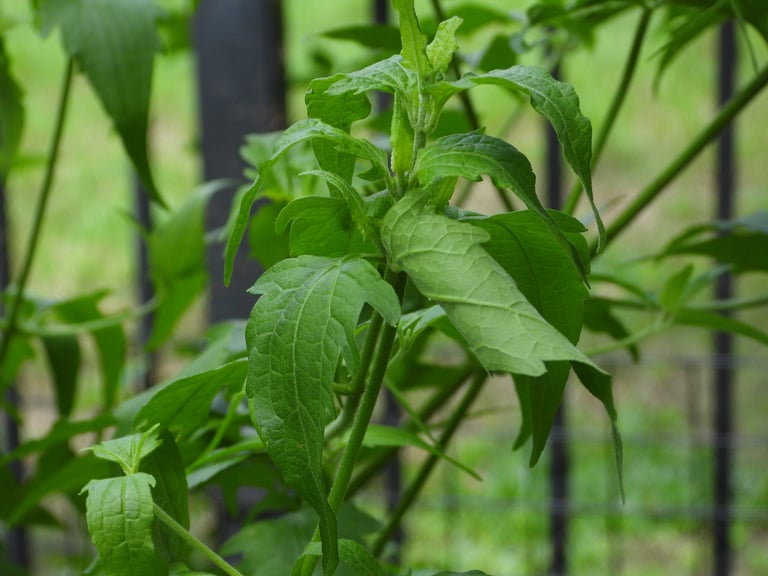
The leaves are covered in long, simple hairs that are thicker along the veins than on the blade. The basal leaves grow up to 15 cm long, are ovate to lanceolate and slightly pointed at the tip, and have a short petiole that clasps the stem. The upper leaves get smaller and narrower, and the topmost are stalkless.
Flowering occurs in late summer. The loose, branched flowerheads sit on long stalks, and each one has many rows of purple bracts around a dense cluster of tiny yellow flowers. Outer flowers are female, with three lobes and rays up to about 9 mm long. Inner flowers are about 7 mm long, with five lobes, and carry both male and female parts. The fruit is a small achene about 2 mm long, topped by white pappus hairs about 8 mm long.
When the plant is in flower, it is easy to identify. The basal leaves, however, look strongly like those of foxglove, and the two can be hard to tell apart. Ploughman's spikenard has softly hairy leaves with usually smooth, untoothed edges, and its fragrance is the surest sign.
Distribution and Habitat
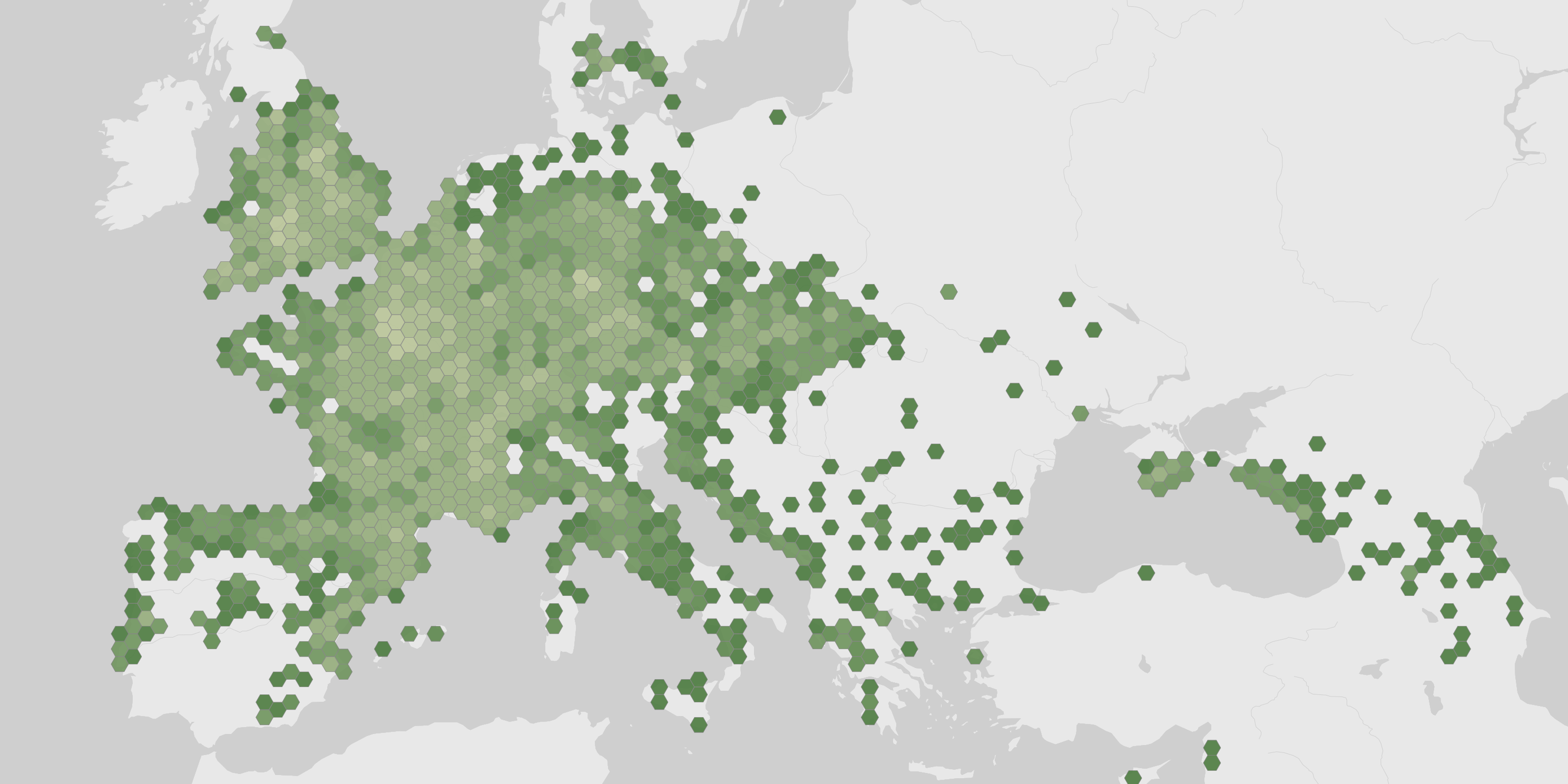
The species is native from Portugal and Spain east through France, Germany, Italy and the Balkans to Ukraine, the Caucasus, Türkiye, Lebanon and Syria, and Iran. Its range reaches North Africa in Algeria, and it has also been introduced to Colombia.
It grows only on calcareous soils over chalk, limestone or sand. It prefers very short turf and often colonizes disturbed ground such as roadsides and old quarries. Plants are rarely abundant and usually grow as scattered individuals. In the British National Vegetation Classification, it is found in calcicolous grasslands CG1 to CG5 and CG7.
Observations peak in July and August, with a smaller rise in late spring.
Growth and Form
Ploughman's spikenard is usually a biennial or a short-lived perennial. In its first season it forms a rosette of leaves that overwinters, and the flowering stem develops the following summer.
The root is an irregularly thickened taproot, and the stem is much branched and often purplish, giving the plant an open, bushy outline when in flower.
Ecology and Relationships
Bees are the main flower visitors. Bumblebees such as Bombus pascuorum are among them, along with solitary bees like Heriades truncorum and Megachile centuncularis. Butterflies, moths and flies visit less often.
The plant supports a wide range of parasites, with at least 48 known. Among them is oxtongue broomrape, which is very rare in Britain but more common in Europe. The spikenard case-bearer moth feeds on this plant and related fleabanes, and the rust fungus Coleosporium inulae completes part of its life cycle on pine trees and part on members of the daisy family.
Uses and Human Relationships
The dried root has been made into a pungent incense. This is probably why the plant is called ploughman's spikenard, a reference to the poor man's version of true spikenard, although its smell is not much like the real thing. The plant was sometimes harvested in the past as a substitute for nard.
The dried leaves are said to have been burned as an insecticide and parasiticide, especially against fleas.
Conservation and Threats
Pentanema squarrosum has not been evaluated for the IUCN Red List.
In Britain, it is classified as Least Concern because it is quite common and not threatened.
In many parts of Britain, the plant is an axiophyte, meaning its presence signals favourable conservation condition. It is therefore likely to count toward the designation of wildlife sites and nature reserves and is used to monitor their condition.
Photos
Photographs from via iNaturalist, licensed under CC0 1.0., by Michal Honskus via iNaturalist, licensed under CC BY 4.0., by Codrin Bucur via iNaturalist, licensed under CC BY 4.0., by Michael Andresek via iNaturalist, licensed under CC BY 4.0., by Ondřej Křivan via iNaturalist, licensed under CC BY 4.0., by 大澤風季 ohsawa_Fuki via iNaturalist, licensed under CC BY 4.0., by osianshirley via iNaturalist, licensed under CC BY 4.0., and by Augustin Soulard via iNaturalist, licensed under CC BY 4.0., credited on each photo.
Ecology and classification
Habitat
Growth habit
- Herb
Classification
- Phylum
- Tracheophyta
- Class
- Magnoliopsida
- Order
- Asterales
- Family
- Asteraceae
- Genus
- Pentanema
- Species
- Pentanema squarrosum
Sources
- GBIF Species names and classification
- iNaturalist Photos
- Wikidata Common names and conservation status
- Wikipedia Summary extract
- Plants of the World Online Native range, life form and climate (WCVP)
- GloBI What it eats, what eats it, parasites and pollinators
- DoPI
- EuPPollNet