A single female cabbage white can, over a few generations, become the progenitor of millions of descendants — a reflection of how effectively this small butterfly has colonized the world.
Pieris rapae is a small-to-medium butterfly in the whites-and-yellows family Pieridae, known variously as the small white, cabbage white, or cabbage butterfly. It carries no special conservation status and thrives across temperate regions of the world, closely tied to human agriculture. Its success as both a common garden visitor and an agricultural pest makes it one of the most familiar butterflies on several continents.
Identification and Appearance
The clearest field mark is the black tip on the forewing paired with the absence of the broad black band that marks the similar, larger Pieris brassicae — the small white is a scaled-down version of that species. Females carry two additional black spots at the center of each forewing, a feature males lack.
Adults have a wingspan of roughly 32 to 47 millimeters. The upperside is creamy white with black-tipped forewings, while the underwings are yellowish and speckled with black. Because of its plain coloring, it is sometimes mistaken for a moth.
Seasonal variation is also present: spring adults tend to be smaller and carry smaller black spots than the butterflies that emerge in summer.
In flight, the wings beat at an average of 12.8 flaps per second.
Distribution and Habitat
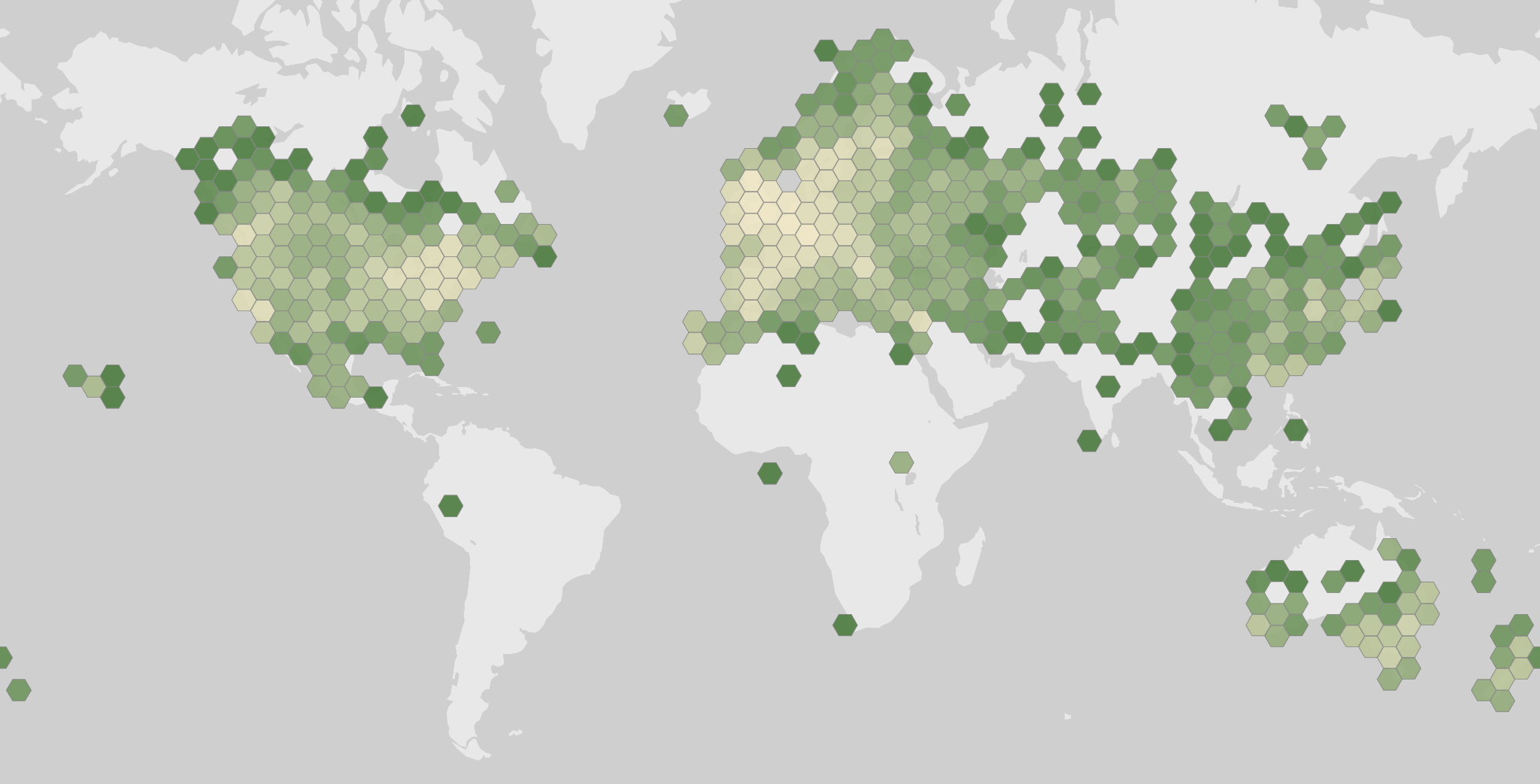
Pieris rapae occurs naturally across Europe, Asia, and North Africa, and has become one of the most widespread butterflies outside that range. After its accidental introduction to Quebec around 1860, it spread rapidly through nearly every North American life zone between the Lower Austral and Canadian zones, though it remains absent or scarce in true desert regions except where irrigation exists. It reached Hawaii by 1898, New Zealand and the Melbourne area of Australia by 1929, and Perth by 1943, but it does not appear to have reached South America.
The species favors open habitats with diverse plant life: meadows, bogs, fields, savanna and grassland, and forest edges, and it is closely associated with cultivated land. It is common in towns and increasingly found entering small forest clearings.
In Britain it flies in two distinct periods, April–May and July–August, while in North America it is continuously brooded, among the first butterflies to emerge in spring and flying until the first hard freeze of autumn. Monthly observation records peak sharply in the middle of the year, consistent with this extended warm-season activity, though these counts reflect how often the species was observed rather than its actual abundance.
Behavior and Lifestyle
Cabbage butterflies are diurnal and solitary, flying from spring through September, with shorter active seasons farther north and longer ones in the south. Females search for host plants using a distinct three-step process: searching for suitable open habitat, landing on candidate plants, and evaluating them by touch and taste.
All known host plants contain glucosinolates, chemical cues that trigger egg-laying. Females avoid shaded woodlands even where host plants grow there, and they will not oviposit in overcast or rainy weather — high light intensity is required to prompt egg-laying. Gravid females fly in a straight, linear search path, independent of wind or sun position, while females seeking nectar instead make tight turns around flower patches.
Once a female lands, she performs a rapid "drumming" motion with her forelegs across the leaf surface, gathering tactile and chemical information to judge the plant's suitability. Females respond most strongly to green and blue-green surfaces reflecting around 550 nanometers, and in natural conditions they prefer larger, older, darker-green plants for laying eggs — even though younger plants are actually better for larval growth. A searching female may range from 500 meters to several kilometers to find a suitable plant.
Communication
Cabbage butterflies rely mainly on visual and chemical signals. Their compound eyes can detect ultraviolet light, which likely helps them judge host plant color and locate mates or flowers.
Chemical communication includes pheromones, used between the sexes, and the plant-derived mustard oils and glucosinolates that females detect to identify suitable host plants for egg-laying.
Diet and Nutrition
Adult cabbage butterflies feed on nectar, showing a preference for flowers of plants that contain mustard oil, including mustard, dandelion, broccoli, cabbage, Brussels sprouts, cauliflower, collards, horseradish, kale, red clover, asters, and mints. Larvae, in contrast, are foliage feeders that consume the leafy parts of these same plants, sometimes stripping a plant down to its stems.
Cabbage plants are a particular favorite of the larvae, giving the species its common name. A single plant can host as many as 57 eggs and 48 larvae at once. Among recorded host plants, crucifers such as radish, wild radishes and mustards, candytufts, pepperworts, yellow cresses, ragworts, woad, and honesty stand out as frequently used.
Reproduction and Life Cycle
Courtship begins when a male spots a female and performs a zigzagging flight above, below, and in front of her until she lands; he then catches her closed forewings with his legs and spreads his own wings, causing her to lean over before he carries her a short distance while she dangles beneath him. An unreceptive female signals rejection by flying vertically or spreading her wings and raising her abdomen.
Females mate only once as early adults, then lay between 300 and 400 eggs over their lifetime, depositing them singly on the undersides of host leaves. The white eggs yellow as they age. Both sexes reach sexual maturity at around 21 days old, and breeding occurs from early spring to early fall.
There is no parental involvement after egg-laying, and time to independence is effectively immediate once eggs are laid. Interestingly, males that engage in mud-puddling to take up sodium appear to gain increased reproductive success.
Population and Ecological Role
Cabbage butterflies and their caterpillars play very different ecological roles despite being the same species. The caterpillars, or cabbage worms, can damage or kill host plants through heavy feeding, while the adult butterflies feed only on nectar and serve as pollinators of crop plants such as cabbage.
The species supports a range of natural enemies. Caterpillars are commonly parasitized by braconid wasps such as Cotesia rubecula and Cotesia glomerata — both introduced to North America from Asia as biological control agents — as well as by flies including Phryxe vulgaris and Epicampocera succinata. Cotesia rubecula develops singly within a host and kills it once nearly grown, while Cotesia glomerata can raise multiple larvae in one host and always kills it at the fifth instar. Pupae are frequently parasitized by the wasp Pteromalus puparum.
Adult butterflies themselves are prey for a wide range of small birds, including warblers, larks, pipits, swifts, and treecreepers among others.
Conservation and Threats
The IUCN Red List gives Pieris rapae no special conservation status, and it likewise holds no protections under the US Federal List, CITES, or Michigan state listings. This reflects its status as one of the most widespread and adaptable butterflies rather than any threat to its survival.
No specific threats to the species are documented; if anything, its broad reliance on cultivated crucifers and disturbed habitats has helped it flourish alongside agriculture worldwide.
Cultural Significance
The genus name Pieris traces back to Greek mythology, where Pieris was one of the names given to a slave who, by Menelaus, was said to be the mother of Megapenthes, a detail recorded in Homer's Odyssey and by the geographer Pausanias.
In human affairs today, the butterfly's main recognized role is as a pollinator of crop plants, a positive contribution that offsets the damage its larvae, the cabbage worms, can inflict on the same crops.
Fun Facts
- It is the only introduced butterfly in some regions of the New World, having arrived from the Old World and become one of the weediest species there, found from sea level up to about 8,000 feet.
- It readily invades disturbed habitats, riparian woodland, and even montane coniferous forest during the summer months, though how or when it first reached some regions remains unclear.
- In Japanese tradition, common butterflies like Pieris rapae and the Asian swallowtail were historically regarded as ordinary and even tedious, despite being considered beautiful, in part because they are multivoltine and fly continuously from spring to autumn.
Photos
Photographs from via iNaturalist, licensed under CC0 1.0., by Barbara Banfield via iNaturalist, licensed under CC BY 4.0., by Matt Pelikan via iNaturalist, licensed under CC BY 4.0., by wormgirlnyc via iNaturalist, licensed under CC BY 4.0., by Roy Lowry via iNaturalist, licensed under CC BY 4.0., by John Hepburn via iNaturalist, licensed under CC BY 4.0., by Barry Stewart via iNaturalist, licensed under CC BY 4.0., by Elizabeth Green via iNaturalist, licensed under CC BY 4.0., by Ondřej Křivan via iNaturalist, licensed under CC BY 4.0., by Emma Barrera via iNaturalist, licensed under CC BY 4.0., by Matt D'Agrosa via iNaturalist, licensed under CC BY 4.0., by Julia Henning via iNaturalist, licensed under CC BY 4.0., by Helen Bovill via iNaturalist, licensed under CC BY 4.0., and by jrcagle via iNaturalist, licensed under CC BY 4.0., credited on each photo.
Ecology and classification
Classification
- Phylum
- Arthropoda
- Class
- Insecta
- Order
- Lepidoptera
- Family
- Pieridae
- Genus
- Pieris
- Species
- Pieris rapae
Sources
- GBIF Species names and classification
- iNaturalist Photos
- Wikidata Common names and conservation status
- Wikipedia Summary extract
- Encyclopedia of Life Habitat, diet and behavior traits
- Animal Diversity Web Animal habitat, behavior and diet
- GloBI What it eats, what eats it, parasites and pollinators
- trophiCH
- Wardeh et al. 2015 (EID2)
- DoPI
- Guzman et al. 2022
- Schwarz et al. 2021
- EuPPollNet