The elkhorn fern, Platycerium bifurcatum, grows in colonies where individual members may take on different roles, a pattern that has led researchers to suspect something resembling social organization in a plant.
This epiphytic fern belongs to the family Polypodiaceae and is native to eastern Australia, growing naturally from southern New South Wales to northern Queensland and on Lord Howe Island. Queensland's government classifies it as of least concern, and it has not been evaluated by the IUCN.
Its distinctive antler-shaped fronds and colony-forming habit have made it one of the most recognizable ferns grown by gardeners worldwide, prized both for its unusual form and its resilience as a houseplant.
Identification and Appearance
The most reliable way to recognize Platycerium bifurcatum is by its two distinct frond types growing from a single short, branching rhizome. Round, shield-like sterile fronds—called nest fronds—press flat against the bark of a host tree, growing up to 45 cm (18 in) across with deeply lobed, spreading upper edges that trap falling leaf litter as a nutrient source.
Rising from among the nest fronds are the fertile foliage fronds, which start semi-erect before drooping downward as they lengthen, reaching up to 90 cm (35 in). They are narrow at the base and widen gradually, forking two or three times into flattened, antler-like segments up to 30 cm (12 in) long and 3 cm (1.2 in) wide.
Spores form only on the undersides of the outermost tips of these fertile segments, so a plant without visible spore patches there is either immature or a sterile member of a colony.
Nest fronds are short-lived structures: once they reach full size they die back, curling inward while colony roots grow into the decaying tissue, and the whole mass keeps expanding outward as new plantlets emerge from its lower margins.
Distribution and Habitat
Platycerium bifurcatum is native to the east coast of Australia, ranging from southern New South Wales north to Queensland, along with an outlying population on Lord Howe Island. In the cooler southern part of this range it grows on tree trunks and boulders across several forest types, including swamp forest and open forest.
Farther north in Queensland, it shifts to growing almost exclusively as an epiphyte on trees within montane rainforest, reflecting the cooler, wetter conditions found at higher elevations.
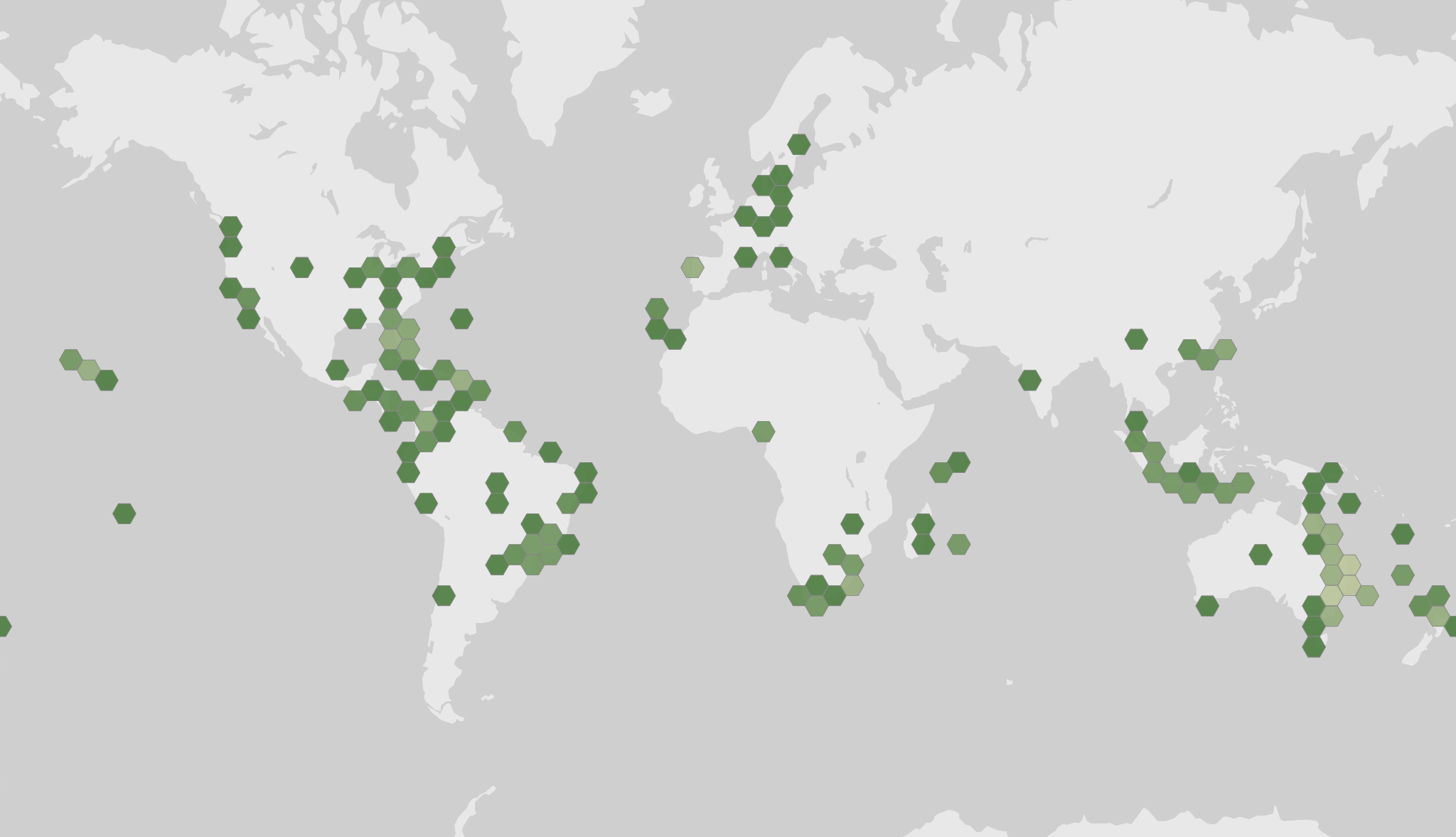
The species has also been introduced well beyond Australia, with cultivated or naturalized populations recorded in the Canary Islands, Colombia, Hawaii, KwaZulu-Natal, New Zealand, and Taiwan. Global Biodiversity Information Facility records show occurrences spanning North and South America, Europe, southeastern Africa, and much of the Asia-Pacific region, though these points mark where the plant has been observed rather than how abundant it is.
Monthly observation counts stay fairly steady year-round, with modest peaks in March and September and a slight dip in December and January—a pattern likely shaped more by when people are out recording sightings than by any true seasonal presence of the plant itself.
Growth and Form
Platycerium bifurcatum grows as an expanding colony rather than a single isolated plant, with new plantlets budding from the lower margins of the nest fronds. As each nest frond matures it dies back but stays attached, curling inward and holding onto trapped litter while the colony's roots grow into it, allowing the whole mass to swell to a substantial size over time.
A 2021 study examined whether members of a colony take on different functional roles. It found that foliage fronds near the bottom of a colony are less likely to bear spores than those near the top, while the nest fronds of lower members absorb more water than those above them—upper nest fronds are more hydrophobic and instead channel water down to their lower neighbors.
The same research found that colonies are mostly clonal but occasionally incorporate unrelated individuals, and the researchers suggested their combined findings might be the first evidence of eusociality documented in a plant.
Uses and Human Relationships
Platycerium bifurcatum is grown around the world as an ornamental plant, valued for its sculptural, antler-shaped foliage. It propagates readily by division, and growers commonly mount divided plants on tree trunks or wooden boards, or grow them in hanging baskets.
The species tolerates temperatures down to about 5°C (41°F), which allows it to be grown outdoors year-round in sheltered spots in temperate climates; elsewhere it is kept as an indoor houseplant.
Its popularity in cultivation is reflected in the Royal Horticultural Society's Award of Garden Merit, which it has been granted.
Conservation and Threats
Platycerium bifurcatum has been assessed as of least concern by the Queensland Government under its Nature Conservation Act, and it does not appear on either the New South Wales or Australian Government threatened species lists. The International Union for Conservation of Nature has not evaluated the species.
Rather than facing conservation threats, the species has shown the opposite problem in parts of its introduced range: it has escaped cultivation and become naturalized in Florida, and it is officially listed as an environmentally invasive species in Hawaii.
No population trend data or dedicated conservation programs are documented for this species within its native Australian range.
Fun Facts
- Beyond its native Australian range, Platycerium bifurcatum also occurs naturally in New Guinea.
- The fern has escaped gardens to become naturalized in Florida and is listed as an environmentally invasive species in Hawaii.
- It is one of the most widely cultivated ornamental ferns in the world, commonly grown alongside its close relative Platycerium superbum.
Photos
Photographs from via iNaturalist, licensed under CC0 1.0., credited on each photo.
Ecology and classification
Classification
- Phylum
- Tracheophyta
- Class
- Polypodiopsida
- Order
- Polypodiales
- Family
- Polypodiaceae
- Genus
- Platycerium
- Species
- Platycerium bifurcatum
Sources
- GBIF Species names and classification
- iNaturalist Photos
- Wikidata Common names and conservation status
- Wikipedia Summary extract