Pleurotus ostreatus's mycelium doesn't just decompose wood — it actively hunts and kills nematode worms, using them as a source of nitrogen. This makes the oyster mushroom one of at least 700 known nematophagous fungi, a carnivorous habit unusual among mushrooms prized for the dinner table.
Also known as the grey oyster mushroom, oyster fungus, or hiratake, this species belongs to the family Pleurotaceae, within the order Agaricales and class Agaricomycetes. It grows across temperate and subtropical forests worldwide, fruiting on the wood of dying and dead hardwood trees.
Beyond the kitchen, it decomposes wood, helps clean up polluted soil, and produces a cholesterol-lowering compound — a fungus whose reach extends from forest ecology to industrial biotechnology.
Fruiting Body and Identification
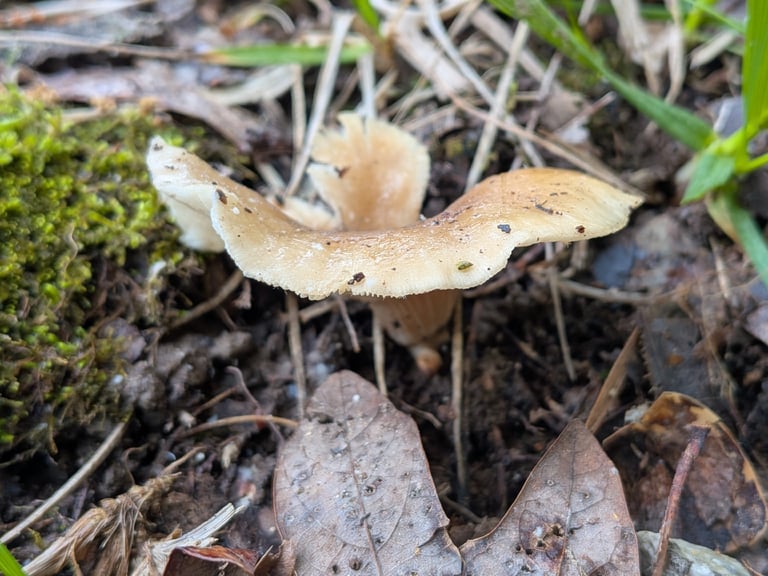
The most reliable field mark is the cap's oyster- or fan-shaped outline, broad and 2 to 30 centimeters (1 to 12 inches) across. In the wild it ranges from white to gray or brown, with a margin that is rolled inward when young and becomes smooth, wavy, and often lobed with age.
The gills are whitish, sometimes turning yellowish, and run decurrent down the stem when one is present. The stipe, if it exists at all, is short — up to 4 centimeters (1.5 inches) long — and thick, attached off-center or laterally where the mushroom meets the wood it grows from.
The flesh is white and firm, with thickness that varies depending on how the stipe is arranged. A bittersweet smell resembling benzaldehyde or bitter almonds is characteristic, and the spore print is white to lilac-gray, best viewed against a dark background.
Pleurotus ostreatus is related to the cultivated king oyster mushroom, Pleurotus eryngii, and resembles P. columbinus, P. cornucopiae, Hohenbuehelia petaloides, the hairy-capped Phyllotopsis nidulans, and the smaller Pleurocybella porrigens.
Distribution and Habitat
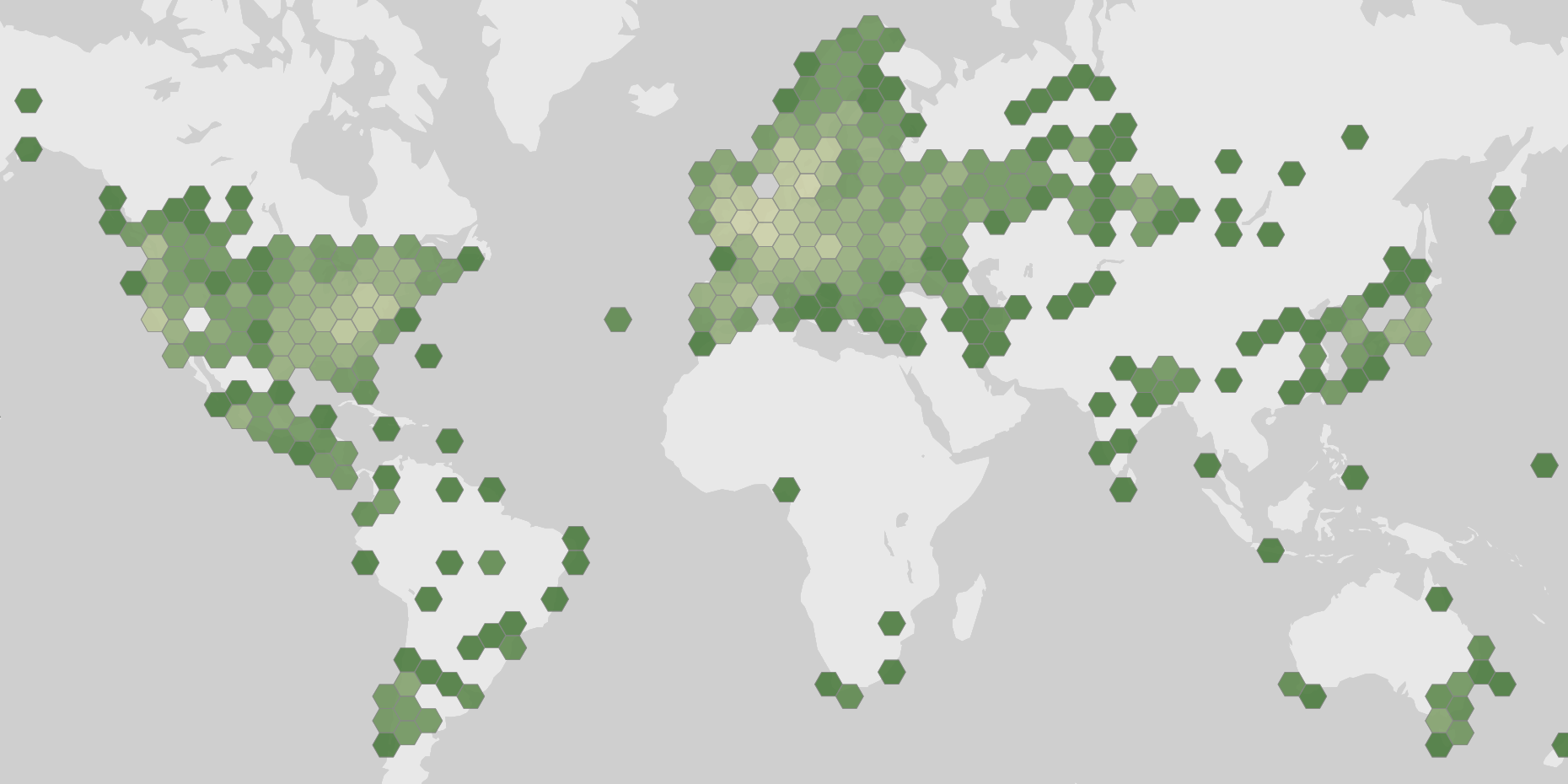
The oyster mushroom occurs widely across temperate and subtropical forests around the world, though it is notably absent from the Pacific Northwest of North America, where it is replaced by P. pulmonarius and P. populinus.
As a saprotroph, it acts as a primary decomposer of wood, favoring deciduous trees and beech in particular, and functions as a white-rot fungus that breaks down lignin. In the United Kingdom it can be found fruiting year-round rather than in a single narrow season.
Monthly observation data show counts climbing from around 1,300–1,600 in April through June to a peak near 7,000–8,400 between October and January, with the lowest numbers in late spring. Because these figures come from presence observations rather than abundance surveys, they should be read as a rough seasonal pattern of when the fungus is most often spotted, not a measure of population size.
Ecology and Relationships
Although it is frequently found growing on dying hardwood trees, Pleurotus ostreatus behaves as a saprophyte rather than a parasite, colonizing the rapidly growing mass of dead and dying wood as a tree succumbs to other causes. In doing so it benefits the surrounding forest, decomposing wood and returning minerals and elements to the ecosystem in forms other organisms can use; the species also bioaccumulates lithium.
All major lineages of the oyster mushroom are carnivorous: their mycelia can trap, kill, and digest nematode worms, a behavior thought to supply the fungus with nitrogen. This places P. ostreatus among at least 700 known nematophagous mushroom species.
The species is also a favored or exclusive food source for many pleasing fungus beetles (family Erotylidae), including Dacne californica, D. quadrimaculata, and especially the breast-plated triplax Triplax thoracica and its cryptic species complex. Most members of that beetle complex require Pleurotus, and in some cases P. ostreatus specifically, as larval food.
Uses and Cultural History
Commercial cultivation of the oyster mushroom began in Germany during World War I as a subsistence food measure, and it is now grown commercially worldwide. Regarded as a choice edible, it appears in Czech, Polish, and Slovak cooking in soups and stews as a meat substitute, and breaded as a vegetarian alternative to the Polish kotlet; it is also a delicacy in Japanese, Korean, and Chinese cuisine, while Indonesian street vendors sell it deep-fried and crispy. Its taste is described as mild with a slight anise-like odor, and it is best harvested young, since the flesh toughens and turns acrid with age.
Beyond the kitchen, the pearl oyster mushroom is used to create mycelium bricks, mycelium furniture, and leather-like materials.
Industrially, oyster mushrooms have been used for mycoremediation, converting 95% of diesel oil in polluted soil into non-toxic compounds. The species can also grow on and degrade oxo-biodegradable plastic bags and contribute to breaking down renewable polyethylene. It has additionally been found to contain lovastatin, a cholesterol-lowering drug.
Fun Facts
- The name Pleurotus combines Greek words meaning "side ear," describing the mushroom's off-center, ear-like shape, while "oyster mushroom" refers to its color and form.
- Several pleasing fungus beetles, including members of the genus Triplax, depend on Pleurotus ostreatus almost exclusively as food for their larvae.
- Commercial cultivation of this species began in Germany during World War I, when it was grown as a subsistence food source.
Ecology
Diet
- Carnivore
Behavior
- Predator
Habitat
- Forest
- Woodland