Despite looking like a jellyfish, the Portuguese man o' war is not one animal at all but a colony of thousands of genetically identical, specialized individuals called zooids, fused together and working as a single organism.
Classified as a hydrozoan in the phylum Cnidaria and order Siphonophorae, it drifts across the warm surface waters of the Atlantic, Indian, and Pacific oceans. It has not been formally assessed by the IUCN, so it carries no conservation status, but its ecology is anything but ordinary.
Between its painful sting, its passive sailing lifestyle, and its close partnerships with fish that live safely among its tentacles, the man o' war offers a case study in how colonial life can blur the line between individual and society.
Identification and Appearance
The most recognizable feature is the pneumatophore, a gas-filled, balloon-like float that can grow over 30 centimeters (12 inches) long, 13 centimeters (5 inches) wide, and 15 centimeters (5.9 inches) tall. This float sits above the waterline and doubles as a sail, catching the wind while the rest of the colony hangs submerged beneath it.
Beneath the float trail the tentacles, typically around 10 meters (30 feet) long but capable of reaching over 30 meters (100 feet). Each tentacle is armed with coiled, thread-like nematocysts that fire venom on contact, a defense and hunting mechanism visible even from a distance as fine, thread-like strands.
The colony itself is made of up to seven types of zooids, divided between medusoid forms (gonophores, nectophores, and vestigial nectophores) and polypoid forms (gastrozooids, tentacle-bearing zooids, gonozooids, and gonopalpons). Each type performs a distinct job, from digestion to reproduction to hunting, and all are budded from the same original fertilized egg, making the whole colony genetically identical throughout.
Because it is a siphonophore rather than a true jellyfish, its body plan differs fundamentally from a classic medusa: it is a floating assembly of specialized parts rather than a single bell-shaped animal, which is the clearest way to tell it apart from true jellyfish despite the superficial resemblance.
Distribution and Habitat
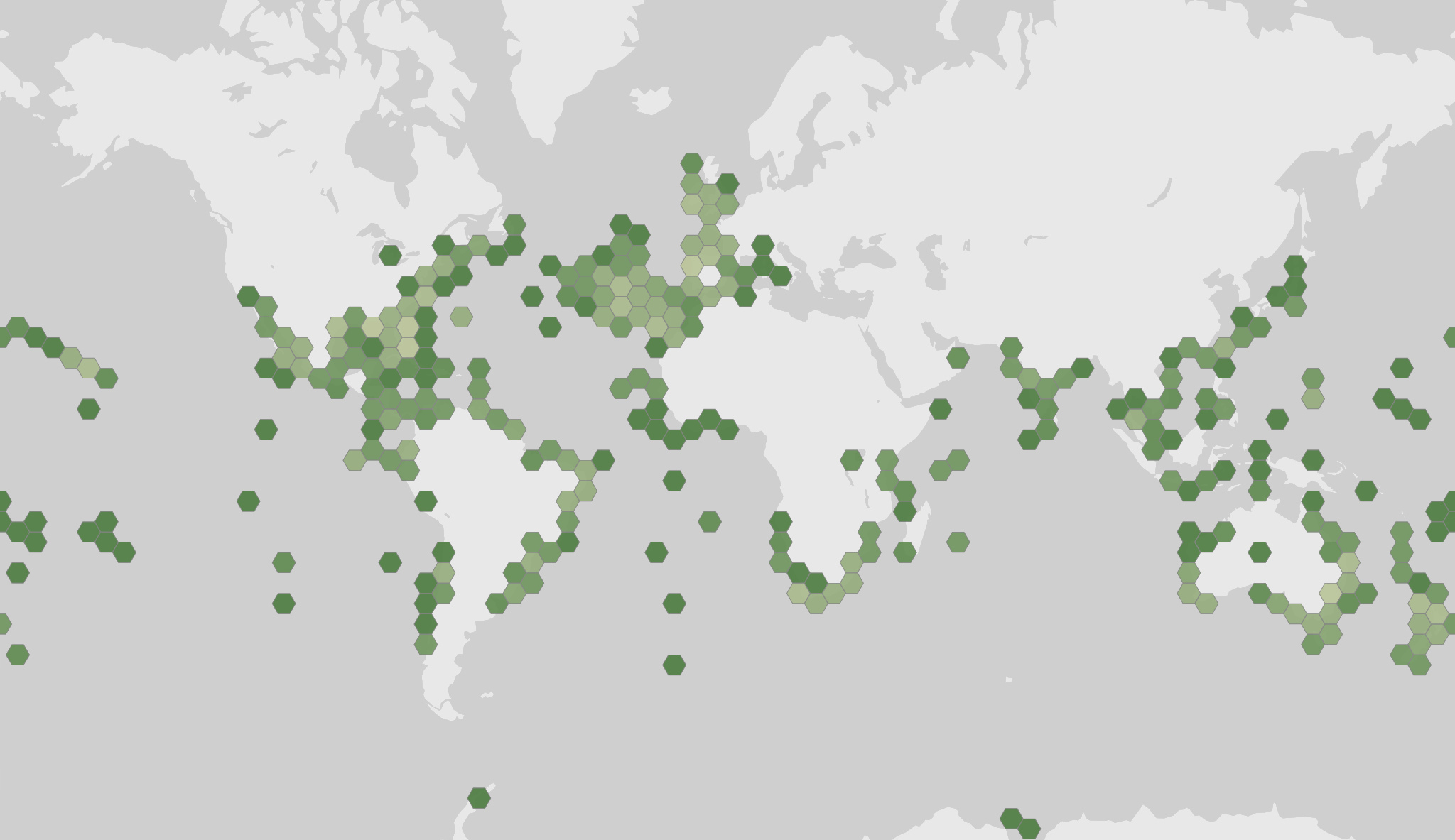
The Portuguese man o' war occurs in warm tropical and subtropical waters across the Atlantic, Indian, and Pacific oceans, with especially dense presence in the Sargasso Sea, the Gulf Stream, the Gulf of Mexico, the Caribbean Sea, and along the Florida Keys and Atlantic coast.
It belongs to the neuston, the community of organisms that live directly on the water's surface. This exposes it to intense ultraviolet light, the risk of drying out, and rough sea conditions, while its gas-filled float stays above water and the rest of the colony remains submerged.
Having no means of self-propulsion, it moves passively at the mercy of wind, current, and tide. Strong winds can push colonies into bays or directly onto beaches, and because they can still sting after washing ashore, their presence often forces beach closures.
Monthly observation counts show more records from January through May (ranging from about 1,595 to 2,005) and again in December (1,813), compared to a dip from June through September (roughly 888 to 1,015). These are presence records rather than a measure of abundance or full range, but the pattern hints at a seasonal peak in visibility during winter and spring in the areas sampled.
Behavior and Lifestyle
Locomotion is entirely passive: the colony cannot swim and instead floats and sails using its gas-filled pneumatophore, letting wind and current dictate its movement across the open ocean.
Individuals come in two mirror-image forms, described as "left-sided" and "right-sided." A left-sided colony drifts at roughly 45 degrees to the right of the wind's direction, while a right-sided one drifts the opposite way. This split direction of travel helps spread the population more evenly across warm ocean waters rather than pushing every colony the same way.
When attacked at the surface, the colony has a defensive option: it can deflate its pneumatophore and briefly submerge, temporarily escaping the threat before resurfacing.
Hunting and Diet
Hunting begins with the tentacles, which can stretch beyond 30 meters and are lined with nematocysts, coiled stinging cells that fire on contact to inject venom, paralyzing prey before it can escape.
Fish make up the bulk of the diet, accounting for an estimated 70 to 90% of prey, mostly fish fry and small adult fish caught in the trailing tentacles. Shrimp, other crustaceans, and assorted small planktonic animals round out the rest. Occasionally larger fish such as flying fish or mackerel are trapped as well, though animals of that size usually manage to break free.
Once prey is subdued, it is drawn up toward the gastrozooids, bag-like digestive zooids arranged along the underside of the float. Each gastrozooid has its own mouth and secretes enzymes that break down proteins, fats, and carbohydrates; indigestible remains are expelled back through these same mouths.
Nutrients absorbed during digestion do not stay local. They circulate outward to the other zooids across the colony, meaning a single successful catch effectively feeds every specialized part of the organism.
Reproduction and Life Cycle
Each colony is dioecious, meaning individuals are either male or female, with sex determined at the level of specialized reproductive zooids called gonozooids. Within each gonozooid, structures called gonophores act as sacs holding either developing sperm or eggs.
Fertilization happens externally in open water. Gametes are released when gonophores, or entire gonozooids, break away from the colony and drift off on their own; this release may be triggered chemically once enough individuals are clustered together in one area, suggesting a critical local density is needed for fertilization to succeed.
Most breeding activity occurs in fall, and it is thought to begin in the Atlantic Ocean, though the exact trigger for the spawning cycle is not known. This seasonal timing produces the large numbers of young commonly seen during the following winter and spring.
The larvae are believed to develop quickly into small floating colonies. There is no parental care at any stage; once gametes and larvae are released into the water, they are left to develop entirely on their own.
Population and Ecological Role
No population counts or trend figures are available, but the species plays a distinctive role in its ecosystem through a web of partnerships and impacts on other marine life.
Young yellow jack and other fish often shelter among the stinging tentacles, gaining protection from predators, while their presence may in turn attract additional prey toward the colony. The blanket octopus is immune to the venom entirely and has been observed tearing off tentacle fragments to wield as weapons of its own. The man-of-war fish goes a step further, living directly among the tentacles and feeding on them and on the colony's gonads, a relationship that may benefit the man o' war by luring in other fish as easy prey.
At times, colonies gather into large blooms of more than 1,000 individuals. These blooms can disturb populations of smaller prey such as larval fish, competing with or displacing them and rippling through the wider food web. Coastal fishing communities feel the effects directly through reduced catches and damaged gear, and such bloom events are expected to become more frequent as ocean conditions shift with climate change.
Conservation and Threats
The Portuguese man o' war has not been evaluated by the IUCN Red List, meaning no formal global conservation assessment exists for the species. It is not currently considered rare, and no urgent conservation measures are seen as necessary.
It also carries no special status under the US Federal List or CITES, reflecting its wide distribution and lack of documented population decline.
Cultural Significance
Its cultural footprint in the available record is mostly indirect, tied to its place in coastal food webs rather than folklore or symbolism. It is preyed upon by certain fish and by sand crabs, some of which are themselves species of commercial value to fisheries.
In this sense, the man o' war feeds into local economies indirectly, as a food source for animals that people later harvest, rather than through any direct trade or use of the man o' war itself.
Fun Facts
- Although it looks and is often called a jellyfish, it is actually a siphonophore, a colonial relative of jellyfish and corals rather than a single medusa.
- Genetic evidence suggests that what is currently classified as one species, Physalia physalis, may actually be a group of several distinct species.
- The gas inside its float is mostly ordinary air, but it also contains up to 13% carbon monoxide, produced internally by a dedicated gas gland rather than simply absorbed from the atmosphere.
- A single colony can include up to seven different types of specialized zooids, covering feeding, hunting, and reproduction, yet every one of them is a genetic clone descended from the same fertilized egg.
- During blooms, swarms of more than 1,000 individuals can gather at once, sometimes disrupting local fisheries and fishing gear.
Photos
Photographs from via iNaturalist, licensed under CC0 1.0., by franciscodocampo via iNaturalist, licensed under CC BY 4.0., by euqirneto via iNaturalist, licensed under CC BY 4.0., by Ryan F. Mandelbaum via iNaturalist, licensed under CC BY 4.0., by Crap Fou via iNaturalist, licensed under CC BY 4.0., by Jennifer Woollin via iNaturalist, licensed under CC BY 4.0., by Sylvain Montagner via iNaturalist, licensed under CC BY 4.0., by fbalboa via iNaturalist, licensed under CC BY 4.0., by James Tatlow via iNaturalist, licensed under CC BY 4.0., and by Amaia via iNaturalist, licensed under CC BY 4.0., credited on each photo.
Ecology and classification
Classification
- Phylum
- Cnidaria
- Class
- Hydrozoa
- Order
- Siphonophorae
- Family
- Physaliidae
- Genus
- Physalia
- Species
- Physalia physalis
Sources
- GBIF Species names and classification
- iNaturalist Photos
- Wikidata Common names and conservation status
- Wikipedia Summary extract
- Animal Diversity Web Animal habitat, behavior and diet