Blue sharks range across the world's temperate and tropical oceans, from Norway in the north to Chile in the south, and they have been found off every continent except Antarctica.
The blue shark, also called the great blue shark, is a requiem shark in the family Carcharhinidae. It is the only living species in the genus Prionace, and an extinct relative, P. clarki, is known from Late Pliocene teeth from California. Adults average around 3.1 m (10 ft), and the species prefers cooler water and migrates long distances.
Its long migrations and open-ocean life show how a shark that is rarely the target of fishing can still face heavy pressure from fisheries. The IUCN lists the species as Near Threatened.
Identification and Appearance
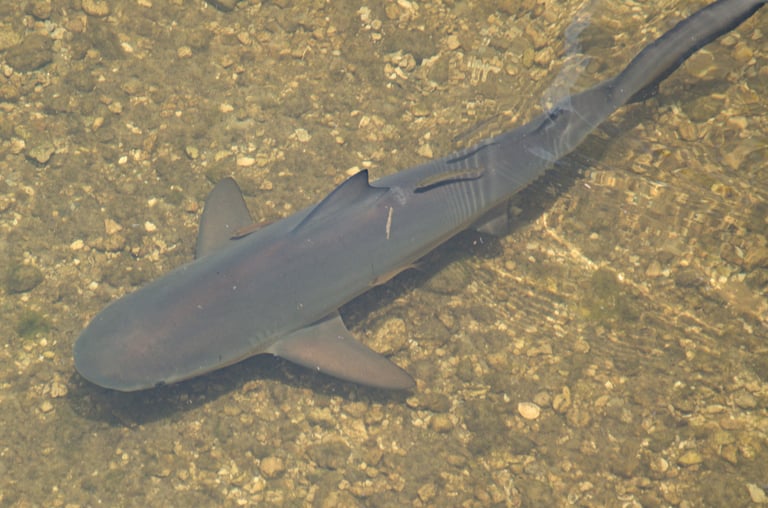
The most useful field mark is the deep blue back, which shades to lighter blue on the sides and gives way to a white underside. Like many sharks, the blue shark is countershaded, so its coloring changes from top to bottom.
The body is light and slender, with long pectoral fins. Males commonly grow to 1.82 to 2.82 m (6.0 to 9.3 ft) at maturity, while the larger females commonly reach 2.2 to 3.3 m (7.2 to 10.8 ft). Large specimens can reach 3.8 m (12 ft).
Weight also differs strongly between the sexes. Males typically weigh from 27 to 55 kg (60 to 121 lb), while large females usually weigh from 93 to 182 kg (205 to 401 lb). A female over 3 metres (10 ft) long can weigh more than 204 kg (450 lb), and the heaviest reported weight for the species is 391 kg (862 lb).
The blue shark is ectothermic, so its body temperature follows the water around it.
Distribution and Habitat
Blue sharks live mainly in the epipelagic and mesopelagic zones, from the surface down to about 350 m (1,150 ft). They prefer water between 12 and 20 °C (54–68 °F), but they tolerate water from 3.9 to 31 °C (39.0–87.8 °F).
They are mostly open-ocean sharks, but in temperate seas they may come close to shore, near the edges of continental shelves, where divers can see them. In tropical waters they stay in deeper water.
In the Pacific, the greatest concentrations occur between 20° and 50° North, though these shift strongly with the seasons. In the tropics, blue sharks spread fairly evenly between 20° N and 20° S.
Occurrence records peak in late summer, from August to September, and are lowest from January to March.

Behavior and Lifestyle
Blue sharks are most active at night, especially in the early evening, and are least active in the early morning. During the day they swim at a mean speed of 1.3 km/h, and at night the mean speed rises to 2.8 km/h, with more vertical movement and brief dives.
During the day they tend to stay around 30 m deep, while at night they move slightly deeper, to about 40 m. Most of their time falls between 18 and 42 m, though they sometimes dive well below that. They prefer a narrow range of 14 to 16 °C and often swim near the surface in cooler months.
Blue sharks sometimes form schools of similar-sized sharks of the same sex. They hold neither permanent home ranges nor territories, because they are free-ranging, open-water animals that keep moving.
When pursued from behind, blue sharks are vulnerable, since a predator attacking from the tail can strike the caudal fin and immobilize the shark. They respond with sharp turns and brief bursts of acceleration instead of sustained high-speed escape.
Communication
Most sharks are known to use body language to signal aggression, and blue sharks are no exception. Little is known about other forms of communication between individuals.
Blue sharks have highly developed senses of smell, sight and touch. A lateral line running along the body detects pressure waves from moving water, which lets them sense the movements of prey. On the underside of the snout, electroreceptors called the ampullae of Lorenzini detect the electrical fields produced by the muscle contractions of prey.
Hunting and Diet
Blue sharks find prey by sensing it. The lateral line picks up the pressure waves of moving animals, and the electroreceptors on the snout detect the electrical fields made by prey muscles.
They feed mainly on cephalopods, with up to 24 species recorded in their diet, and on about 16 species of fish. Their main cephalopod prey are non-active, gelatinous squid and octopuses from the mesopelagic and bathypelagic zones, including the blanket octopus (Tremoctopus), bathyscaphoid squids of the family Cranchiidae, and the pelagic octopus Ocythoe tuberculata.
Small schooling fish make up the other major part of the diet, among them the long-snouted lancetfish Alepisaurus ferox, the snake mackerel Gempylus serpens and the castor oil fish Ruvettus pretiosus.
During their reproductive migrations off Brazil, they also take seabirds, including great shearwaters (Puffinus gravis).
Reproduction and Life Cycle
Blue sharks gather on continental shelves during the summer to breed. Mating begins when a male bites a female between her first and second dorsal fins, and the male then inserts one of his claspers to transfer sperm. The female's skin over her back can be up to three times thicker than the male's, which protects her from these bites.
Blue sharks form no pair bonds, and individuals separate after mating. Mating is polygynandrous, so both sexes mate with several partners. Females can store sperm in the oviductal gland for several months after mating, and it is not yet clear whether females breed every year.
Males mature at about 187 cm in length and females at about 220 cm, with both sexes reaching maturity at around 5 to 6 years of age. Blue sharks are viviparous, and pregnant females migrate north to birthing grounds on the sub-Arctic boundary. In the northern Pacific, most births occur from December to April.
Gestation lasts 9 to 12 months. A litter usually contains 25 to 50 pups, although up to 130 have been counted, and the pups average 39 cm at birth. The mother nourishes and protects the developing young, but the pups separate from her after birth and have no further contact.
Population and Ecological Role
Blue sharks are top-level predators that help regulate prey populations in the open pelagic ocean. Their own predators include larger sharks such as great white and tiger sharks, which prey on younger and smaller individuals, and orcas have been reported to hunt them. California sea lions, Northern elephant seals and Cape fur seals also feed on them.
Blue sharks host a range of partners. Pilot fish (Naucrates ductor) live with them in a mutualistic relationship, cleaning their teeth and gills and removing parasites from their skin, while gaining protection and a ready food supply. Copepods live on the gills and outer skin, and tapeworms and a nematode live in the stomach and spiral valve after the sharks eat infected fish.
Conservation and Threats
The IUCN lists the blue shark as Near Threatened. Blue sharks are not usually a targeted species, but they are caught as bycatch by longline and dragnet fleets and, to a lesser extent, by sport fishermen. They make up approximately 85–90% of the total elasmobranchs caught by oceanic fisheries as bycatch.
Several measures aim to reduce the catch. In 1991, Australia banned Japanese longline fleets from taking shark fins without the attendant carcasses. Canada's 1995 shark management plan set a catch limit of 250,000 kg for blue sharks and limited finning, gear, licenses, areas, seasons and bycatch. The United States has managed shark fisheries since 1993, with licensing, commercial quotas and a ban on finning in its Exclusive Economic Zone.
Despite these measures, exploitation by the shark finning industry has still reduced populations globally. New Zealand classified the blue shark as Not Threatened in June 2018 under its own system.
Cultural Significance
Blue sharks are valued commercially for their fins, squalene from the liver, skin, cartilage, teeth and jaws. The skin is used for leather, the fins for shark-fin soup and the liver for oil. Their meat is less valued because of its high ammonia content, and one report found high levels of mercury and lead in the flesh.
Blue sharks are occasionally sought as game fish for their beauty and speed.
Blue sharks tend to fare poorly in captivity. Sea World San Diego made the first attempt in 1968, and most captive individuals at other aquaria lasted about three months or less. One shark taken in Shizugawa Bay on July 27, 2018, lived for 873 days at the Sendai Umino-Mori Aquarium before dying, the longest survival recorded for the species in captivity. Transport, predation by larger sharks and collisions with smooth tank surfaces are the main problems.
Photos
Photographs from via iNaturalist, licensed under CC0 1.0., by Kalvin Chan via iNaturalist, licensed under CC BY 4.0., by er-birds via iNaturalist, licensed under CC BY 4.0., by Ryan F. Mandelbaum via iNaturalist, licensed under CC BY 4.0., by Vsevolod Rudyi via iNaturalist, licensed under CC BY 4.0., by Cricket Raspet via iNaturalist, licensed under CC BY 4.0., and by vinicius_s_domingues via iNaturalist, licensed under CC BY 4.0., credited on each photo.
Ecology and classification
Classification
- Phylum
- Chordata
- Class
- Elasmobranchii
- Order
- Carcharhiniformes
- Family
- Carcharhinidae
- Genus
- Prionace
- Species
- Prionace glauca
Sources
- GBIF Species names and classification
- iNaturalist Photos
- Wikidata Common names and conservation status
- Wikipedia Summary extract
- Animal Diversity Web Animal habitat, behavior and diet
- AnAge Longevity
- FishBase Fish size, habitat and depth
- GloBI What it eats, what eats it, parasites and pollinators
- Wardeh et al. 2015 (EID2)
- HWML Parasite Collection