Pseudopolydesmus serratus belongs to the flat-backed millipedes, a group named for the lateral keels that press their bodies flat against bark, leaf litter, and soil surfaces. It is a member of the family Polydesmidae, within the order Polydesmida, class Diplopoda, and phylum Arthropoda.
The species is found across North America, though the available record does not specify a conservation status. What makes it worth attention is less its rarity than its place in a large and diverse family of millipedes whose flattened, keeled body plan sets them apart from the rounder, burrowing millipedes many people picture.
Identification and Appearance
The clearest clue to this species' identity is its flattened profile, produced by lateral extensions (paranota) on each body segment that give flat-backed millipedes their name and distinguish them from rounder-bodied millipede groups. Beyond this family-level trait, the available record does not give specific measurements, coloration, or markings for Pseudopolydesmus serratus.
No details on sex, age, or seasonal differences in appearance are documented here, and no similar species are named for direct comparison.
Distribution and Habitat
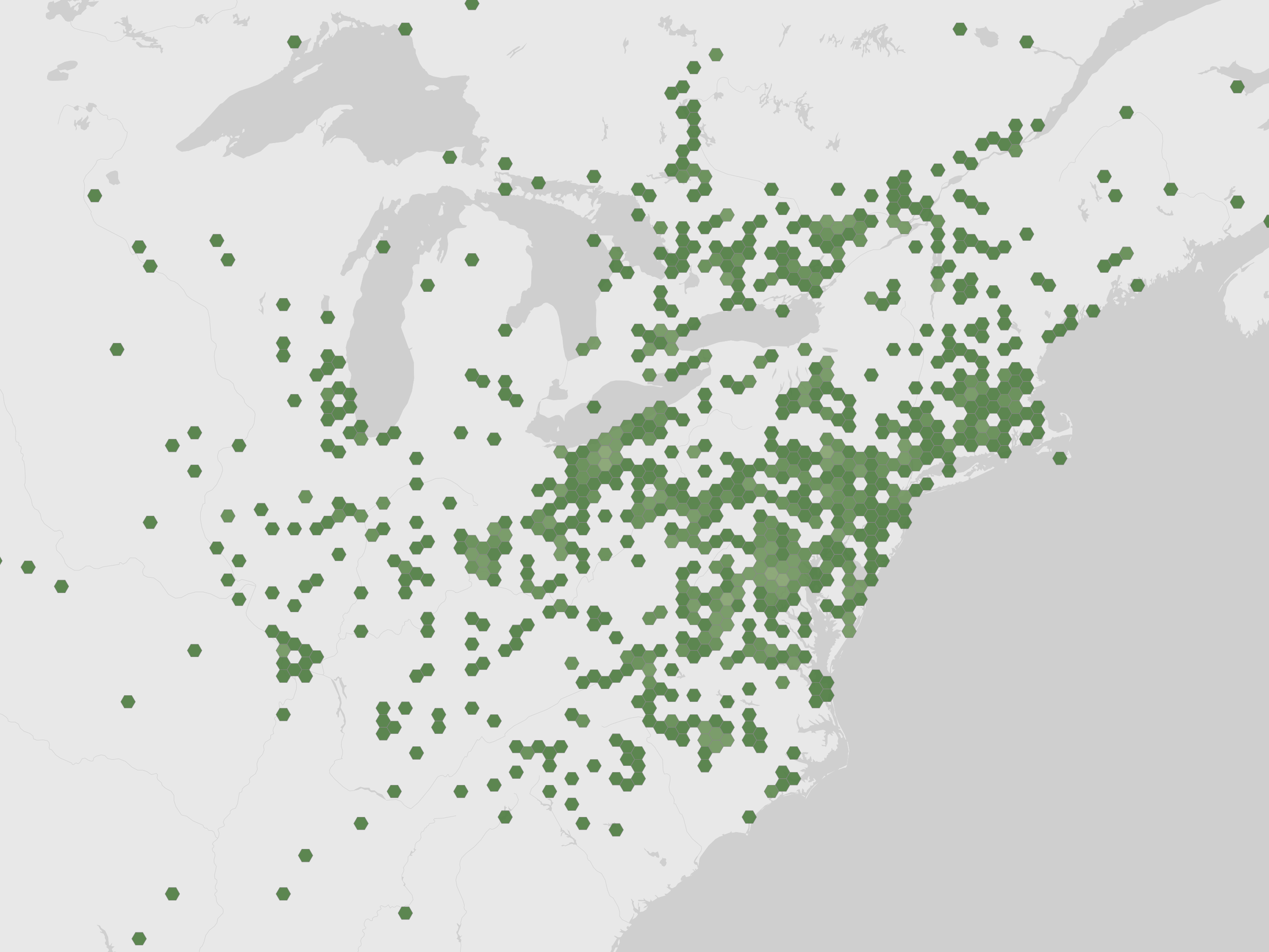
Pseudopolydesmus serratus occurs across North America, though the exact extent of its range is not detailed beyond that. Monthly observation counts show a clear seasonal pattern in when people report encountering the species, rather than a measure of how common it actually is.
Recorded sightings rise sharply from a low in January (37) and February (48) to a peak in April (515), staying elevated through May (322) and June (382). A second, smaller rise appears in October (361) before numbers fall off again through November and December.
This pattern likely reflects when the millipede is most active or visible aboveground, such as during spring warm-up and again in autumn, rather than a true seasonal change in population size. As the underlying data are presence observations only, they cannot be read as an abundance count or a complete picture of the species' native range.
Fun Facts
- The species was formally named by the American naturalist Thomas Say in 1821, making it one of the earlier described millipedes in North America.
- In 1966, J. M. Ramsey documented "vast migrating armies" of Pseudopolydesmus serratus in the Dayton region, a striking account of mass movement rarely reported for millipedes.
- As a flat-backed millipede, it belongs to a body plan shared across the family Polydesmidae, defined by keeled, plate-like segments rather than the rounded, cylindrical shape of many other millipede groups.
Photos
Photographs from via iNaturalist, licensed under CC0 1.0., by Lehmann via iNaturalist, licensed under CC BY 4.0., by Karina M. Torres via iNaturalist, licensed under CC BY 4.0., by Dalton Watt via iNaturalist, licensed under CC BY 4.0., by geosesarma via iNaturalist, licensed under CC BY 4.0., by Kristen Diesburg via iNaturalist, licensed under CC BY 4.0., by Aleks via iNaturalist, licensed under CC BY 4.0., by Jeff Clark via iNaturalist, licensed under CC BY 4.0., by Zakqary Roy via iNaturalist, licensed under CC BY 4.0., by Frog The Kermit via iNaturalist, licensed under CC BY 4.0., by Andrew Conboy via iNaturalist, licensed under CC BY 4.0., by Chris Stahl via iNaturalist, licensed under CC BY 4.0., and by inbetweenbays via iNaturalist, licensed under CC BY 4.0., credited on each photo.
Ecology and classification
Behavior
- Migratory
Classification
- Phylum
- Arthropoda
- Class
- Diplopoda
- Order
- Polydesmida
- Family
- Polydesmidae
- Genus
- Pseudopolydesmus
- Species
- Pseudopolydesmus serratus
Sources
- GBIF Species names and classification
- iNaturalist Photos
- Wikidata Common names and conservation status
- Wikipedia Summary extract