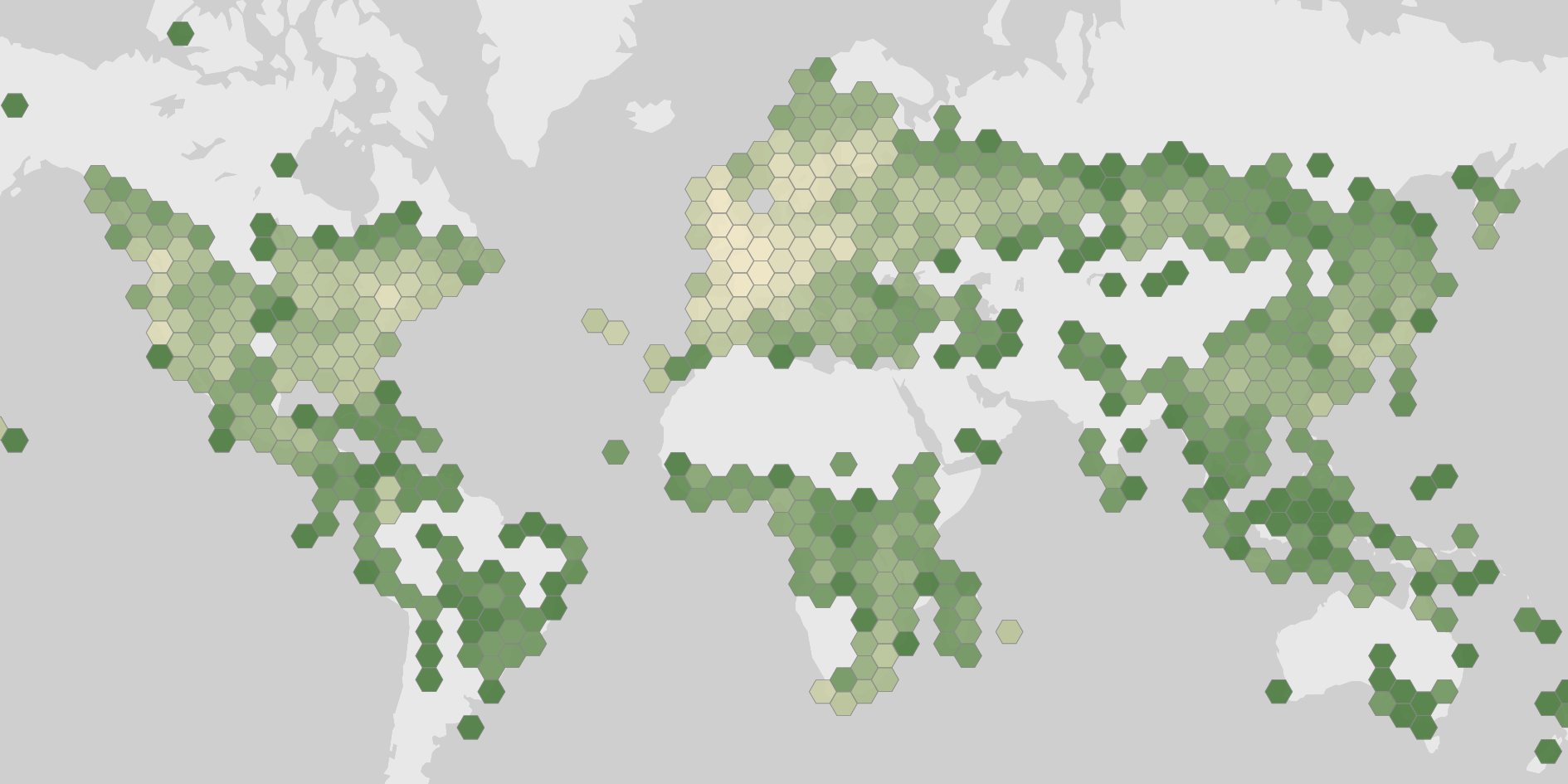
The lightness of its spores is so extreme that bracken has drifted across oceans and continents, giving it one of the widest natural distributions of any fern on Earth. Originally native to Eurasia and North America, Pteridium aquilinum now grows across temperate and subtropical regions in both hemispheres, wherever wind can carry its microscopic spores.
This herbaceous perennial belongs to the fern family Dennstaedtiaceae and is known by many names, including brake, pasture brake, and eagle fern. It grows from a spreading underground rhizome and sends up large, triangular fronds each year, making it one of the most recognizable and successful ferns in the world.
Identification and Appearance
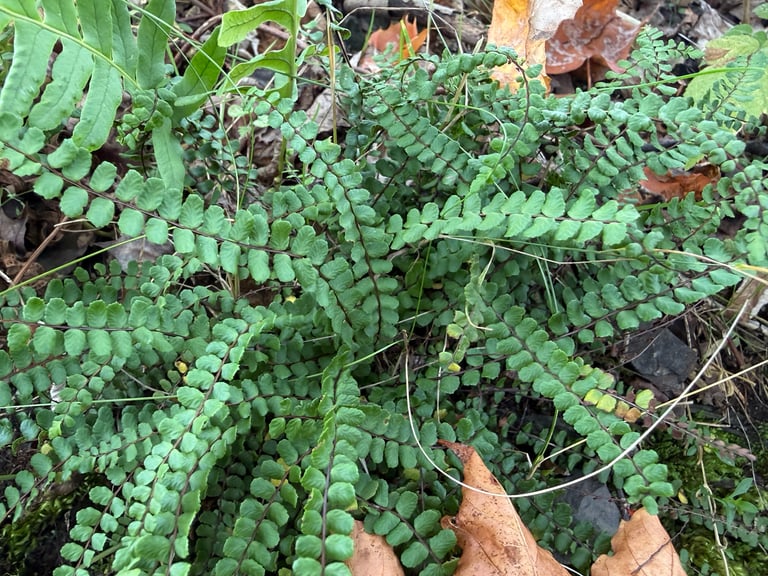
The single most reliable field mark is the frond's shape: large, roughly triangular in outline, and deeply divided into finely cut leaflets, arising singly from a hidden underground rhizome rather than in a tight cluster. Fronds reach 0.3 to 1 meter tall, with a main stalk, or stipe, up to 1 centimeter thick at the base.
In spring, new growth emerges as coiled fiddleheads covered in silvery-grey hairs, standing a meter or more tall before unfurling into the mature triangular frond. The plant is deciduous, dying back to ground level each autumn and regrowing from the rhizome the following spring.
Because new fronds sprout repeatedly from a single spreading rhizome, bracken typically forms dense colonies of genetically identical plants rather than scattered individuals. These clonal stands can be strikingly old: one colony studied at Raakkyla in North Karelia, Finland, measured 489 meters across and, based on its growth rate, was estimated at over 1,400 years old, while individual rhizomes are known to live up to 72 years.
The rhizome itself is a useful hidden character: it can grow up to 3.5 meters deep, about 5 centimeters in diameter, and as long as 15 meters, an underground structure far larger than the visible fronds suggest.
Distribution and Habitat
Bracken is native to Europe, eastern Asia, and North America but now has an almost cosmopolitan distribution. In the Americas it occurs throughout the continental United States and in the Canadian provinces of Ontario, Quebec, and Newfoundland, with its range reaching north to southern Alaska and south into northern Mexico and the Greater Antilles of the Caribbean.
The species favors acidic soils and turns up in pastures, deciduous and coniferous woodlands, and open hillsides. It is a strong colonizer of disturbed ground, and in parts of its native range it behaves almost like an invasive weed: in England it has spread into heather (Calluna vulgaris) stands on the North Yorkshire moors, while in Ireland it is common in open woodland and sandy pastures.
Monthly observation counts show a clear seasonal pattern, rising sharply from low winter numbers to a broad peak across late spring and summer before falling again in autumn. This pattern likely reflects when the deciduous fronds are visible and actively growing rather than any change in actual population size, since the counts record presence, not abundance.
Reproduction and Life Cycle
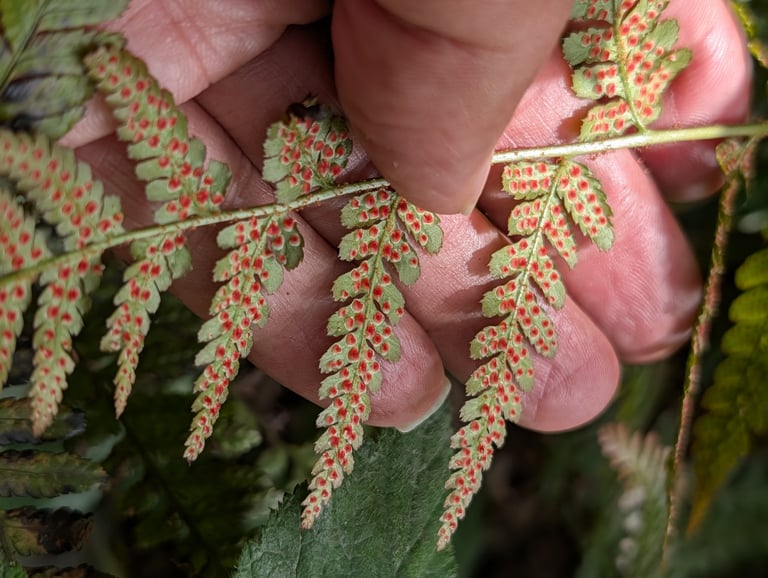
Bracken reproduces by spores rather than seeds, in keeping with its identity as a fern. Sporangia form in sori arranged in narrow brown bands along the underside of each frond, where they mature and release spores over July, August, and September.
This spore-based reproduction, combined with the extraordinary lightness of the spores themselves, underlies bracken's ability to establish in new locations far from existing colonies. Once established, a plant also spreads locally and persistently through its underground rhizome, allowing a single colony to expand into a dense stand of genetically identical fronds over long periods of time.
Uses and Human Relationships
Bracken has a long history of use as food, medicine, and material, despite carrying real risks. The plant contains ptaquiloside, a carcinogenic compound linked to haemorrhagic disease in ruminants, tumors and blood disorders in non-ruminant animals, and to oesophageal and gastric cancer in humans; chronic consumption is also tied to squamous cell carcinomas of the upper digestive tract in cattle. High stomach cancer rates in Japan and North Wales, where young bracken stems are eaten as a vegetable, and in parts of Venezuela's Andean states, where ptaquiloside-contaminated milk is consumed, have raised concern, though a direct causal link to bracken in humans remains unconfirmed.
Because ptaquiloside is water-soluble and breaks down with heat, traditional preparation methods reduce its danger. Korean and Japanese cooks have long soaked bracken shoots in water and ash before eating them, and boiling largely denatures the toxin, with salt and baking soda also helping to volatilize it. Research has also looked at whether selenium supplementation can prevent or reverse the compound's immunotoxic effects, and the plant has been studied for anti-inflammatory and antioxidative properties.
Beyond food, bracken has served many practical and medicinal roles. In Finnish tradition, a root powder was used to repel maggots, a decoction treated stomach problems, gout, and joint pain, and dried leaves stuffed mattresses in the belief that they eased rheumatic pain and drove away vermin. In California, the Ohlone people used a root decoction or paste as a hair rinse to encourage growth, used the fronds for umbrellas, roofing, and lining acorn-leaching pits and earth ovens, and wove the roots into basketry.
Fun Facts
- Pteridium aquilinum is considered the fifth most widely distributed common weed species in the world, a rank made possible largely by how easily its spores travel on the wind.
- Its combination of wide distribution and known toxicity has produced very different cultural attitudes toward the plant, from a valued traditional food and medicine in some regions to a hazardous weed to be avoided in others.
- Modern research has examined the plant for antidiarrhoeal properties and potential antidiabetic effects, alongside the cancer risks tied to its ptaquiloside content, making bracken a fern of genuine medical interest as well as concern.
Photos
Photographs from via iNaturalist, licensed under CC0 1.0., by Andrew Lai via iNaturalist, licensed under CC BY 4.0., by Abby Hyde via iNaturalist, licensed under CC BY 4.0., by Harrison Cole via iNaturalist, licensed under CC BY 4.0., by Roberto Daniel Avila via iNaturalist, licensed under CC BY 4.0., by zebedeugalinha via iNaturalist, licensed under CC BY 4.0., by Joshua Ebright via iNaturalist, licensed under CC BY 4.0., by Jose Gutierrez Higa via iNaturalist, licensed under CC BY 4.0., by Nick Kleinschmidt via iNaturalist, licensed under CC BY 4.0., and by Sabarni Sarker via iNaturalist, licensed under CC BY 4.0., credited on each photo.
Ecology and classification
Growth habit
- Fern
Classification
- Phylum
- Tracheophyta
- Class
- Polypodiopsida
- Order
- Polypodiales
- Family
- Dennstaedtiaceae
- Genus
- Pteridium
- Species
- Pteridium aquilinum
Sources
- GBIF Species names and classification
- iNaturalist Photos
- Wikidata Common names and conservation status
- Wikipedia Summary extract