The pumpkinseed is a small to medium-sized freshwater fish whose body is shaped much like a pumpkin seed, which gives it its name. It is also known as sun perch, pond perch, common sunfish, punkie, sunfish, sunny and kivver.
The Lepomis gibbosus belongs to the sunfish family Centrarchidae in the order Perciformes. It is native to eastern North America, and the International Union for Conservation of Nature (IUCN) rates it as Least Concern.
The species is worth knowing about because it has spread far beyond its native range. Outside North America it is treated as a pest in many places, and it hybridizes readily with other sunfish.
Identification and Appearance
The pumpkinseed is recognized by the orange-red spot on the margin of its black gill cover. Its body is deep and rounded, and adults are typically about 10 cm (4 inches) long, though they can reach 28 cm (11 inches). Most weigh less than 450 g (about one pound).
The fish is vividly colored and may look orange, green, yellow or blue. Its sides and back are speckled, and its breast and belly are yellow-orange. Faint green or blue vertical bars cover the sides, and these bars are usually more prominent in females. Orange spots may mark the dorsal, anal and tail fins, and the cheeks carry blue lines.
The pumpkinseed has a small mouth, with the upper jaw ending directly under the eye. Its pectoral fins may be amber or clear, and its dorsal spines are black.
The bluegill is very similar and often shares the same habitats. The pumpkinseed's gill flap has a crimson, half-moon spot on its back portion, while the bluegill's flap lacks it. The pumpkinseed also has seven or eight irregular vertical bands on its sides, which are duller than those of the bluegill.
Distribution and Habitat
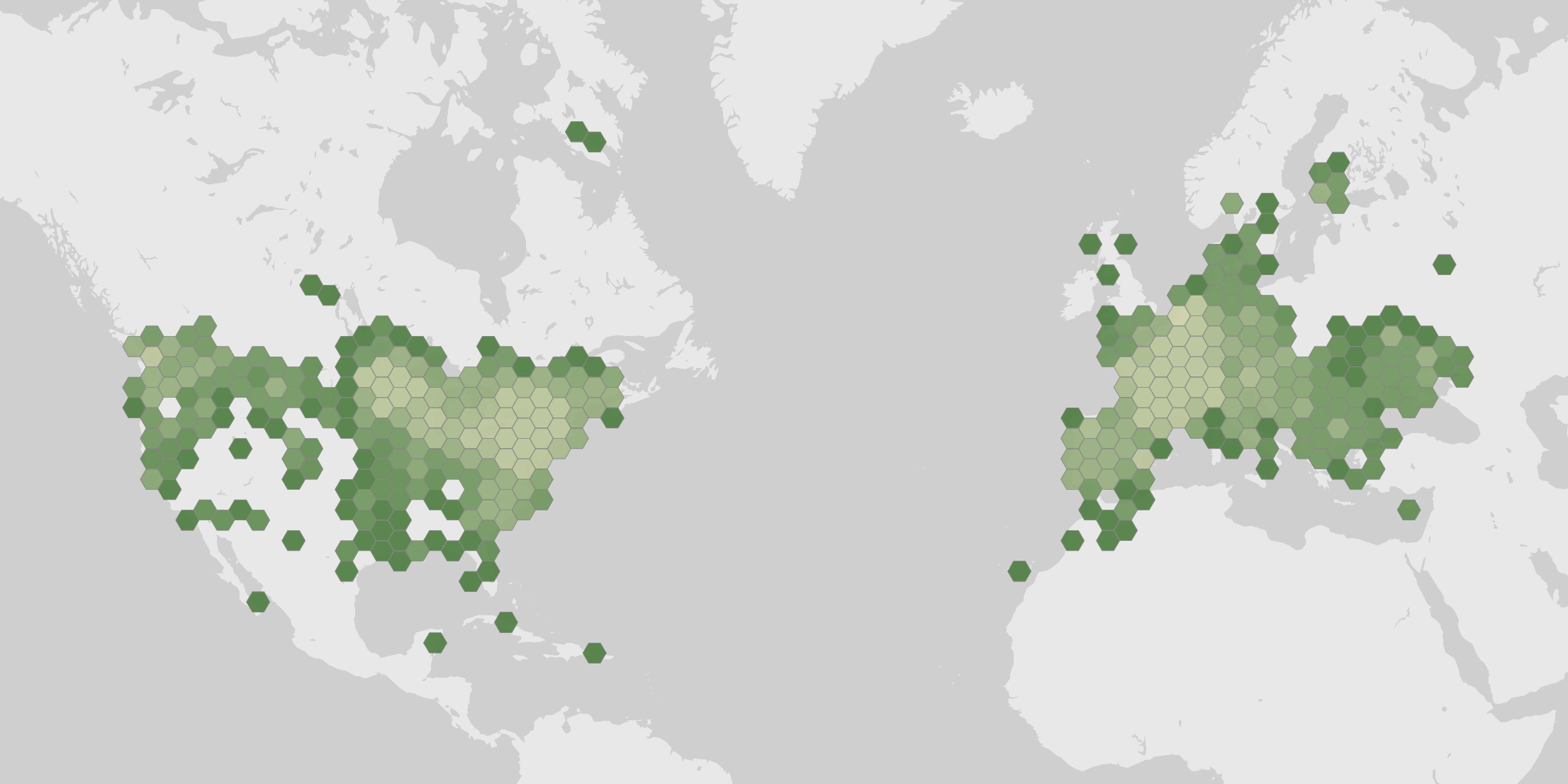
The native range of the pumpkinseed runs from New Brunswick, Canada, down the east coast of the United States to South Carolina. It extends inland to the middle of the continent from Pennsylvania to Iowa, following various river systems.
The species has been introduced across most of North America. It now occurs from Washington and Oregon on the Pacific Coast to Georgia on the Atlantic Coast. Most records come from the northeastern United States, with fewer in the south-central and southwestern parts of the continent.
In Europe, the pumpkinseed is considered invasive. Since its introduction it could outcompete native fish, and since 2019 it has been on the Union list of Invasive Alien Species of Union concern. Under this list, it cannot be imported, bred, transported, sold or intentionally released anywhere in the European Union.
The pumpkinseed favors warm, calm lakes, ponds, pools of creeks and small rivers with plenty of vegetation. It prefers clear, cool to moderately warm water that is 1 to 2 m deep, and it stays near shore in shallow, protected areas. Its ideal water temperature ranges from 21 to 24 °C (70 to 75 °F).
Behavior and Lifestyle
Pumpkinseeds are active during the day and rest at night near the bottom, in rock crevices, near submerged logs or in dense vegetation. They are most active in daylight, and their heaviest feeding occurs in the afternoon.
Young fish school close to shore, while adults travel in groups of two to four in slightly deeper but still covered water. Pumpkinseeds often travel in schools that also include bluegills and other sunfish.
Each fish keeps a home range of about 0.23 to 1.12 hectares. Adults defend territories, and males in particular are aggressive around their nests.
Pumpkinseeds tolerate low oxygen levels better than bluegills do, but they handle warm water less well.
Communication
Male pumpkinseeds change color during the breeding season, which suggests that visual signals matter to other males and to females. Males also spread their gill covers to show dominance and territoriality, and they flare their gills in the spring spawning season.
The fish rely on several channels to sense their surroundings. Visual and tactile cues are both important, and chemical cues are also part of how they perceive the world.
Their lateral line system detects changes and movements in the water through mechanical receptors. This allows a pumpkinseed to sense approaching predators or prey.
Diet and Nutrition
Pumpkinseeds are carnivores that feed mainly on small animals. Their prey includes insects, insect larvae, mollusks, snails, crustaceans, leeches and small fish. Their diet is most closely tied to insects, and they are effective at reducing mosquito larvae.
The main prey groups include midges and other flies, caddisflies, stoneflies, beetles and mayflies. Named prey includes midge larvae of the genus Ablabesmyia and freshwater shrimp-like amphipods of the species Gammarus roeselii.
Pumpkinseeds take food from every level of the water, from the surface to the bottom. They also eat detritus and small amounts of aquatic vegetation.
In the southern part of their range, pumpkinseeds have larger mouths and enlarged jaw muscles. These features let them crack the shells of crustaceans and mollusks to reach the soft flesh inside, which is the source of the nickname 'shellcracker'.
Reproduction and Life Cycle
Spawning takes place from April to August, depending on location, when water temperatures reach 13 to 28 °C (55 to 63 °F). Males begin building nests once the water warms in late spring or early summer.
Males sweep out shallow, oval nest holes in sand or gravel with their caudal fins. Each nest stretches about twice the length of the fish, and males remove debris and large rocks with their mouths. Nests are grouped in colonies of about three to 15 sites, and a typical nest is about 30 cm (12 inches) across and 5 to 7 cm (2 to 3 inches) deep.
Females arrive from deeper water after the nests are finished. A female spawns in a circular path above the nest with the male, and the male releases milt while the female releases eggs in intervals. Females may spawn in more than one nest, and more than one female may use the same nest. A female can produce 1,500 to 1,700 eggs, depending on her size and age.
The eggs stick to gravel, sand or debris and hatch in as few as three days. The larvae stay in the nest for about five days, feeding on their yolk sac. Males guard the nest for about the first 11 days and return stray fry to the nest in their mouths. Pumpkinseeds reach sexual maturity at about two years of age, and in the wild most do not live beyond six to eight years, though captive fish have lived to 12.
Population and Ecological Role
The pumpkinseed is common and abundant in suitable habitat. Its susceptibility to silt and pollution makes it a useful indicator of water cleanliness and health.
In the food web, it is an important link. Birds and larger fish prey on it, including pike, largemouth bass, trout, and herons. Its feeding on insects also shapes local insect populations.
Where it has been introduced, the species hybridizes with most other Lepomis species, especially bluegill and green sunfish. The resulting hybrids are fast-growing, sterile males, which can lead to overcrowding and stunted growth in native species.
Conservation and Threats
The International Union for Conservation of Nature (IUCN) rates the pumpkinseed as Least Concern, and it is not listed by the US Federal List or CITES. Populations are not considered at risk.
Shoreline development and erosion from heavy lake use can disturb the spawning grounds. Because the nests lie in shallow water, these changes can directly affect breeding success.
In Europe, the main concern is its invasive status. It is on the Union list of Invasive Alien Species of Union concern, which bans its import, breeding, transport, sale and intentional release.
Cultural Significance
Pumpkinseeds have little economic value, but many anglers treat them as a good panfish because of their flavor. Their eagerness to bite most bait makes them easy to catch, though experienced anglers often release them because they are small.
The species is also kept in aquariums and is sold in the pet trade. Researchers sometimes use it in laboratory experiments.
Photos
Photographs from by feralist via iNaturalist, licensed under CC BY 4.0., via iNaturalist, licensed under CC0 1.0., by Steve Lawson via iNaturalist, licensed under CC BY 4.0., by Yves Bas via iNaturalist, licensed under CC BY 4.0., by toad-wife via iNaturalist, licensed under CC BY 4.0., by moxostoma via iNaturalist, licensed under CC BY 4.0., by inbetweenbays via iNaturalist, licensed under CC BY 4.0., by Alexander Pohle via iNaturalist, licensed under CC BY 4.0., by Daughter Dad via iNaturalist, licensed under CC BY 4.0., and by Eli Talhouk via iNaturalist, licensed under CC BY 4.0., credited on each photo.
Ecology and classification
Classification
- Phylum
- Chordata
- Order
- Perciformes
- Family
- Centrarchidae
- Genus
- Lepomis
- Species
- Lepomis gibbosus
Sources
- GBIF Species names and classification
- iNaturalist Photos
- Wikidata Common names and conservation status
- Wikipedia Summary extract
- Animal Diversity Web Animal habitat, behavior and diet
- GloBI What it eats, what eats it, parasites and pollinators
- trophiCH
- Wardeh et al. 2015 (EID2)
- HWML Parasite Collection