A single bloom of Rafflesia arnoldii can span over a meter across and weigh up to 11 kilograms, making it the largest individual flower known anywhere on Earth. The largest specimen ever measured reached 1.14 meters wide, a record recognized by the Guinness Book of World Records.
This is a holoparasitic flowering plant native to the rainforests of Sumatra and Borneo, living entirely off nutrients and water drawn from vines in the genus Tetrastigma. It has not been formally assessed by the IUCN, but conservationists already consider it a species of concern.
What makes it worth attention is not just its size but its strategy: a plant that spends up to a year building a single bloom, then uses the stench of rotting meat to lure the flies it depends on for survival.
Identification and Appearance
The single most reliable way to recognize Rafflesia arnoldii is by its flower: an enormous reddish-brown bloom covered in white spots, emitting a smell of decaying flesh. No other rainforest plant in its range produces anything resembling it.
The flower reaches roughly 1 meter in diameter and can weigh as much as 11 kilograms, with the largest confirmed individual measuring 1.14 meters across. It emerges from a large, cabbage-like bud, typically about 30 centimeters wide and colored maroon or dark brown. The largest bud ever recorded, found at Mount Sago in Sumatra in May 1956, measured 43 centimeters across. Indonesian researchers often refer to this developing bud as a "knop."
Because the plant lacks chlorophyll, leaves, stems, and roots, the flower is the only structure that is ever identifiable as distinctly plant-like. Inside the bloom, stigmas or stamens sit on a spiked central disk, and the flowers are either male or female, never both. Observers have reported that the bloom opens with an audible hissing sound.
Before flowering, the organism is completely invisible, living as fine strands of tissue embedded within the tissue of its Tetrastigma host vine, much like a fungal network.
Distribution and Habitat
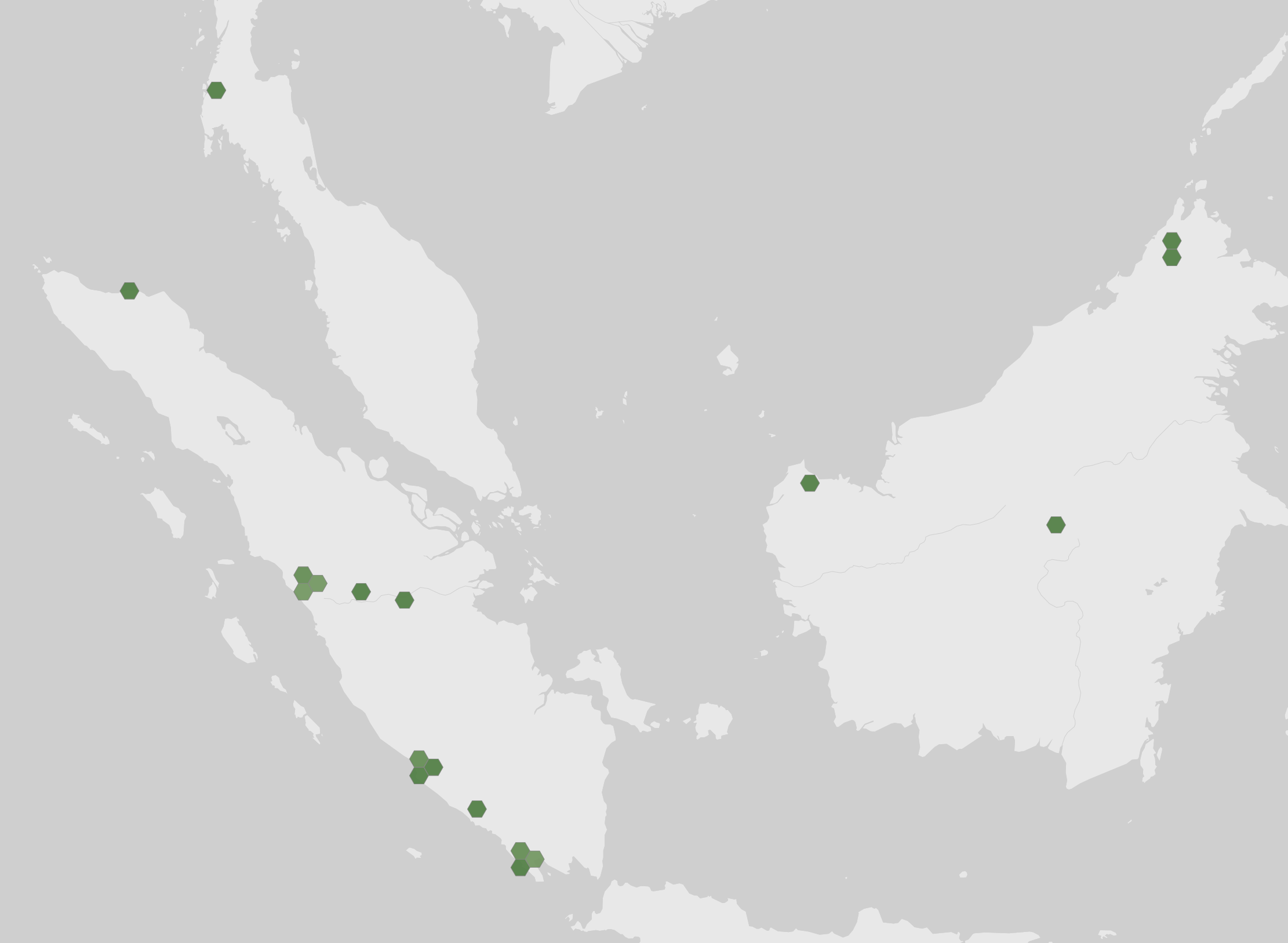
Rafflesia arnoldii is native to the rainforests of Sumatra and Borneo, with records also noted from Malaysia, the Philippines, and Thailand. It grows in both primary and secondary rainforest, always in close association with its sole documented host in West Sumatra, Tetrastigma leucostaphylum.
The plant favors the darkest parts of the forest floor. Its host vine climbs saplings and bushes such as Laportea stimulans and Coffea canephora before enveloping the subcanopy so thickly that little light reaches the ground beneath, and the greatest concentration of buds is found precisely in these shaded, light-starved patches. Rafflesia arnoldii has been recorded on alkaline, neutral, and acidic soils, always near water, at elevations between 490 and 1,024 meters.
Monthly observation counts show a rise through the year, peaking around the middle months before tapering off toward year's end. These figures reflect when the conspicuous flowers were noticed and recorded, not the overall size of the population, so they should be read only as a rough seasonal signal of visible blooming rather than abundance.
Reproduction and Life Cycle
Each flower results from a bud that takes close to a year to develop, yet the open bloom itself lasts only a few days before collapsing. Because Rafflesia arnoldii is dioecious, with separate male and female flowers, successful pollination depends on flies or beetles visiting a male bloom and then a female one in the same brief window.
The flower's stench of rotting meat comes from sulfur-containing compounds, including dimethyl disulfide and dimethyl trisulfide, the same chemicals released by decomposing organic matter. This scent, combined with the bloom's mottled coloring, deceives carrion flies of the family Calliphoridae into treating it as a carcass; as the flies move between blooms searching for a place to lay eggs, they carry pollen from male to female flowers. Other flies recorded visiting late-stage blooms include Drosophila colorata, Chrysomya megacephala, and Sarcophaga haemorrhoidalis.
Not every bud survives to flower. Black ants of the genus Euprenolepis have been observed feeding on developing buds, likely killing some before they open. Successfully pollinated flowers produce round berries packed with numerous minute seeds.
Uses and Human Relationships
In parts of its range, Rafflesia arnoldii carries deep symbolic weight: some tribes regard it as an emblem of fertility, while others consider it a magical or mysterious being with mystical power. These beliefs have in turn encouraged a degree of local reverence and protection toward the plant.
Beyond symbolism, dried petals have reportedly been used to treat fevers and postpartum pain. The flower is also woven into ceremonies tied to fertility and to protecting young mothers, reinforcing its place in local tradition well beyond its botanical rarity.
Conservation and Threats
Rafflesia arnoldii has not been formally assessed on the IUCN Red List, but it is widely regarded as a species of concern because of converging pressures on its survival. Deforestation and direct harvesting are the main human-driven threats, stripping away the primary and secondary rainforest the plant and its host vine depend on.
Biological factors compound the problem. The species is dioecious, meaning male and female flowers must bloom close together in time and space to reproduce, yet populations are limited and skewed heavily toward male flowers, making successful pollination increasingly difficult to achieve by chance alone.
Somewhat counterintuitively, ecotourism is considered a leading threat rather than a safeguard. At sites that receive regular visitor traffic, the number of flower buds produced each year has measurably declined, suggesting that foot traffic and disturbance around blooming sites take a toll on the plant's already fragile reproductive cycle.
Fun Facts
- Rafflesia arnoldii has been nicknamed the "panda of the plant world" for symbolizing both the extraordinary biodiversity and the fragility of Southeast Asian rainforests.
- When a bloom finally opens after months of development inside its cabbage-like bud, it reportedly does so with an audible hissing sound.
- Indonesian researchers commonly call the plant's large developing bud a "knop," the local term for knob.
Photos
Photographs from by Samuel GUIRAUDOU via iNaturalist, licensed under CC BY 4.0. and via iNaturalist, licensed under CC0 1.0., credited on each photo.
Ecology and classification
Habitat
Classification
- Phylum
- Tracheophyta
- Class
- Magnoliopsida
- Order
- Malpighiales
- Family
- Rafflesiaceae
- Genus
- Rafflesia
- Species
- Rafflesia arnoldi
Sources
- GBIF Species names and classification
- iNaturalist Photos
- Wikidata Common names and conservation status
- Wikipedia Summary extract