The blonde ray is one of the larger skates found along Europe's Atlantic coastline, reaching lengths of up to 120 centimeters (47 inches), yet the International Union for Conservation of Nature now lists it as Near Threatened, a status shaped largely by decades of fishing pressure on a slow-growing, late-maturing fish.
A cartilaginous fish in the family Rajidae, the blonde ray belongs to the same broad lineage as sharks and other rays. It ranges through the Eastern Atlantic from Scotland to Morocco and turns up occasionally in the Mediterranean Sea, living on the seafloor at depths that can exceed 380 meters. Its combination of size, distinctive markings, and vulnerability to overfishing make it a species worth watching closely in European waters.
Identification and Appearance
The most useful field mark is the blonde ray's coloration: a brown, kite-shaped body scattered with creamy-white blotches and dense dark spots that extend all the way to the edges of the pectoral fins and onto the tail. This flattened, wing-finned body plan is typical of rays, but the short tail — the source of the species name brachyura — sets it apart from relatives with longer, whip-like tails.
Size changes dramatically over the ray's life. Newborns measure just 16 to 18 centimeters (6.3 to 7.1 inches) in total length, while individuals reach sexual maturity at around 80 to 90 centimeters (31 to 35 inches). The maximum published length is 120 centimeters (47 inches), and the species can weigh close to 7.9 kilograms at that size.
Juveniles are disproportionately common in shallow coastal waters, since these areas function as nurseries for the species. This means a ray encountered close to shore is more likely to be young than one found farther offshore or in deeper water.
Distribution and Habitat
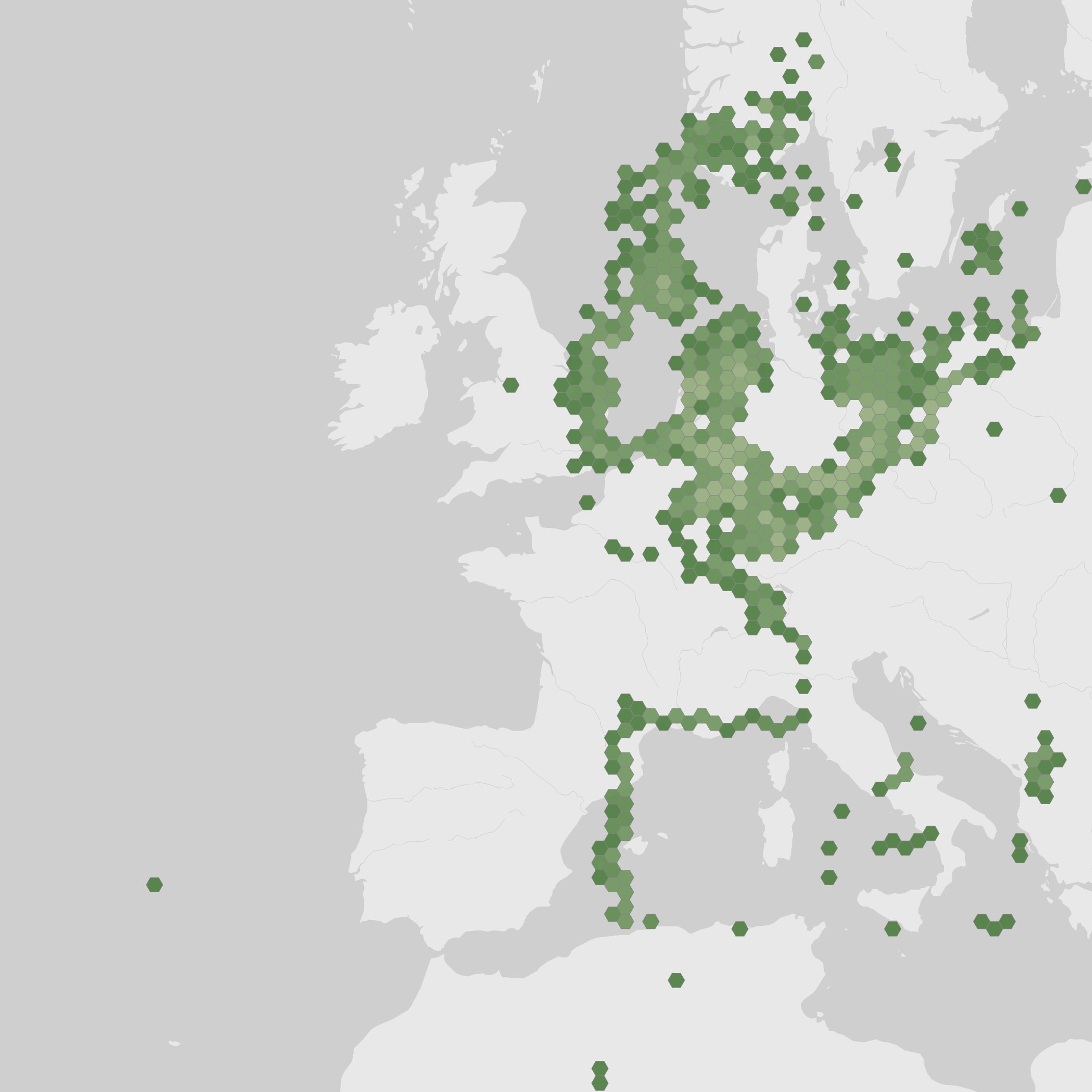
The blonde ray occurs through the Eastern Atlantic from Scotland south to Morocco, typically at depths between 10 and 380 meters (33 to 1,247 feet), with occasional records as deep as 900 meters (3,000 feet). It is also found, less frequently, in the Mediterranean Sea.
It is a demersal species, spending its time on the seafloor rather than swimming in open water, and it favors sandy and muddy bottoms. Shallow coastal waters serve as nursery grounds, which is why juveniles are disproportionately represented among rays found close to shore.
Monthly observation counts show a clear seasonal pattern, with a sharp peak in September (2,795 records) and comparatively high counts in February and March, against a summer low between May and August. These figures reflect presence records rather than true abundance or a complete range, but the pattern hints at greater seasonal detectability or activity in early autumn and late winter.
Diet and Nutrition
The blonde ray feeds on cephalopods, small bony fish, and crustaceans, with brown shrimp (Crangon crangon) singled out as a notable prey item. This mix of soft-bodied and hard-shelled prey suits a bottom-dwelling predator that forages over sandy and muddy seafloors.
Notably, this diet holds for both juveniles and adults, suggesting the ray does not undergo a major shift in prey type as it grows, unlike some species that switch from small invertebrates to larger fish with age.
Cultural Significance
Beyond its ecological role, the blonde ray has a long history as a food and sport fish. It is caught for human consumption in places such as the United Kingdom, and it draws recreational anglers seeking a trophy catch — the record stands at 17 kilograms (37 pounds), landed at Cobh, Ireland, in 2008.
That same popularity carries risk. Skates like the blonde ray are long-lived, slow-growing, and late to mature, producing few young over a lifetime. Because juveniles concentrate in shallow, easily fished coastal waters, many are caught before they ever get the chance to breed, tying the species' fortunes closely to how fisheries in its range are managed.
Fun Facts
- The blonde ray has been recorded at depths of up to 900 meters (3,000 feet), well beyond its usual range of 10 to 380 meters.
- Newborns are barely a hand's length at 16 to 18 centimeters, but adults can grow more than six times longer, reaching up to 120 centimeters.
- Its name derives from Ancient Greek brachyura, meaning "short tail," distinguishing it from longer-tailed relatives in the ray family.
- Although its main range runs from Scotland to Morocco in the Eastern Atlantic, the species only turns up occasionally in the Mediterranean Sea.
Conservation status
- LC
- NT
- VU
- EN
- CR
Near Threatened
Ecology
Habitat
- Marine
- Coastal
Diet
- Carnivore