The reed cormorant, also called the long-tailed cormorant, dives for fish in shallow African waters and then returns to the surface to swallow its catch. It is a small member of the cormorant family, Phalacrocoracidae, breeding across much of Africa south of the Sahara and on Madagascar.
The species is resident throughout its range but makes some seasonal movements rather than undertaking true long-distance migration. The IUCN lists it as Least Concern, reflecting its wide distribution and common status.
Identification and Appearance
The reed cormorant is best identified by its mainly black plumage glossed with green, paired with silvery wing coverts that create a distinctive two-toned look during the breeding season. It measures 50 to 55 centimeters in length, with a wingspan of 80 to 90 centimeters and a weight around 0.545 kg.
Its longish tail and short head crest give it a slightly unkempt silhouette compared to larger cormorants, while a red or yellow face patch and yellow bill add color to an otherwise dark bird. The sexes look alike.
Non-breeding adults and juveniles are browner overall and show a white belly, contrasting with the glossy black of breeding adults. Some southern populations keep their crest year-round rather than losing it outside the breeding season.
Distribution and Habitat
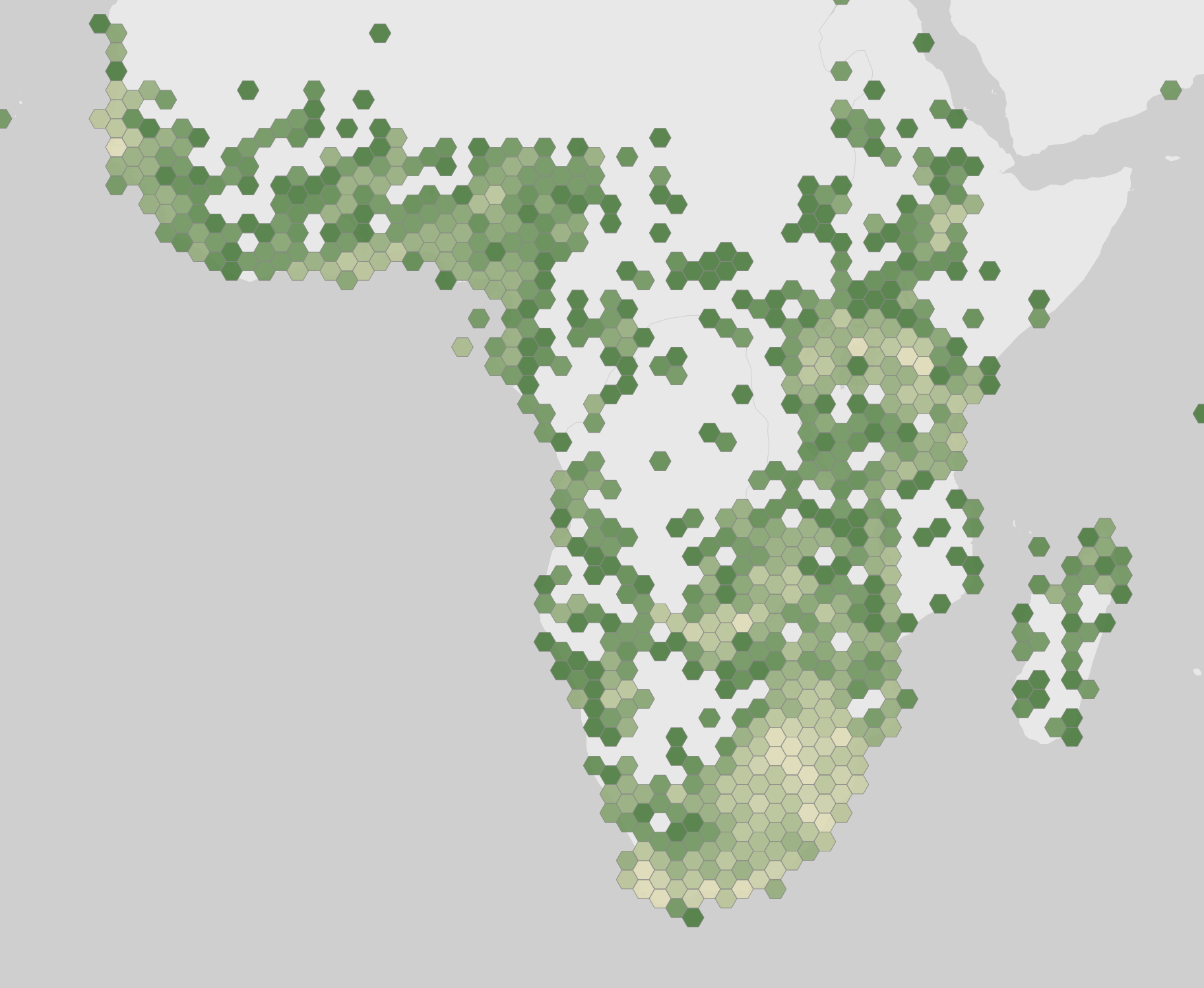
The reed cormorant occupies an enormous range, estimated at 17,500,000 square kilometers, spanning most of sub-Saharan Africa and Madagascar. It favors freshwater wetlands for breeding, and also uses quiet coastal waters.
It is described as common and widespread rather than restricted to particular strongholds, fitting an open habitat density across its African range.
Monthly observation counts show relatively steady presence through the year, with somewhat higher figures from October through January and a dip in the middle of the year, consistent with its sedentary lifestyle and only modest seasonal movement rather than a dramatic migration pattern.
Behavior and Lifestyle
The reed cormorant is a sedentary, aquatic bird that spends much of its life around shallow water, where it hunts by diving. Although capable of reaching considerable depths, it typically feeds in shallow water and frequently brings its prey back to the surface before eating it.
Its hunting style favors small, slow-moving fish with long, tapering bodies, such as mormyrids, catfishes, and cichlids, though soles, frogs, aquatic invertebrates, and even small birds are taken less often. Soles can become locally important in its diet in certain areas.
Breeding behavior includes laying two to four eggs in a nest built in a tree or directly on the ground, usually concealed within long grass to protect the eggs and young from view.
Fun Facts
- The species is also known as the long-tailed cormorant, a name referencing its longish tail relative to its small body size.
- It was first scientifically described by J. F. Gmelin in 1789 under the name Halietor africanus, before later being placed in the genus Microcarbo.
- It has been the subject of numerous African field studies and literature surveys over the decades, appearing in ornithological records from West and Central Africa.
Photos
Photographs from by Jiro Iguchi via iNaturalist, licensed under CC BY 4.0., by Murray Yoko via iNaturalist, licensed under CC BY 4.0., by Henry de Lange via iNaturalist, licensed under CC BY 4.0., by Glynn Morris via iNaturalist, licensed under CC BY 4.0., by Cricket Raspet via iNaturalist, licensed under CC BY 4.0., by Shaun Swanepoel via iNaturalist, licensed under CC BY 4.0., by Bruno - Yolande Zanette via iNaturalist, licensed under CC BY 4.0., by chrisdt via iNaturalist, licensed under CC BY 4.0., by Liezl van der Merwe via iNaturalist, licensed under CC BY 4.0., by Sara Navarro via iNaturalist, licensed under CC BY 4.0., by Mark Clarke via iNaturalist, licensed under CC BY 4.0., and by Luciano Massa via iNaturalist, licensed under CC BY 4.0., credited on each photo.
Ecology and classification
Classification
- Phylum
- Chordata
- Class
- Aves
- Order
- Suliformes
- Family
- Phalacrocoracidae
- Genus
- Microcarbo
- Species
- Microcarbo africanus
Sources
- GBIF Species names and classification
- iNaturalist Photos
- Wikidata Common names and conservation status
- Wikipedia Summary extract
- AVONET Bird mass, habitat, migration, diet and range size