Rhizopogon vinicolor never breaks the soil surface to release its spores into the air, an odd trait for a relative of boletes. Instead, this fungus produces its entire fruiting body underground, forming small rounded or irregular masses that begin dirty white and turn wine-red once exposed to air or injury.
The species is an ectomycorrhizal fungus, meaning it lives in a mutually beneficial partnership with tree roots, most notably those of the Douglas-fir. First described scientifically in 1966 by American mycologist Alexander H. Smith, R. vinicolor is now recognized as a species complex rather than a single uniform taxon. Its hidden, subterranean habit and tight bond with one of North America's most important timber trees make it a quietly essential part of the forests it inhabits.
Fruiting Body and Identification
The most reliable identifying feature of Rhizopogon vinicolor is its color change: the outer skin, or peridium, starts dirty white but turns wine-red wherever it is exposed or bruised, a reaction that gives the species its name. The fruiting bodies are small, measuring only 10 to 33 millimeters across, and are rounded to irregularly lobed in shape. A few thin, root-like rhizomorphs extend from the base, anchoring the fruiting body to the surrounding soil and host roots, though in some specimens these cords are sparse or entirely absent.
Inside, the peridium consists of a single layer of tissue. The gleba, or spore-bearing flesh, is firm and buff-colored when young, darkening progressively with age. Its internal structure is made up of small, maze-like (labyrinthine) locules, and the internal tissue, or trama, is densely packed with basidiospores.
Those spores are elliptical to egg-shaped, measuring 5 to 9 by 3 to 5 micrometers. They lack an internal partition (septum), and their surface is smooth and translucent (hyaline) under the microscope. Because the fruiting body never opens to the air, these microscopic features and the peridium's red-staining reaction are the main tools for identification.
Distribution and Habitat
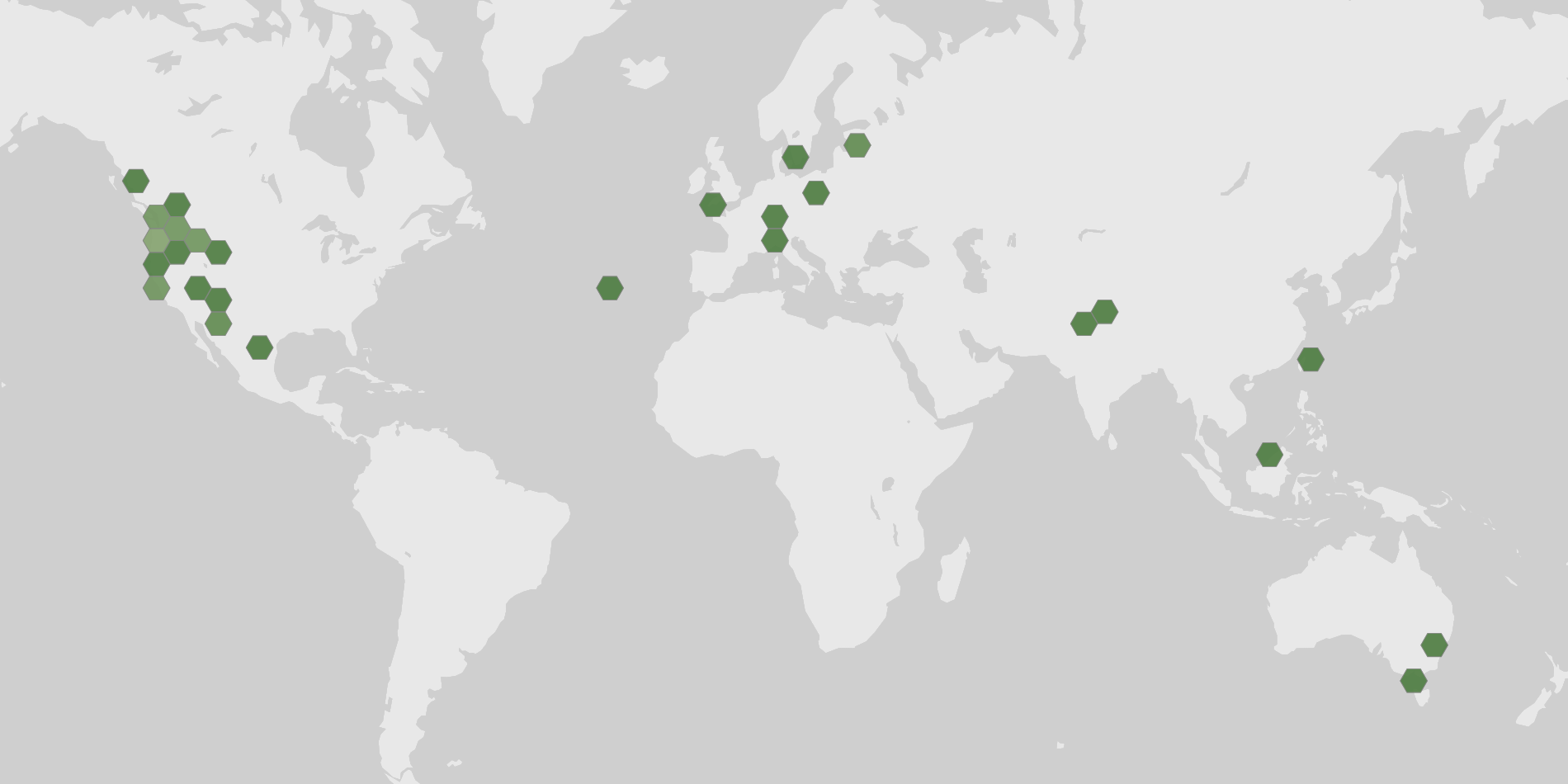
Observation records for Rhizopogon vinicolor follow a strongly seasonal pattern, with sightings rising sharply through spring and peaking in August, when they are roughly twenty times more frequent than in the winter months. A secondary rise occurs in July before numbers fall away again by October and November, suggesting the fungus fruits and is most detectable in mid-to-late summer.
These figures come from presence records rather than measures of abundance, population size, or a complete picture of the species' range, so they should be read as a record of when and where people have noticed and reported the fungus rather than how common it actually is. Because R. vinicolor fruits entirely underground, it is likely under-recorded compared to surface-dwelling fungi, and its true distribution may extend beyond what these observations capture.
As an ectomycorrhizal partner of coniferous trees, its presence is tied directly to the root systems of its host trees, meaning its distribution mirrors that of suitable forest stands rather than open ground.
Ecology and Relationships
Rhizopogon vinicolor lives in a close mutualistic partnership with coniferous trees, most consistently the Douglas-fir, though some records also link it to ponderosa pine and other pines and firs. The fungus breaks down leaf litter and rotting wood, making nutrients available to its host, while the tree supplies the fungus with carbohydrates produced through photosynthesis.
Because its fruiting bodies never surface, R. vinicolor depends on animals to disperse its spores. The western red-backed vole is one of several rodents that dig up and eat the fruiting bodies; the spores pass unharmed through the vole's gut and are later deposited in fecal pellets throughout its burrow system, allowing the fungus to colonize new, uninfected tree roots.
This relationship is fragile. When a forest is clear-cut and the dead wood removed, R. vinicolor and other mycorrhizal fungi stop fruiting, the vole population that depends on them collapses, and newly planted trees struggle to establish healthy root partnerships without their fungal allies.
Fun Facts
- Rhizopogon vinicolor is treated as a species complex, meaning what has been called one species likely contains several closely related forms rather than a single uniform organism.
- The species was formally described in 1966 by American mycologist Alexander H. Smith.
- Type material for the species was collected by Trueblood and is held under the identifier MICH 2195.
- As a basidiomycete fungus, it follows the standard genetic code used across most eukaryotic organisms, though its mitochondrial genetic code differs, a technical detail that separates fungi from many other life forms at the cellular level.
Ecology
Habitat
- Forest