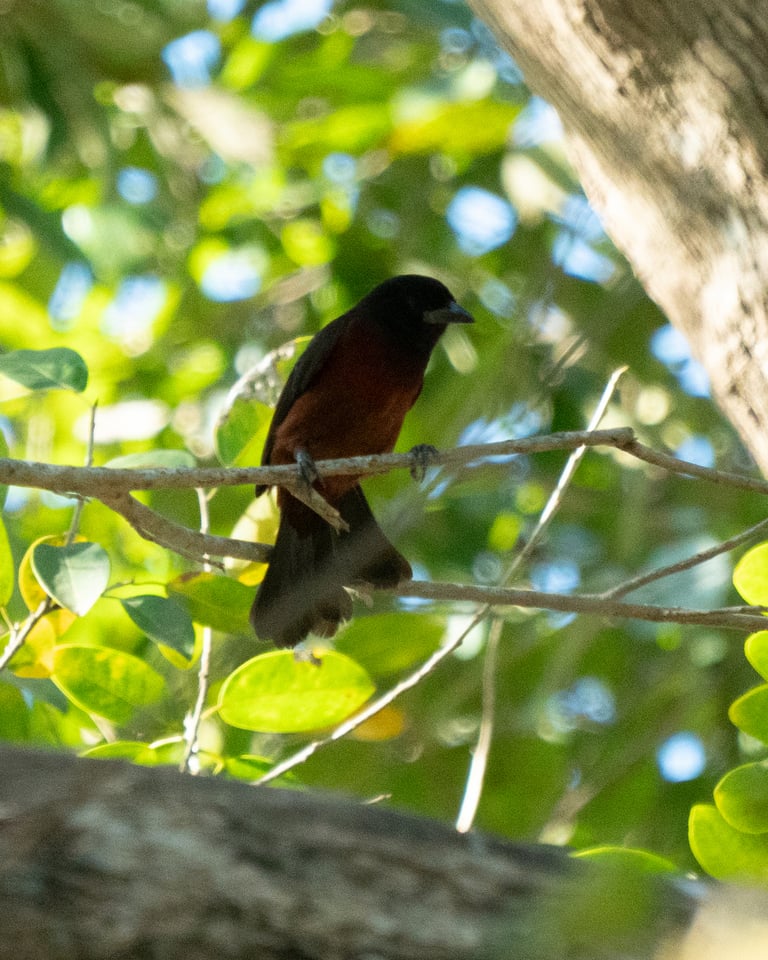
With a whistled song that ends in a long clear upslurring note, the cinnamon-bellied saltator announces itself across forest edges and gardens from Mexico to Panama.
This passerine belongs to the tanager family Thraupidae and is native to a broad stretch of Mexico and Central America. The IUCN lists it as Least Concern, reflecting its wide range and apparent stability. Its adaptability to human-altered landscapes, from plantations to urban parks, makes it one of the more familiar birds across its range.
Identification and Appearance
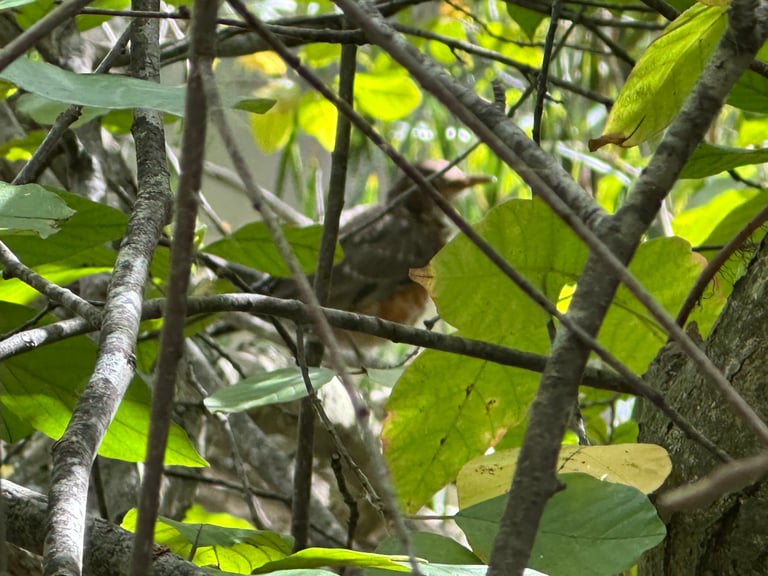
The most useful field mark is the combination of a deep brownish gray head with a wide white supercilium reaching past the eye and a cinnamon-buff belly. Adults measure 22 to 24 cm long and weigh about 50 to 60 g, with males and females sharing the same plumage.
The nominate subspecies, S. g. grandis, has deep brownish gray crown, nape, upperparts, and wings with an olive tinge on the rump and uppertail coverts, and a brown tail. The chin and throat are white or pale buffy with a dark stripe along the side, while the breast, sides, and flanks are grayish olive with a strong buffy wash on the flanks. The belly, vent, and undertail coverts show the deep buff to cinnamon buff color that gives the species its name. All subspecies share a brown to gray-brown iris, a blackish bill, and blackish to leaden gray legs and feet.
Several subspecies show subtle regional differences. S. g. vigorsii has somewhat grayer underparts than the nominate, S. g. plumbiceps shows an ashy gray head with more olive upperparts, and S. g. yucatanensis differs little from the nominate. S. g. hesperis is larger with a thinner, shorter supercilium and darker, more slaty plumage overall, while S. g. brevicaudus is smaller with a shorter tail and darker, more plumbeous upperparts with less olive tone.
Distribution and Habitat
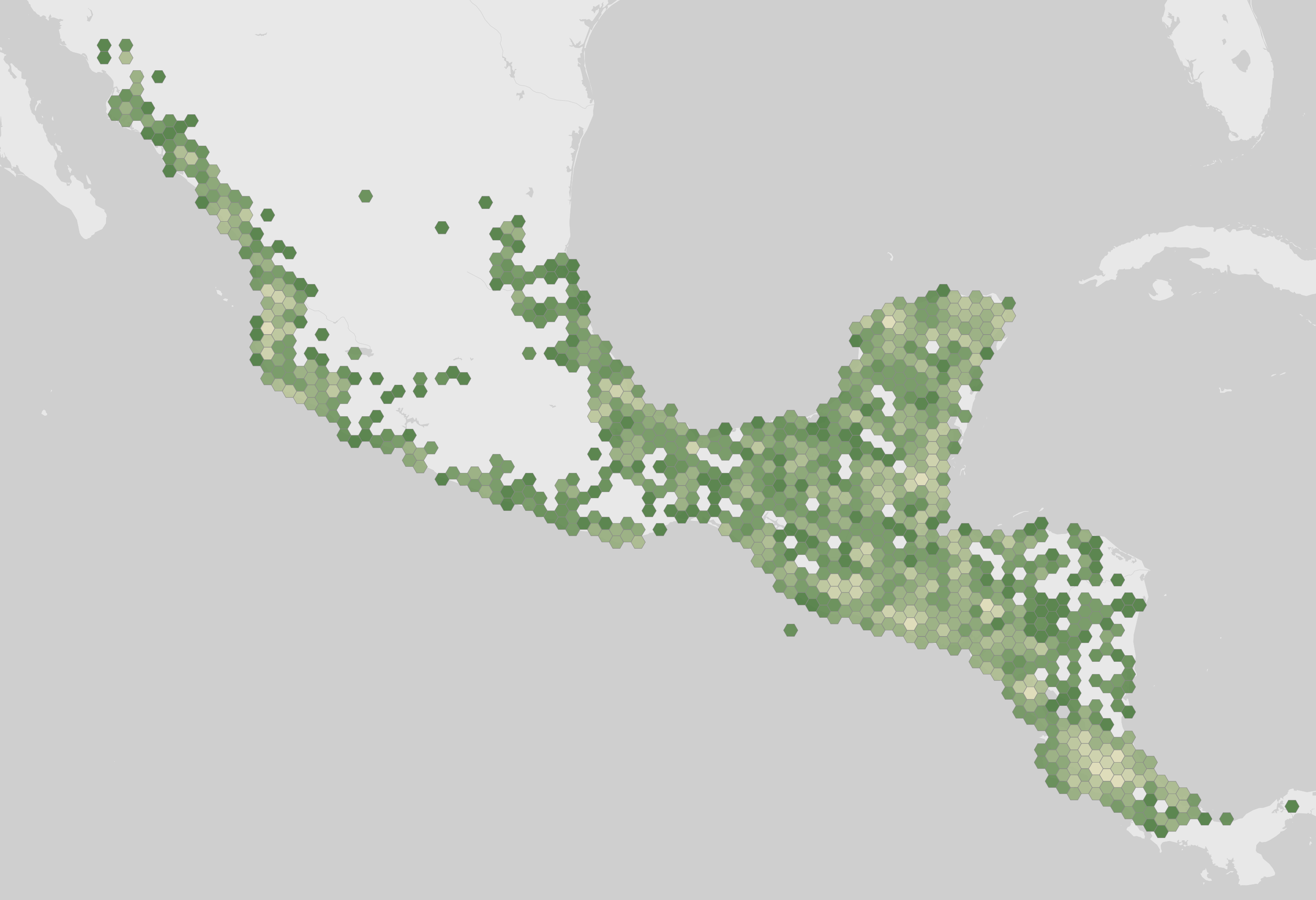
The cinnamon-bellied saltator occupies a very large range, estimated at 743,000 square kilometers, spanning Mexico south through Belize, Guatemala, Honduras, Nicaragua, and Costa Rica, with some sources extending the range into Panama. Six subspecies occupy distinct portions of this range, from northwestern Mexico's Sonora and Jalisco through the Yucatán Peninsula and down both the Pacific and Caribbean slopes of Central America. Notably, the species bypasses most of the Yucatán Peninsula itself, which is instead occupied by the distinct subspecies S. g. yucatanensis.
It uses a wide range of landscapes, from drier semideciduous or deciduous vegetation to humid evergreen habitats. It favors forest edges, watercourses, and other semi-open settings, including plantations, gardens, and urban parks, reflecting its comfort near human activity. Elevation range generally runs from sea level to 1,500 m, though it reaches that upper limit in northern Central America between Mexico and Nicaragua and in Costa Rica.
Monthly observation counts show relatively steady presence through the year with a mild rise in spring months, consistent with its status as a year-round resident rather than a migrant.
Behavior and Lifestyle
The cinnamon-bellied saltator is a year-round resident across its range, showing no seasonal migration. Its sedentary lifestyle allows it to maintain consistent use of forest edges and semi-open habitats throughout the year.
Its insessorial lifestyle means it is adapted to perching and moving through vegetation at various levels rather than covering long distances in flight, fitting its habit of foraging at all levels of its habitat from ground to canopy.
Communication
Its whistled song is the species' most conspicuous form of communication, described as a three- or four-part series ending in a long, clear upslurring whistle rendered as "teeut-peeur-weeeeeeeet!" Another description characterizes it more simply as a pleasant whistled phrase that ends on a rising note.
This rising, whistled phrase likely serves to advertise territory and presence within its forest-edge and semi-open habitats, carrying well through the dense or scattered vegetation it favors.
Diet and Nutrition
The cinnamon-bellied saltator eats a mixed diet of fruits, other plant material such as flowers and nectar, and insects, changing its foraging approach as it moves through different microhabitats. It forages at all levels of its habitat, from the ground up through the canopy, taking advantage of whatever food sources are available at each level.
It typically forages alone or in small groups, and it sometimes joins mixed-species feeding flocks, a strategy that can improve foraging efficiency and predator detection while searching for fruit, flowers, and insects.
Nesting and Breeding
Breeding occurs between April and August across most of the species' range. Nests are large cups built from twigs and leaves and lined with rootlets and plant fibers, typically placed between 1.5 and 4 m above the ground and well concealed within a shrub or tree.
Clutches contain two to five eggs; in Mexico and Costa Rica these are bright blue with black markings. The incubation period has not been documented, but at one recorded nest the brood fledged just 15 days after hatching.
Conservation and Threats
The IUCN has assessed the cinnamon-bellied saltator as Least Concern, reflecting its very large range and generally stable population, even though exact population size remains unknown. No immediate threats have been identified across its range.
The species is considered common in northern Central America, though its status varies regionally within countries. In Costa Rica, for example, it is fairly common in the Central Valley and parts of the Caribbean lowlands, less common on the Pacific slope, and rare around the Gulf of Nicoya. It occurs in protected areas across most of the countries within its range, which helps support its continued stability.
Fun Facts
- The species' range runs from forest edge and scrub in lowlands to hills, stretching along the Pacific slope of Mexico from southern Sonora to Oaxaca and along the Caribbean slope from southwestern Tamaulipas through the Yucatán Peninsula to central Panama.
- It carries several regional names in Spanish, including pepitero ventricanelo, pepitero grisáceo norteño, saltador ventricanelo, saltador gris mesoamericano, and dichosofuí.
Photos
Photographs from via iNaturalist, licensed under CC0 1.0., by Javier Hernandez via iNaturalist, licensed under CC BY 4.0., by Infanzon Yuseimi via iNaturalist, licensed under CC BY 4.0., by James Heal via iNaturalist, licensed under CC BY 4.0., by Amber M. King via iNaturalist, licensed under CC BY 4.0., by Carlos Domínguez-Rodríguez via iNaturalist, licensed under CC BY 4.0., by Arturo Benavides Mendoza via iNaturalist, licensed under CC BY 4.0., by Anthony Batista via iNaturalist, licensed under CC BY 4.0., by Alfonso Xavier Rolon Perez via iNaturalist, licensed under CC BY 4.0., by Chris Ratzlaff via iNaturalist, licensed under CC BY 4.0., by Aaron Liston via iNaturalist, licensed under CC BY 4.0., by josebarrientos via iNaturalist, licensed under CC BY 4.0., by Thomas Ebner via iNaturalist, licensed under CC BY 4.0., by Tristan Jobin via iNaturalist, licensed under CC BY 4.0., and by Quinn via iNaturalist, licensed under CC BY-SA 4.0., credited on each photo.
Ecology and classification
Classification
- Phylum
- Chordata
- Class
- Aves
- Order
- Passeriformes
- Family
- Thraupidae
- Genus
- Saltator
- Species
- Saltator grandis
Sources
- GBIF Species names and classification
- iNaturalist Photos
- Wikidata Common names and conservation status
- Wikipedia Summary extract
- AVONET Bird mass, habitat, migration, diet and range size