With a bill that looks dipped in silver, the silver-beaked tanager cuts a striking figure against its own jet-black-and-crimson plumage. This medium-sized songbird of the tanager family Thraupidae is found across nearly all of mainland South America east of the Andes, from eastern Colombia and Venezuela south to Paraguay and central Brazil, plus Trinidad, with only a vagrant record reaching Argentina.
Classified as Least Concern by the IUCN, the species thrives even in disturbed and human-altered landscapes, making it one of the more familiar and conspicuous birds across much of its huge range.
Identification and Appearance
The most useful field mark is the bill itself: males show a dark blue-gray upper bill paired with a silvery white lower bill tipped in black, a combination unlike most other tanagers. Females, by contrast, have an entirely brownish dusky bill.
At 16 to 17 centimeters long and weighing between 21 and 37.5 grams, this is a compact, heavy-billed bird with a wide-based mandible. Adult males of the nominate subspecies R. c. carbo have a deep carmine head, neck, and throat with a plush texture, carmine-black upperparts, dusky black flight feathers and tail, and a rich deep crimson breast fading to black with a crimson tinge on the belly and undertail coverts.
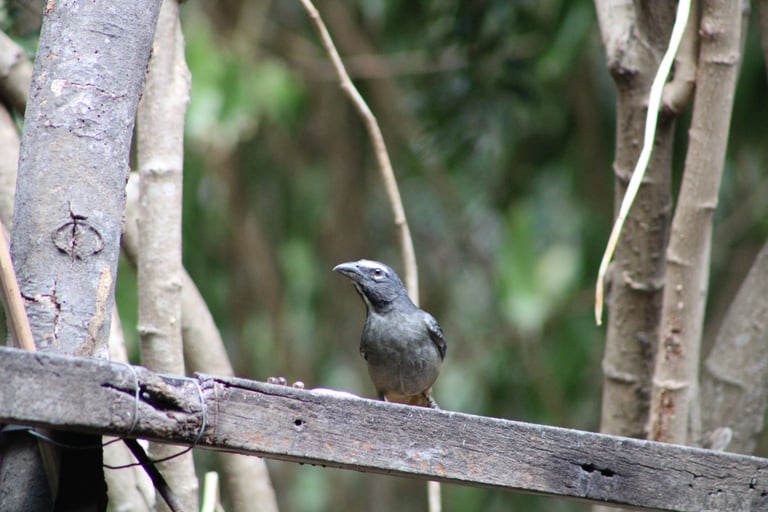
Females look quite different, with a rich dark rusty-red head and upper back, a redder lower back and rump, dusky wings edged in rufescent brown, and underparts that range from reddish brown to warm brown with a grayish wash on the breast. Immature birds resemble the duller females rather than the plush-red males.
Eight subspecies vary subtly in brightness and pattern: R. c. atrosericeus is the darkest, appearing mostly velvety black with a dark scarlet head and upper breast, while R. c. unicolor shows a brighter red head and more uniform upperparts. R. c. magnirostris stands out with a notably larger, heavier bill and more white on the male's mandible. Both sexes of every subspecies share a reddish brown iris and dark horn-gray legs.
Distribution and Habitat
The silver-beaked tanager occupies an extremely large range across northern and central South America east of the Andes, spanning from southeastern Colombia and eastern Ecuador through Peru, Venezuela, the Guianas, and much of Brazil south into Paraguay, with a population on Trinidad as well. Its range covers roughly 10,500,000 square kilometers, and it turns up as a vagrant in Argentina.
The species favors semi-open, often human-altered landscapes: forest edges and clearings, secondary forest, open woodlands, areas near human habitation, and shrubby growth along watercourses. In Brazil it is frequently found close to water.
Elevation limits shift by region. North of the Orinoco River in Venezuela it reaches 1,900 meters, dropping to 1,250 meters south of the river, while in Brazil it tops out around 1,000 meters. It reaches higher ground in the Andes-adjacent countries, up to 1,200 meters in Colombia, 1,100 meters in Ecuador, and 1,800 meters in Peru.
Monthly observation counts show activity across all months without an obvious single peak, consistent with its status as a year-round resident rather than a migrant.

Behavior and Lifestyle
As a sedentary, year-round resident, the silver-beaked tanager does not migrate, instead remaining within its home range throughout the year. Its insessorial lifestyle centers on perching and moving through semi-open vegetation and forest edges.
Longevity data from a Brazilian study recorded an individual living more than 11 years, an unusually long lifespan that points to a stable, low-risk daily routine for a bird of this size.
Communication
The song is described as a quiet, wheezy, repetitive series of short phrases, rendered as chichi churee-chew chi-chi churee-chew or alternatively as tchu-wee tchu-wee chyeét, both semimusical and simple in structure.
Calls include a thin, rising wheezy zweet, a frequently heard hard metallic chep, and a loud tchink that is often doubled. These varied calls likely serve different functions, from contact within foraging groups to alarm or spacing signals.
Recordings
call · Ecuador · Niels Krabbe · CC BY-SA
song · Ecuador · Niels Krabbe · CC BY-SA
Diet and Nutrition
The silver-beaked tanager forages in noisy, conspicuous groups of ten or more individuals, working from the ground up to about 12 meters, though it will climb into fruiting trees as high as 25 meters. This group foraging style makes it an omnipresent and easily noticed bird wherever it occurs.
Its diet splits roughly evenly between animal and plant foods where studied. Arthropods make up a major share, with a Trinidad study finding 77% of insect prey taken from foliage, 13% from grass and weeds, 7% snatched in mid-air, and the remainder from branches and other substrates.
On the plant side, fruit is a staple, with Melastomataceae berries a particular favorite, and the bird occasionally takes flowers and nectar as well.
Nesting and Breeding
Breeding timing varies widely across the species' huge range rather than following one fixed season. Nesting spans at least January to March in Colombia, December to September on Trinidad, December to August in Suriname, and September to February in northeastern Brazil, with additional records in April and May in Venezuela, July and August in French Guiana, and November in Mato Grosso.
Pairs sometimes nest semi-colonially, building nests close together without defending them against neighboring pairs, and the species also sometimes breeds cooperatively. The nest itself is a deep, bulky cup of dead leaves and plant fibers, typically placed in a bush between 1 and 3 meters above the ground.
The usual clutch holds two greenish to bluish eggs marked with dark blotches, though clutches of one or three occur. In a Brazilian study, the female alone incubated the eggs for 11 to 13 days, and the young fledged 11 to 12 days after hatching, with both parents provisioning the nestlings.
Conservation and Threats
The IUCN lists the silver-beaked tanager as Least Concern, reflecting an extremely large range and a population believed to be stable, even though its exact size is unknown. No immediate threats have been identified.
The species is described as common across much of its range: common in Colombia, common and conspicuous in Ecuador, widespread and common in Peru, common in Venezuela, and common to frequent in Brazil. It occurs in numerous protected parks and preserves while also thriving in vast areas of unprotected but suitable habitat.
Its tolerance for many kinds of second growth and disturbed habitat buffers it against potential threats and allows it to expand as forests are opened and settled, a flexibility that sets it apart from many forest-dependent birds facing habitat loss.
Fun Facts
- Foraging groups of silver-beaked tanagers can number 10 or more birds moving together through the vegetation, noisy and conspicuous wherever they go.
- One individual tracked in a Brazilian study lived more than 11 years, an unusually long recorded lifespan for the species.
- The bird's bill is a two-toned tool: males sport a dark blue-gray upper half paired with a silvery-white lower half tipped in black.
Photos
Photographs from via iNaturalist, licensed under CC0 1.0., by William Stephens via iNaturalist, licensed under CC BY 4.0., by avocat via iNaturalist, licensed under CC BY 4.0., by Conrado Pável de Oliveira via iNaturalist, licensed under CC BY 4.0., and by Nicolas Olejnik via iNaturalist, licensed under CC BY 4.0., credited on each photo.
Ecology and classification
Classification
- Phylum
- Chordata
- Class
- Aves
- Order
- Passeriformes
- Family
- Thraupidae
- Genus
- Ramphocelus
- Species
- Ramphocelus carbo
Sources
- GBIF Species names and classification
- iNaturalist Photos
- Wikidata Common names and conservation status
- Wikipedia Summary extract
- Xeno-canto Audio recordings
- AVONET Bird mass, habitat, migration, diet and range size
- GloBI What it eats, what eats it, parasites and pollinators
- SquamataBase