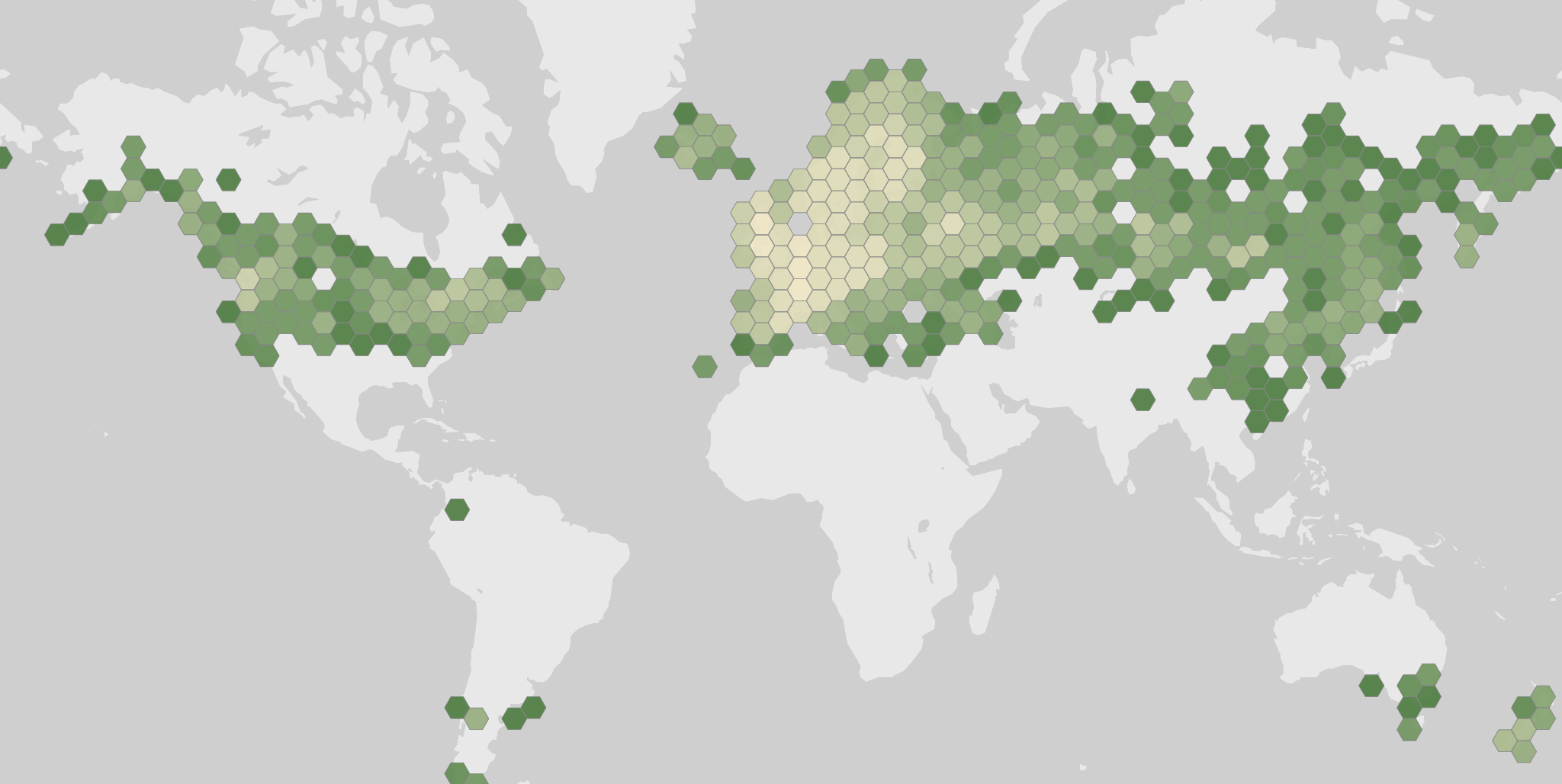
Few broadleaved trees in Europe push as far north as Sorbus aucuparia, which reaches latitude 70° in Norway and grows at the very edge of the Arctic tree line, often as the only deciduous tree among stunted krummholz. Commonly called rowan or mountain-ash, it is a deciduous tree or shrub in the rose family (Rosaceae) found across almost all of Europe, the Caucasus, and into Siberia, and it has also naturalized successfully from Washington to Alaska and across eastern Canada and the northeastern United States. The IUCN lists it as Least Concern, reflecting its wide range and tolerance of harsh conditions.
What makes rowan worth a closer look is how many roles it plays at once: pioneer tree on cleared or burned ground, lifeline for dozens of bird species through the winter, and a plant wrapped for centuries in European folklore as a guardian against misfortune. Few trees combine such ecological versatility with such a deep cultural footprint.
Identification and Appearance
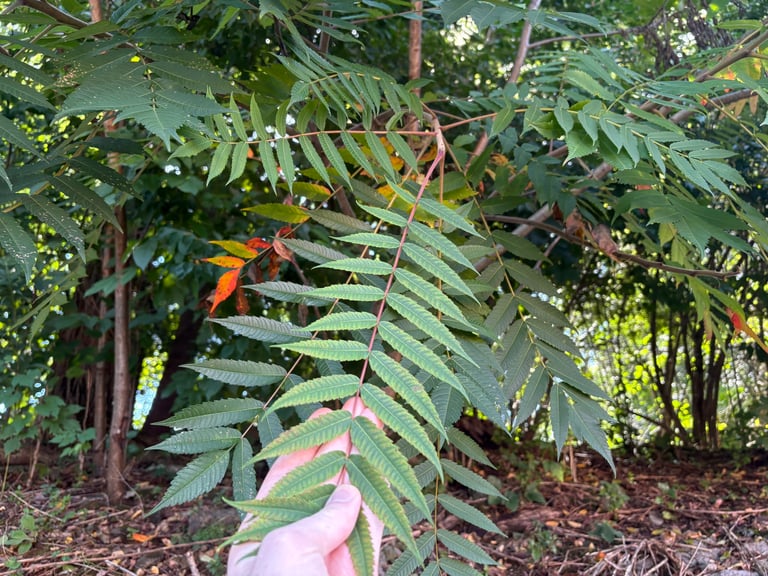
The clearest field mark separating rowan from superficially similar trees is its alternate, pinnate leaves with paired stipules at the leaf base — a detail that immediately distinguishes it from ash (Fraxinus excelsior), whose compound leaves are opposite and lack stipules. Each leaf carries four to nine pairs of sharply serrated, lance-shaped leaflets plus a terminal leaflet, reaching up to 20 cm long and 8 to 12 cm wide overall; young leaflets are covered in grey-silvery hairs and smell faintly of marzipan when crushed.
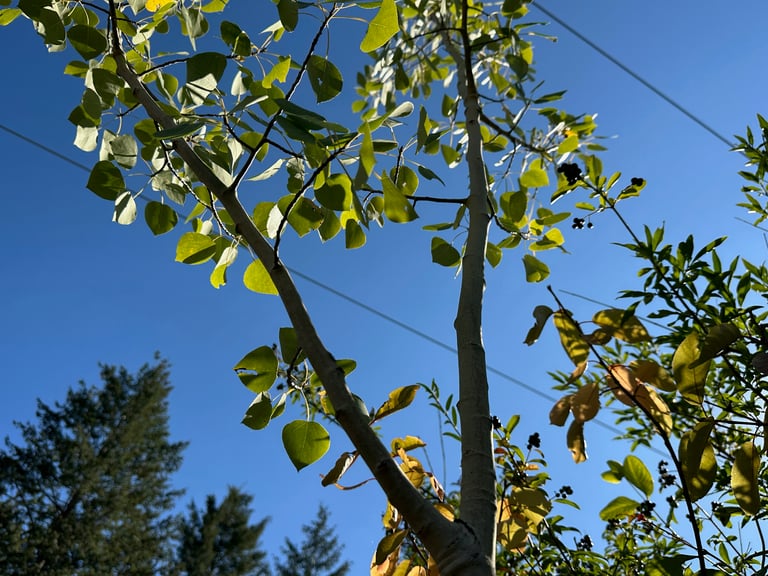
Mature trees typically stand 5 to 15 meters tall, occasionally to 20 meters, and exceptionally to 28 meters, with a loose, roundish or irregular crown and a slender trunk up to 40 cm in diameter that often splits into multiple stems. Young bark is yellowish-grey and glossy, aging to grey-black with longitudinal cracks and small flaking scales; bright ochre lenticels run in elongated streaks along it.
From May to June the tree produces large, upright corymbs holding roughly 250 small yellowish-white flowers, each 8 to 10 mm across with five petals and up to 25 stamens, but carrying an unpleasant trimethylamine odor rather than a pleasant scent. By August through October these mature into round pomes 8 to 10 mm wide, green at first and ripening to orange or scarlet, each marked on top by the five persistent black sepals forming a small star — a reliable identification feature once fruit has set.
The five recognized subspecies differ mainly in hairiness and fruit shape: subsp. glabrata is nearly hairless and found in northern Europe and central European mountains, subsp. praemorsa has hairy leaflets and ovoid fruit restricted to southern Italy, Sicily, and Corsica, and subsp. sibirica is nearly glabrous and confined to northeastern Russia.
Distribution and Habitat
Rowan occupies nearly the whole of Europe and the Caucasus, extending through northern Russia into Siberia, though it is absent as a native from southern Spain, southern Greece, Sardinia, the Balearic Islands, the Azores, and the Faroe Islands. Introduced as an ornamental in North America, it has naturalized vigorously from Washington to Alaska and eastward across Canada into the northeastern United States.
The species tolerates an unusually broad range of conditions: it withstands shade, frost, winter drought, short growing seasons, wind, snow pressure, and even air pollution. It grows on soils from stony or clay ground to sandy soil or wet peat, generally favoring acidic, low-nutrient, well-drained sites, though it performs best on fresh, loose, fertile ground and avoids saline or waterlogged soil. This adaptability lets it colonize as a pioneer on fallen dead trees, in clearcuts, on forest edges, along roadsides, and even on inaccessible rock faces, ruins, branch forks, or hollow trees, since its seeds germinate readily almost anywhere they land. In Scotland, this trait lets rowan grow on cliffs, steep stream-banks, and boulder tops out of reach of browsing red deer.
Elevation-wise, the tree is widespread from lowland plains up to the tree line, reaching 2,000 meters in the Alps and appearing north of the boreal forest at the Arctic tree line, including as far as 71° north in Norway. Exceptional individuals include a 28-meter specimen with a 56 cm trunk diameter in the Chiltern Hills of southeast England, and an 18-meter tree at Glenstal Abbey in County Limerick, Ireland.
Monthly observation counts from GBIF, which reflect recorder activity rather than true abundance, rise sharply from spring, peak in July at nearly 235,000 records, and stay high through August and September before falling off by late autumn. This pattern likely tracks the tree's conspicuous flowering in late spring and its ripening, brightly colored fruit through summer and early autumn, rather than any real change in population size.
Ecology and Relationships
Bees and flies pollinate the flowers, while the ripe berries feed an unusually wide circle of wildlife: around 60 bird species and several mammals rely on the fruit, with thrushes and other songbirds — including Bohemian waxwing, blackbird, fieldfare, and redwing — feeding on it from late summer into winter. Because the seeds pass through birds' digestive tracts undigested, this feeding relationship also disperses the species, seeding new rowans wherever droppings fall. Cloven-hoofed mammals such as deer, sheep, and cattle browse the fruit and sometimes the foliage and bark, while red fox, European badger, dormouse, and squirrel also take the berries.
Below ground, rowan roots form symbioses mainly with arbuscular mycorrhizal fungi and occasionally with ectomycorrhizal fungi, an association that helps the tree establish on poor or disturbed soils. Ecologically it behaves as an early colonizer, often growing alongside red-berried elder, goat willow, Eurasian aspen, and silver birch before being overtopped and replaced by larger, longer-lived forest trees; it is fire-intolerant and does not build up much litter.
The species hybridizes readily with other Sorbus species and with the related genus Aria, producing offspring now classified under the genus Hedlundia, such as Hedlundia hybrida and Hedlundia thuringiaca. Its main pests include the apple fruit moth (Argyresthia conjugella) and the rowan berry-borer (Hoplocampa alpina), while the rust fungus Gymnosporangium cornutum causes leaf galls; several moth larvae, leaf miners of the genus Stigmella, and the snail Cornu aspersum also feed on its leaves, and the tree is susceptible to fire blight.
Uses and Human Relationships
Across Celtic and Norse tradition, rowan carried a reputation as a protective tree: it was called the "wayfarer's tree" or "traveller's tree" for its supposed power to guard those on a journey, and it was considered sacred to Brigid, the Celtic goddess of hearth, healing, and poetry. In Norse mythology it was linked to the god Thor, who was said to have saved himself from drowning in an underworld river by grasping a branch of the tree bent over the water.
The fruit itself is bitter, astringent, laxative, and diuretic to humans, and its parasorbic acid can irritate the stomach lining if eaten in quantity, though it is rich in vitamin C. Debittering by freezing, cooking, or drying breaks down the parasorbic acid and makes the berries usable for jelly, jam, syrup, chutney, juice, wine, liqueurs, tea, and flour, traditionally harvested in October after the first frost; in Austrian folk medicine the fruit has been used as tea, syrup, jelly, or liqueur for respiratory ailments, fever, colds, rheumatism, and gout. The oldest Finnish candy still made today, Pihlaja, takes its name from and originally contained rowanberries.
Breeding efforts produced sweeter, larger-fruited varieties, starting with a form discovered near Ostružná in Moravia in 1810 and continuing through cultivars such as 'Konzentra' and 'Rosina', selected in Saxony from the 1940s for juicing and preserves, and Russian hybrids like 'Burka' and 'Titan' bred by Ivan Vladimirovich Michurin from 1905. Beyond its fruit, rowan's tough, elastic wood has long been used for cartwright's work, turner's work, and woodcarving, usable from trees as young as 20 years old.
Fun Facts
- In Norse legend, the god Thor was said to have saved himself from drowning in an underworld river by grabbing hold of a rowan branch bending over the water.
- Celtic tradition considered the tree sacred to Brigid, goddess of hearth, healing, and poetry, and treated it as a guardian for travelers, giving rise to the old name "wayfarer's tree."
- The tree has also been called the "Tree of Life," credited in folklore with offering protection, resilience, and renewal.
- Rowan's young leaflets release a scent like marzipan when crushed between the fingers.
Conservation status
- LC
- NT
- VU
- EN
- CR
Least Concern
Ecology
Habitat
- Forest
- Woodland
- Mountain
- Disturbed Ground
Growth habit
- Tree