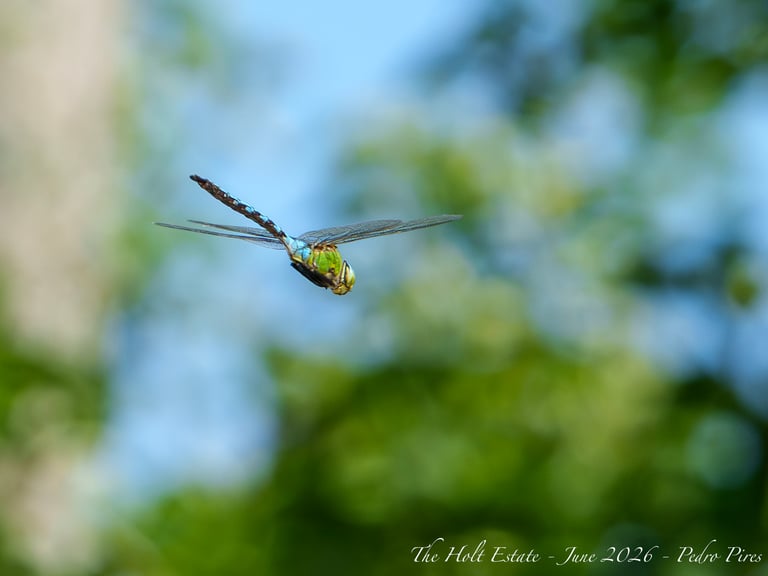
The Southern Hawker often flies straight toward people out of pure curiosity, hovering an arm's length away before veering off—an almost fearless approach rare among dragonflies.
Aeshna cyanea, known as the southern or blue hawker, belongs to the hawker family Aeshnidae within the order Odonata. It ranges across most of Europe, from Scotland and southern Scandinavia to Italy and the northern Balkans, and is classified as Least Concern by the IUCN.
Beyond its wide range, the species stands out for its bold green-and-blue markings and its habit of patrolling garden ponds with fierce determination, making it one of the easiest large dragonflies to observe up close.
Identification and Appearance
The clearest field mark is the black, T-shaped spot on the forehead, set against a brown thorax marked with two broad, ante-humeral green stripes running lengthwise.
This is a large dragonfly, with a body length of about 70 millimeters (2.8 inches) and a wingspan reaching 110 millimeters (4.3 inches). The wings are clear (hyaline) with a dark pterostigma and a dark leading edge.
Males show a dark abdomen patterned with bright apple-green markings, except on segments S8 to S10 near the tip, where the markings turn pale blue and merge into a continuous band. Females have a browner abdomen with the same bright green pattern but lack the blue tip coloring.
Eye color also separates the sexes: males have eyes that shift from green at the base to blue or greenish-blue at the top, while females show yellowish-green or brownish eyes throughout.
Distribution and Habitat
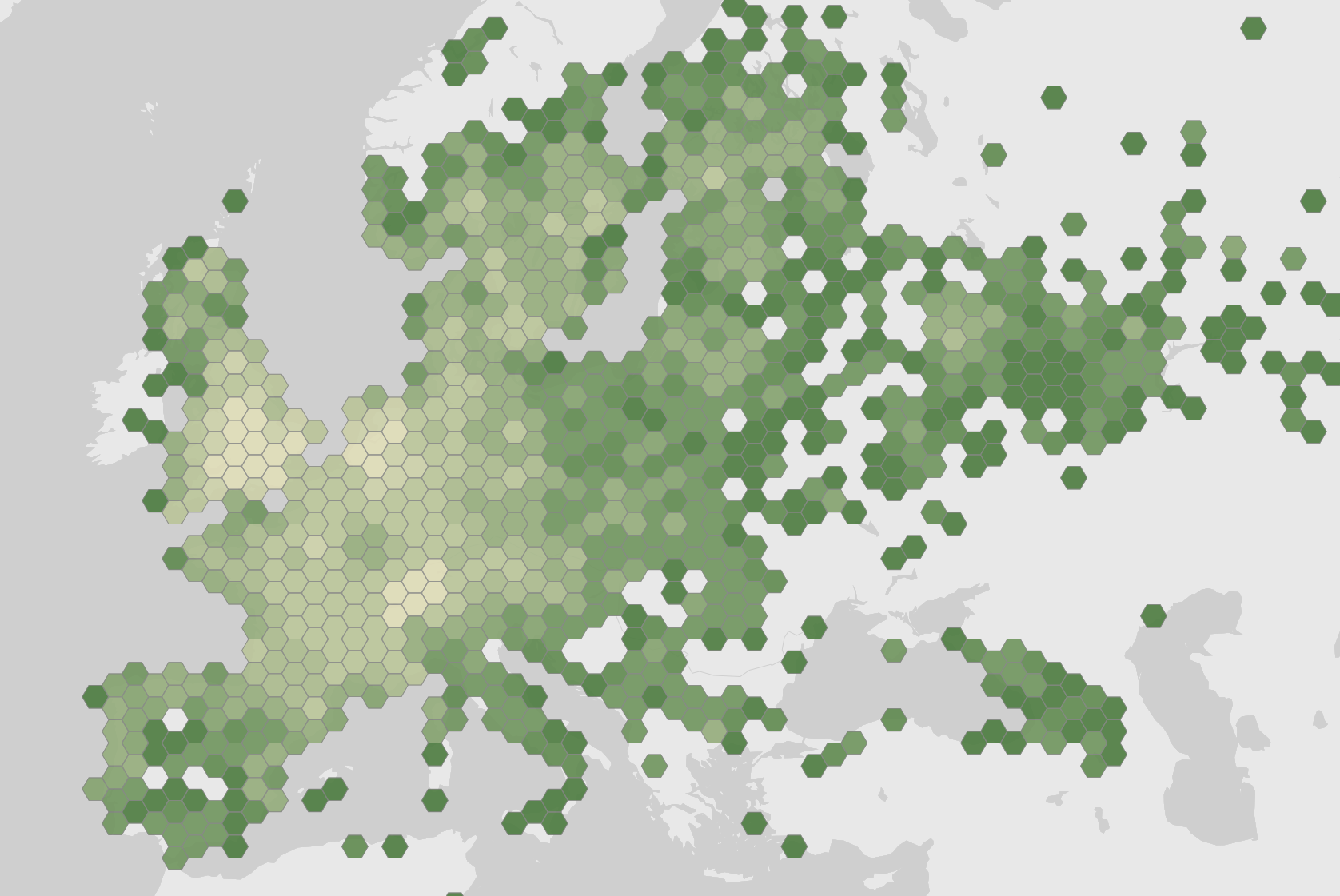
Aeshna cyanea is one of the most common and widespread dragonflies in Europe, with a range spanning from Ireland in the west to the Ural Mountains in the east. It reaches Scotland and southern Scandinavia in the north and extends south to Italy and the northern Balkans, with an outlying population in Algeria in northwest Africa. The species is especially common across Central Europe.
It favors well-vegetated, small ponds, including garden ponds, but adults wander widely and are frequently seen in gardens and open woodland far from water.
Monthly observation data show activity concentrated between June and September, peaking in August, which lines up with the species' known flight period; these are presence records only and do not measure population size or abundance.
Behavior and Lifestyle
Adults fly from June to October, with occasional sightings in May and November, and hunt other insects on the wing rather than from a perch.
Males patrol pond edges and slow rivers, defending territory by crashing into rival males and spiraling through the air until one withdraws. Females are far less conspicuous while egg-laying, often revealed only by the clatter of reeds as they climb up from the water's edge.
Eggs are jabbed into rotting vegetation or wood near the water in summer or autumn and hatch the following spring. The nymphs then spend two to three years underwater, feeding on aquatic insects, small tadpoles, invertebrates and even small fish before emerging as adults in July and August.
Despite its size and predatory habits, the Southern Hawker poses no threat to people. The cerci at the tip of its abdomen are sometimes mistaken for a stinger or claws, but dragonflies have no ability to sting, and this species—males especially—is simply inquisitive, often flying close to humans in parks, fields and streets without any aggression.
Cultural Significance
The species name cyanea derives from the Greek word for dark blue, an allusion to the blue tones in its coloring. In Greek mythology, the nymph Cyane—whose name shares this same root—attempted to stop Hades from abducting Persephone, a story recounted in Ovid's Metamorphoses.
Beyond this etymological echo, the name has left little mark on literature or popular culture, and the species itself is not tied to specific folklore or traditional uses beyond its recognition among naturalists and pond-watchers across Europe.
Fun Facts
- The genus and species name references the Greek word for "dark blue," a nod to the nymph Cyane from Ovid's Metamorphoses.
- Its wingspan can reach 110 millimeters (4.3 inches), making it one of the larger dragonflies in its range.
- The black T-shaped mark on its forehead is a quick way to distinguish it from similar hawker species.
- Nymphs live underwater for two to three years before emerging as adults, feeding on invertebrates, tadpoles and even small fish.
- People sometimes mistake the cerci at the tip of its abdomen for a stinger, but dragonflies cannot sting at all.
- Its curiosity often brings it flying within an arm's length of people, even far from its home pond.
Conservation status
- LC
- NT
- VU
- EN
- CR
Least Concern
Ecology
Habitat
- Wetland
- Woodland
- Freshwater
- Urban
Behavior
- Predator
- Territorial
- Diurnal
- Semi-aquatic
Diet
- Insectivore