Stropharia cyanea, widely known as the blue roundhead, stands out for a cap color that shifts from pale blue-green to yellowish-green as it ages and dries, often fading quickly from its original vivid tone. It is a saprophytic fungus in the family Strophariaceae, growing across Europe and North America in meadows, roadsides, hedgerows, gardens, and woodchip mulch.
Its underground mycelial networks, which forage for nutrients through cord-like structures, make it a fungus worth knowing beyond its striking coloration.
Fruiting Body and Identification
The most reliable identifying feature is the cap's blue-green to yellowish-bluish green coloration, which fades with age and moisture, often leaving a whitish zone around the margin that retains bluish-green tints. The cap is conical to flattened, measuring 2 to 7.5 centimeters across, usually with a low, broad umbo. When moist it becomes sticky with a peelable cuticle; dry caps turn smooth and shiny.
The gills start pale purplish-brown and darken to brown as the spores mature, attaching to the stipe in an adnate or sinuate fashion. The stipe carries a short-lived ring zone: smooth above it, fibrous and scaly below. The flesh is colorless, sometimes tinged blue in the cap and stipe, with no distinctive odor or flavor. The spore print is brown, with ellipsoid to oblong spores measuring 8.0 to 9.0 by 4.0 to 5.5 micrometers.
Several greenish Stropharia species can be confused with this one.
Distribution and Habitat
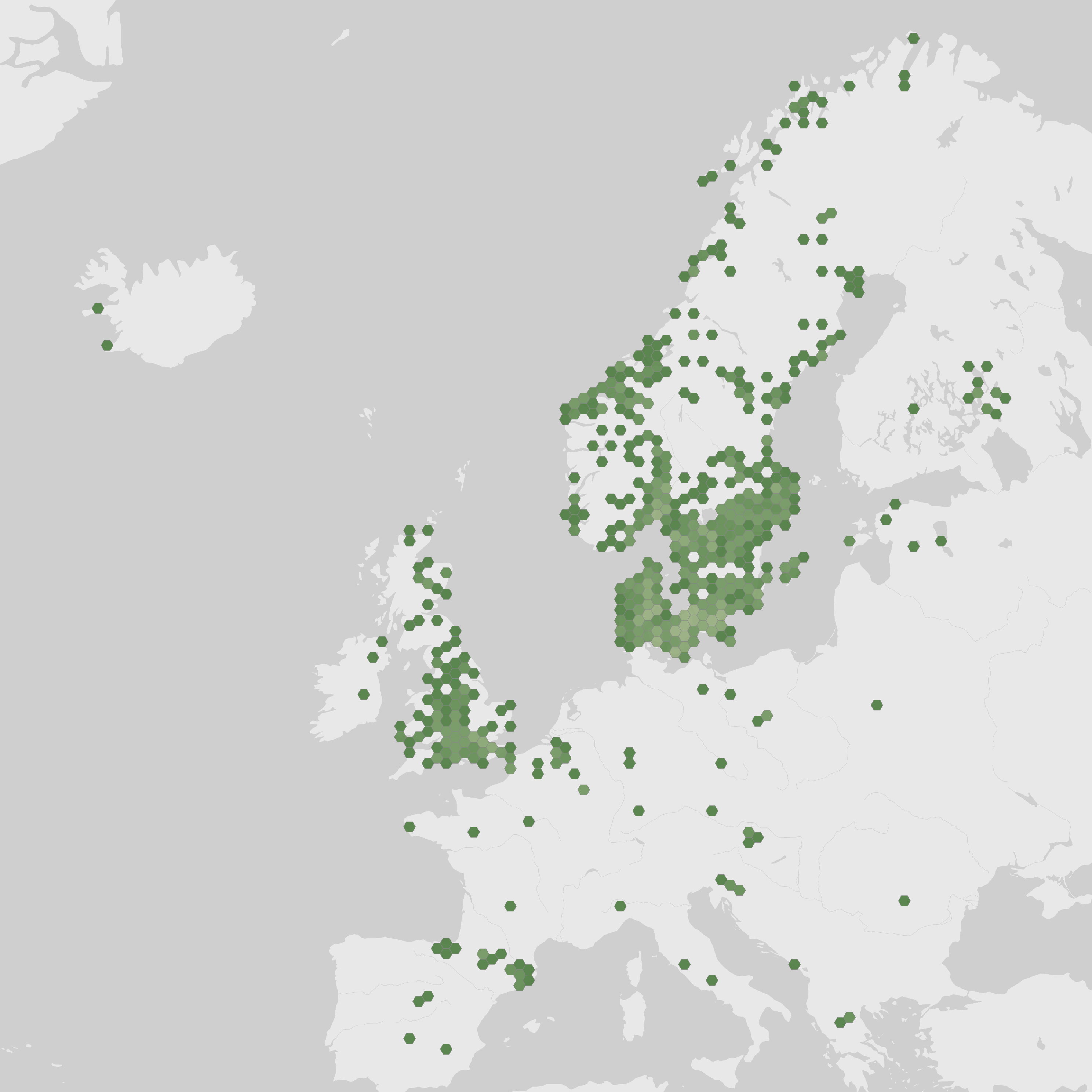
Stropharia cyanea is common throughout Europe, where it grows singly or in groups on meadows, roadsides, hedgerows, gardens, and woodchip mulch, and is often found in beech woods on alkaline soil. In Europe it fruits from July to November; in North America, where it also occurs but whose full range there remains unclear, it typically fruits from August to October.
Monthly observation data shows a sharp concentration of records in the late summer and early autumn months, consistent with its known fruiting season, though these figures reflect presence observations rather than actual abundance or a complete picture of its range.
The fungus forms mycelial cords, dense rootlike masses of hyphae that build extensive underground networks for moving nutrients and foraging. These networks often associate with the stems and rhizomes of common nettle. The mycelium grows in a fractal pattern with a dense, slow-extending front suited to finding nutrients spread evenly through the soil, a strategy known as short-range foraging. Increased soil nitrogen or phosphorus boosts this fractal branching, letting the fungus take up more nutrients.
Uses and Cultural History
The mycological history of Stropharia cyanea includes a naming lineage tied to the Greek nymph Cyane, whose name derives from the Ancient Greek word for dark blue, reflecting the mushroom's coloration.
Fun Facts
- The species name traces back to Cyane, a Sicilian nymph in Greek mythology who tried to stop Hades from abducting Persephone, her playmate.
- Though formally described to science only in 1979, the fungus had been recognized as a distinct species for roughly two centuries beforehand.
- The name Stropharia cyanea, coined by Tuomikoski in 1953, continues to be used by some authors as a synonym for Stropharia caerulea.
Photos
Photographs from via iNaturalist, licensed under CC0 1.0., by pietrasagh via iNaturalist, licensed under CC BY 4.0., by sukhorukov_andrey via iNaturalist, licensed under CC BY 4.0., by Artem Abdukakharov via iNaturalist, licensed under CC BY 4.0., by lizfrost47 via iNaturalist, licensed under CC BY 4.0., by Anita Engler via iNaturalist, licensed under CC BY 4.0., and by Matt D'Agrosa via iNaturalist, licensed under CC BY 4.0., credited on each photo.
Ecology and classification
Classification
- Phylum
- Basidiomycota
- Class
- Agaricomycetes
- Order
- Agaricales
- Family
- Strophariaceae
- Genus
- Stropharia
- Species
- Stropharia cyanea
Sources
- GBIF Species names and classification
- iNaturalist Photos
- Wikidata Common names and conservation status
- Wikipedia Summary extract