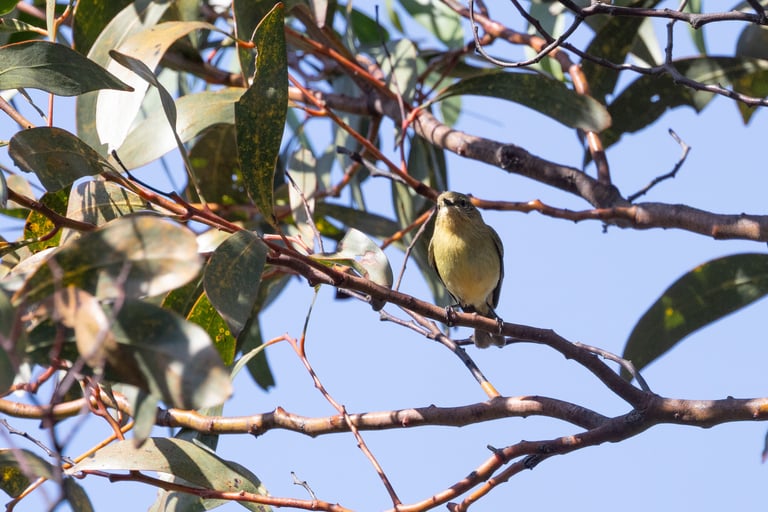
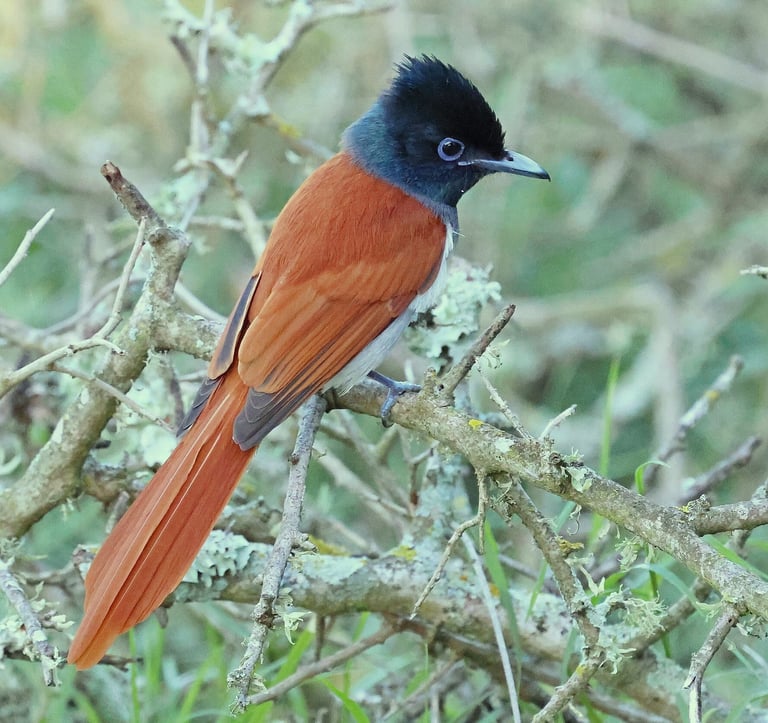
The blackcap and its closest relative, the garden warbler, look quite different but sing a similar song. The Eurasian blackcap is a common and widespread warbler in the Sylvidae family, and it lives across much of Europe and western Asia. It has mainly olive-grey upperparts and pale grey underparts, and its five subspecies differ only slightly in appearance.
Both sexes carry a neat cap on the head, black in the male and reddish-brown in the female. The male's typical song is a rich, musical warble that often ends in a loud, high-pitched crescendo. Some isolated populations, such as those in Alpine valleys, sing a simpler fluting song instead.
The species is classed as Least Concern by the International Union for Conservation of Nature. Its large range and growing numbers in the north make it a useful subject for understanding how warblers respond to a changing climate.
Identification and Appearance
The adult male's black cap is the single most useful field mark, and it sets the species apart from the other dark-headed Sylvia warblers. Those species, such as the Sardinian and Orphean warblers, have extensive black across the head and are larger, with white edges on the tail.
The nominate subspecies is about 13 cm long, with a wing length of 7 to 8 cm. An adult typically weighs 16 to 25 g, and birds preparing to migrate can reach about as a baseline figure before adding fat, up to 31 g. The upperparts are olive-grey with a paler grey nape, and the underparts are light grey, becoming silvery white on the chin, throat and upper breast. The tail is dark grey with an olive tint along the outer edge of each feather. The bill and long legs are grey, and the iris is reddish-brown.
The female resembles the male but has a reddish-brown cap and browner grey upperparts. Juveniles look like the female, with a slight rufous tinge to the upperparts and an olive wash on the breast and flanks. Young males have a darker brown cap than females of the same age.
Blackcaps moult completely in their breeding areas in August and September, before migrating. Some long-distance migrants add a partial moult between December and March. Birds from the north of the range moult earlier and more briefly than those further south, and captive breeding experiments show that this timing is genetically controlled.
Distribution and Habitat
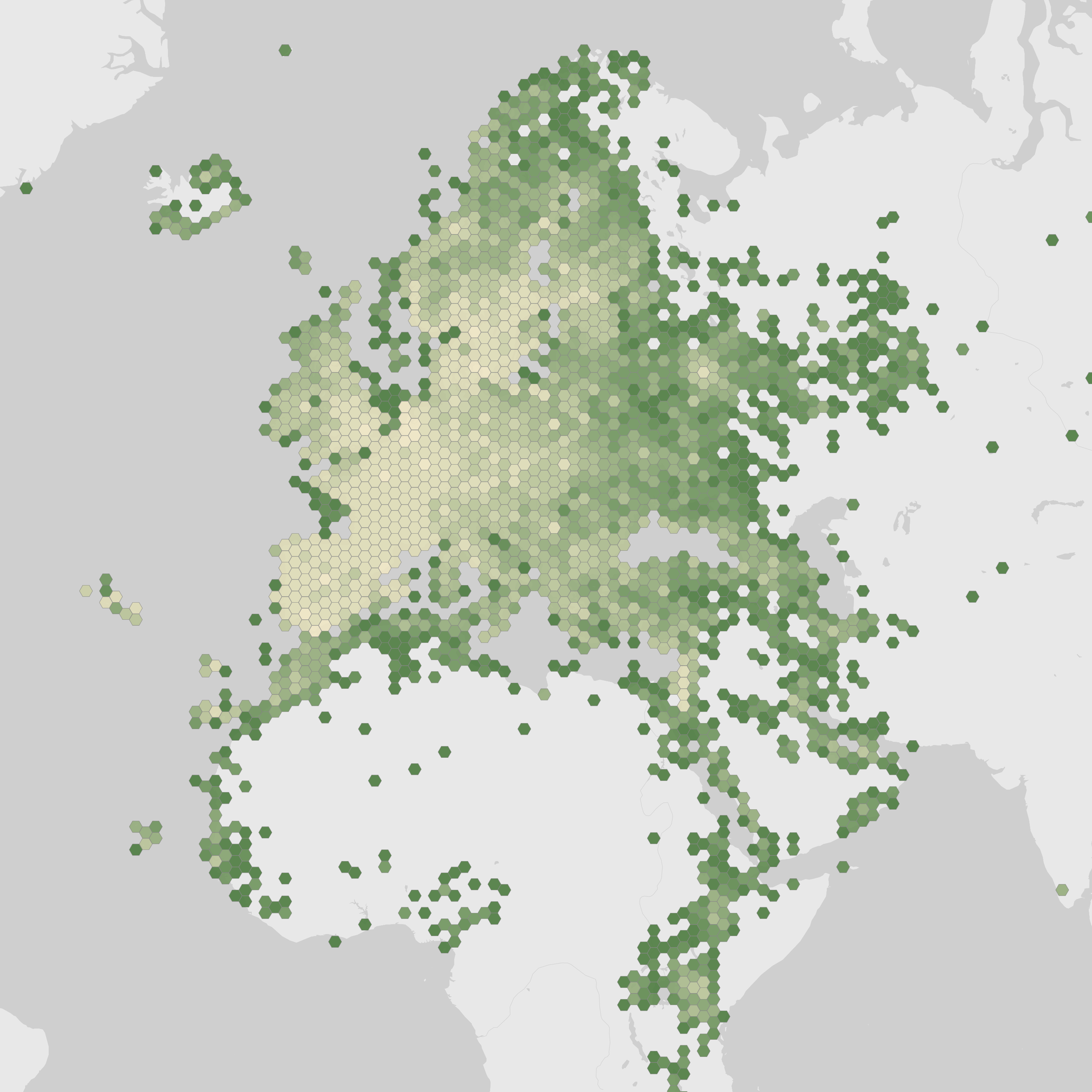
The blackcap breeds across a continental range that lies between the 14 to 30 degree July isotherms, and it covers about in total. The nominate subspecies occupies most of this range. The other forms are restricted to islands or to fringe areas in the Caucasus and eastern Iberia.
Birds on the Mediterranean and Atlantic islands, and in the milder west and south of the main Eurasian range, often winter within their nesting range. Elsewhere the species is migratory. Blackcaps are leap-frog migrants, so birds from the north of the breeding range travel furthest south, while Mediterranean breeders move only short distances. Wintering areas extend across West Africa, East Africa south to Lake Malawi, and parts of Ethiopia, South Sudan and Eritrea.
A migratory divide runs through Europe at about 10 to 11 degrees east. Birds west of this line head southwest towards Iberia or West Africa, while birds to the east travel to the eastern Mediterranean and on to East Africa. Experiments with captive birds show that both the urge to migrate and its direction are genetically determined.
Since the 1980s, a growing number of continental European birds have wintered in gardens in Great Britain and, to a lesser extent, Ireland. Garden feeding provides a steady food supply and a shorter migration, which offsets the cooler British climate. Isotope analysis suggests that most of these birds come from France, with some from as far away as Spain and Poland.
Behavior and Lifestyle
Males return to their breeding areas and establish territories first. Adults usually return to the site they used in earlier summers. Inexperienced birds either wander until they find a suitable area or claim a very large territory that shrinks as neighbours press in.
Boundaries are set by loud singing, with the male raising his crown, fanning his tail and beating his wings slowly. If this display fails, a chase often follows and may end in a fight. Territory size varies widely with food supply. A French study found typical territories of 1.12 hectares, while in insect-rich tall maquis in Gibraltar the average was only 0.16 hectares. Females feed within a home range that can cover up to six times the area of the defended zone.
Blackcaps defend their territories against other Sylvia warblers as well as their own species. Blackcaps and garden warblers use the same habitats in the same woods, yet their territories never overlap because of aggressive encounters. Later studies suggest that other sympatric Sylvia species separate mainly through subtle habitat preferences rather than fighting.
Blackcaps are migratory insessorial birds, which means they forage among foliage and twigs rather than on the ground.
Communication
The male's song is a rich, musical warble delivered in bursts of up to 30 seconds. He repeats the full song for about two and a half minutes, with a short pause before each repetition. The introduction resembles the song of other blackcaps, but its final part is a simple alternation between two fluting notes, similar to the call of a great tit.
The main song is easily confused with that of the garden warbler. The blackcap's version is slightly higher pitched, broken into more distinct segments and less mellow. Both species also give a quiet subsong, a muted version of the full song, which is even harder to tell apart.
Blackcaps sometimes copy the songs of other birds, most often the garden warbler and the common nightingale. Their main call is a hard tac-tac, like stones knocking together. Other sounds include a squeaking, sweet alarm call and a low trill similar to that of a garden warbler. Males sometimes sing while incubating, especially during the second brood, which seems to help maintain the bond with the female. Wintering birds in Africa are quiet at first and begin singing in January or February, before they head north.
Recordings
song · France · Philippe_Grange · Public domain
Diet and Nutrition
Blackcaps are omnivores whose diet changes with the seasons. During the breeding season they feed mainly on insects, with aphids especially important early in the year, and flies, beetles and caterpillars taken in large numbers. Small snails are swallowed whole, and the shell provides calcium for the eggs. Chicks are fed mostly soft-bodied insects, and fruit only when invertebrates are scarce.
Blackcaps mainly pick prey from foliage and twigs, although they sometimes hover, catch insects in flight or feed on the ground. Migrants arriving on their territories may first take berries, pollen and nectar if insects are scarce, then switch to their preferred diet.
From July the diet shifts increasingly to fruit. Fruit sugar replaces the protein needed for egg-laying and chick growth, and it helps the birds fatten for migration. Blackcaps eat many kinds of small fruit, and they squeeze out seeds on a branch before eating the pulp. Elder is an important food for northern birds preparing to migrate, and olives and lentisc are favoured by birds wintering in the Mediterranean.
In British gardens, wintering birds depend largely on supplied food, mainly bread and fat, each making up around 20% of their diet. They also eat cotoneaster fruit, ivy and honeysuckle, and some learn to take peanuts from feeders. In the wild they defend good food sources and at garden feeders they chase off competitors as large as starlings and blackbirds.
Nesting and Breeding
Blackcaps first breed at one year old and are mainly monogamous, although either sex may sometimes deviate from this. The male attracts a female to his territory with song, a display that raises the black crown feathers, fluffs the tail and includes slow wingbeats, and a short flapping flight. He builds one or more simple cock nests near his songpost.
The final nest is a neat cup of roots, stems and grasses, lined with fine material such as hair. The female builds most of it, usually in bramble, scrub or trees. The nest is typically 5.5 cm deep and 10 cm across. It is usually less than 1 m above the ground, though it can be up to 4.5 m high. The clutch is typically 4 to 6 eggs, with a range of 2 to 7. The eggs are buff with grey and brown blotches and a few dark brown spots, and they average 19.7 mm by 14.7 mm.
Both adults incubate, but only the female sits at night. The eggs hatch after an average of 11 days, within a range of 10 to 16 days. The chicks are altricial, hatching naked with closed eyes, and both parents feed them. The young fledge about 11 to 12 days after hatching, shortly before they can fly, and parents continue feeding them for another two or three weeks. If a predator approaches, the non-incubating bird gives an alarm call that keeps the sitting parent and chicks still. A male may mob the predator or lure it away with disjointed runs and flaps on the ground.
Blackcaps normally raise one brood a season. Second broods occur, especially in the milder Mediterranean and Atlantic islands, and one female was observed to lay 23 eggs in a single season across three broods.
Population and Ecological Role
The European population is estimated at 41 to 65 million breeding pairs. Including birds that breed in Africa and Asia, the total is between 101 and 161 million individuals. The population has risen for several decades as the range has spread north, reaching Scotland and Denmark.
As an insect eater and a fruit eater, the blackcap helps control invertebrate numbers and disperses seeds of plants such as mistletoe. Mistletoe seeds need to be deposited on branches, and the blackcap's habit of squeezing seeds onto branches makes it an important propagator of this plant.
A range of predators takes blackcaps and their eggs. Eurasian sparrowhawks catch adults in the breeding range, and Eleonora's falcons catch them on migration. Jays, magpies, stoats, weasels and squirrels take eggs and young. Domestic cats are the most important predator, possibly killing up to 10% of blackcaps.
Conservation and Threats
The International Union for Conservation of Nature classes the blackcap as Least Concern. Its range is very large, and its European population has grown for several decades as it spreads north.
Blackcaps and other small birds are illegally trapped and shot in large numbers in Mediterranean countries. The birds are considered a delicacy in Lebanon, Syria, Palestine, Malta, Libya, Egypt and Cyprus. Despite this hunting and other natural hazards, the population has continued to rise.
The species has begun to nest outside its main range, with occasional records in northern Israel and the Faroes. Wandering birds have also reached Iceland and islands of Arctic Russia. In the Baltic, blackcaps have expanded into territories once held by the declining barred warbler.
Cultural Significance
The blackcap's song has earned it the names mock nightingale and country nightingale. The English poet John Clare, in The March Nightingale, describes a listener who thinks the rarer nightingale has arrived too early. The song is also the subject of Giovanni Pascoli's Italian poem La Capinera, which means The Blackcap.
Giovanni Verga's 1871 novel Storia di una capinera was inspired, according to its author, by a blackcap trapped and caged by children. The novel was adapted into films in 1917, 1943 and 1993, and the 1993 version, directed by Franco Zeffirelli, was released in English as Sparrow.
Folk names often refer to the black cap or the song, such as black-headed peggy, King Harry black cap and coal hoodie. Other old names come from its nesting material, including Jack Straw, hay bird, hay chat and hay Jack. A former Royal Navy Fleet Air Arm base near Stretton in Cheshire was named HMS Blackcap.
Photos
Photographs from via iNaturalist, licensed under CC0 1.0., by Andrew Bazdyrev via iNaturalist, licensed under CC BY 4.0., by Edoardo Nardelli via iNaturalist, licensed under CC BY 4.0., by frangp via iNaturalist, licensed under CC BY 4.0., by S. Menéndez via iNaturalist, licensed under CC BY 4.0., by David Pereira via iNaturalist, licensed under CC BY 4.0., by Jordi Casanovas via iNaturalist, licensed under CC BY 4.0., by Priya Sandhu via iNaturalist, licensed under CC BY 4.0., and by Борис Георги via iNaturalist, licensed under CC BY 4.0., credited on each photo.
Ecology and classification
Classification
- Phylum
- Chordata
- Class
- Aves
- Order
- Passeriformes
- Family
- Sylviidae
- Genus
- Sylvia
- Species
- Sylvia atricapilla
Sources
- GBIF Species names and classification
- iNaturalist Photos
- Wikidata Common names and conservation status
- Wikipedia Summary extract
- Xeno-canto Audio recordings
- AnAge Longevity
- AVONET Bird mass, habitat, migration, diet and range size
- GloBI What it eats, what eats it, parasites and pollinators
- trophiCH
- Wardeh et al. 2015 (EID2)
- DoPI
- TETRA-EU