Few meadow plants can flavor a cheese, but alpine clover can. Its volatile compounds pass into the milk of cattle that graze it, and cheeses from those cows carry a measurable chemical signature of the pasture.
Trifolium alpinum is a flowering plant in the legume family, Fabaceae. It grows in the high meadows of the Alps, and it is known as alpine clover. The species is assessed as Least Concern by the IUCN.
The plant is worth reading about because it links many parts of the alpine world: its fragrance shapes the summer smell of the meadows, its roots stabilize eroding slopes and its flowers feed a wide range of insects.
Distribution and Habitat
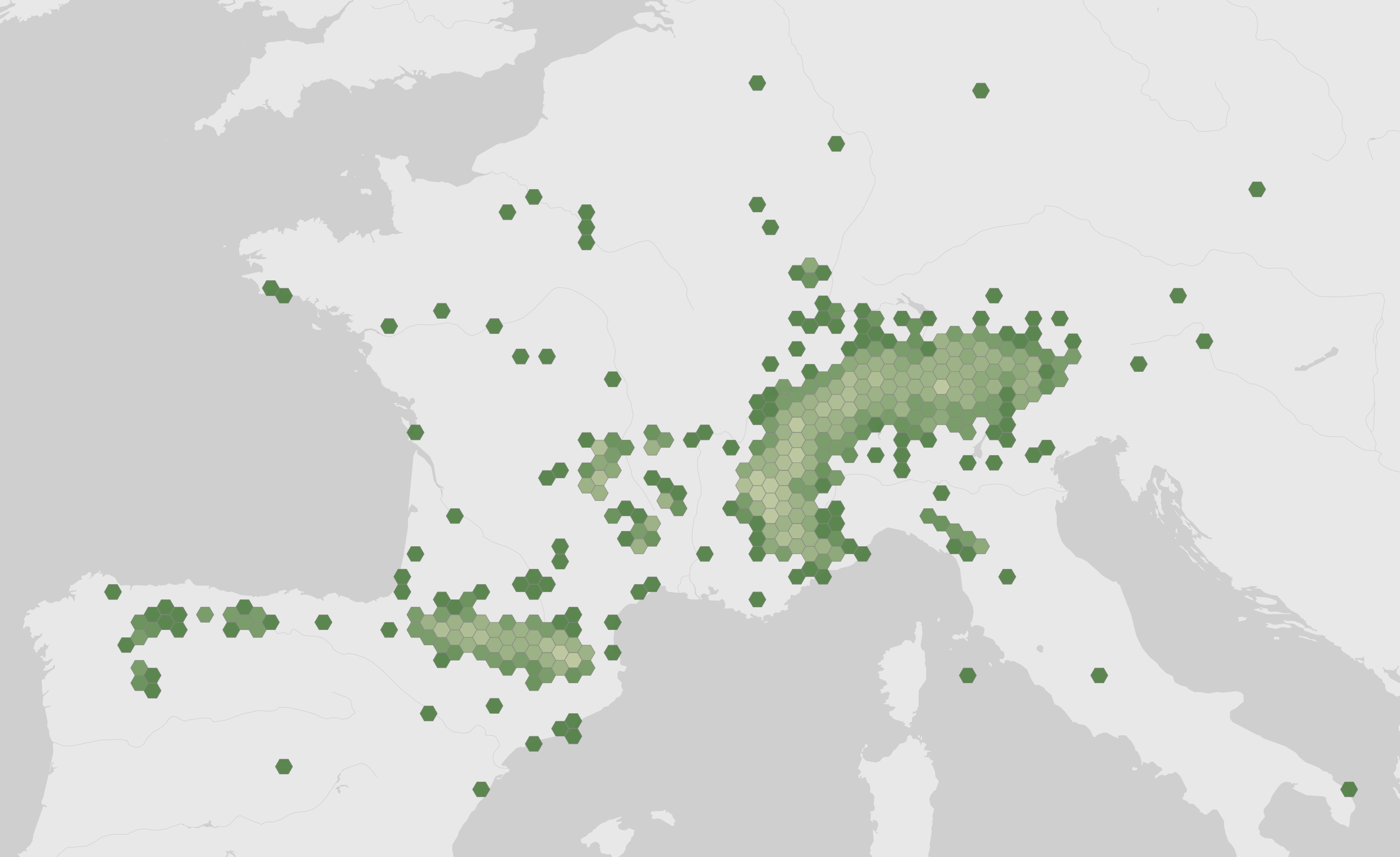
Trifolium alpinum is native to the Alps, the Pyrenees and the northern Apennines. Its native range runs from northern Spain through the Alps to Italy, and it is also native to Austria, France and Switzerland.
The plant grows in subalpine and alpine climates at elevations between 1,700 and 2,800 metres, and sometimes as high as 3,100 metres. Its high-elevation range places it well above the tree line in many mountain areas.
It is typically found in rocky meadows and poor alpine grasslands. It prefers deep, warm, acidic soils that are low in nutrients.
In the wider region, it has also been introduced to Czechia and Slovakia.
Growth and Form
Trifolium alpinum is a perennial herb. It lives for several years and returns from its root each season.
The plant has a large taproot that can reach about 1 metre in length and about 1 centimetre in width. This deep root anchors the plant in steep, rocky ground.
The short stems bear ternate leaves, each divided into three leaflets up to 5 centimetres long. The plant stays low and compact, which suits the exposed alpine meadows where it grows.
Ecology and Relationships
The flowers of Trifolium alpinum emit a strong, spicy fragrance that carries well across open meadows. The scent works as a long-range signal that draws bees, especially honey bees and bumblebees, to the plant.
The plant is self-incompatible, so it depends entirely on insects to set seed. Several groups of visitors come to its flowers, with butterflies and moths as the main group, alongside bees, flies and beetles in smaller numbers. Mining bees of the genus Andrena and bumblebees such as Bombus pomorum are among the flower visitors.
Many animals feed on the plant. Grasshoppers, leaf beetles, true bugs and weevils eat its leaves, and songbirds and game birds such as the rock partridge take it as food. Alpine herbivores, including chamois and marmots, also use it as forage.
The volatile compounds in its scent may also deter herbivores. The plant produces terpenes and phenolic compounds that help it cope with intense ultraviolet radiation at high elevation.
Uses and Human Relationships
Trifolium alpinum is valued as a nutrient-rich, digestible forage for livestock, including cattle and sheep. Its nitrogen-fixing ability and deep taproot also make it useful in ecological restoration, where it helps stabilize soil on eroded high-altitude slopes.
In traditional use, the sweet, liquorice-flavored root was eaten as a confection in some alpine regions. In German folk medicine, a decoction of the root was used for chest complaints.
Cattle that graze the plant pass its volatile compounds into their milk. These compounds give the milk a distinct aroma and flavor. Cheeses made from such milk carry higher levels of odd-chain fatty acids and a characteristic ratio of hydrocarbons, which link the local flora to the taste of regional alpine cheeses.
Photos
Photographs from via iNaturalist, licensed under CC0 1.0., by Denys Vynokurov via iNaturalist, licensed under CC BY 4.0., by Adi Peter via iNaturalist, licensed under CC BY 4.0., by Renee Grebe via iNaturalist, licensed under CC BY 4.0., by Katrin Simon via iNaturalist, licensed under CC BY 4.0., by Matteo Martini via iNaturalist, licensed under CC BY 4.0., by Diego González Dopico via iNaturalist, licensed under CC BY 4.0., by frangp via iNaturalist, licensed under CC BY 4.0., by Lieven Decrick via iNaturalist, licensed under CC BY 4.0., by Jean Jacques Godon via iNaturalist, licensed under CC BY 4.0., by Codrin Bucur via iNaturalist, licensed under CC BY 4.0., by Roland Godon via iNaturalist, licensed under CC BY 4.0., and by DDutrey via iNaturalist, licensed under CC BY 4.0., credited on each photo.
Ecology and classification
Classification
- Phylum
- Tracheophyta
- Class
- Magnoliopsida
- Order
- Fabales
- Family
- Fabaceae
- Genus
- Trifolium
- Species
- Trifolium alpinum
Sources
- GBIF Species names and classification
- iNaturalist Photos
- Wikidata Common names and conservation status
- Wikipedia Summary extract
- Plants of the World Online Native range, life form and climate (WCVP)
- GloBI What it eats, what eats it, parasites and pollinators
- trophiCH