The silky, white-tipped hairs covering its flower heads give this plant its common names — hare's-foot, rabbitfoot, or stone clover — and its fuzzy, oblong flower spikes are unmistakable among European clovers.
Trifolium arvense is a flowering plant in the family Fabaceae, native to Europe. It has since spread widely outside its native range. Beyond its ecological role, the plant carries cultural associations tied to clovers in general, and its resilience in poor, dry soils makes it a persistent feature of disturbed ground across continents.
Identification and Appearance
The dense, fuzzy flower head is the clearest field mark: a compact inflorescence 2–3 cm long and 1–1.5 cm wide, covered in silky white hairs that tip the five sepals, which are noticeably larger than the rosy-white petals themselves.
This is a small, erect herbaceous annual or biennial, reaching 10–40 cm in height. Its leaves are trifoliate, with slender, sessile leaflets 1–2 cm long and 3–5 mm wide, sometimes edged with fine hairs and finely serrated margins. A pair of stipules sits at the base of each leaf, often tipped in red.
Individual flowers are tiny, only 4–5 mm long, and the plant is hermaphroditic. The hairy sepals and oblong shape of the flower head — resembling a small furry paw — are what inspired the "hare's-foot" name and distinguish it from smoother-headed clover species.
Distribution and Habitat
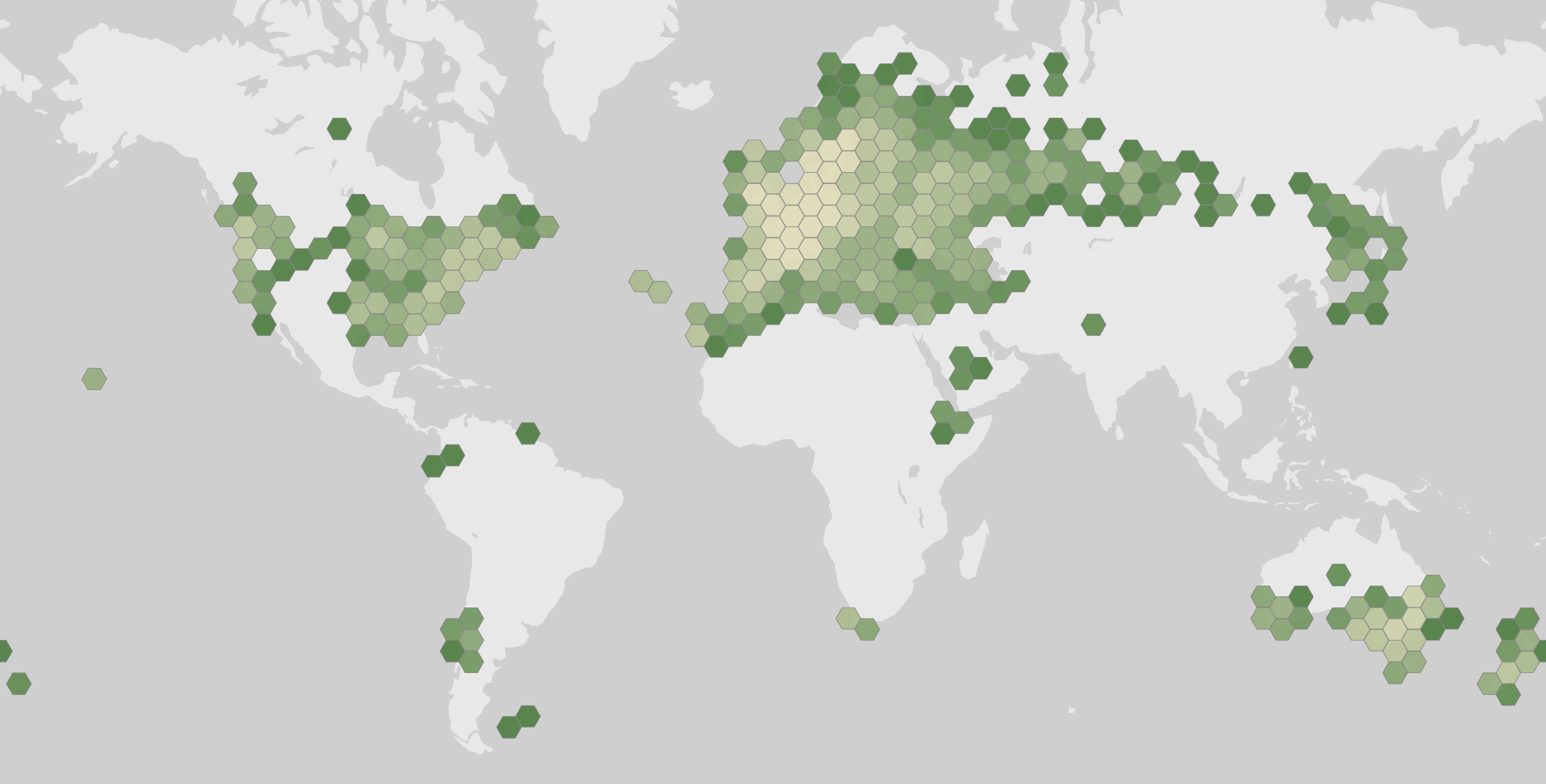
Trifolium arvense is native across most of Europe, excluding the Arctic zone, as well as western Asia, reaching up to 1,600 meters in elevation in plain or mid-mountain habitats. It has since been introduced widely, now found throughout the eastern United States, southern Canada, the Pacific Coast of the western U.S., and parts of Hawaii.
The species favors dry, sandy soils, tolerating both acidic and alkaline conditions and dry-mesic moisture regimes. It typically grows at field edges, in wastelands, along roadsides, on sand dunes, and opportunistically in unirrigated vineyards and orchards.
Observation records peak sharply in the mid-summer months, consistent with its flowering and active growth period, though these presence records do not indicate population size or abundance.
Growth and Form
Trifolium arvense grows as an annual or biennial herb, completing its life cycle within one or two growing seasons depending on conditions. It reaches a mature height of 10 to 40 centimeters, growing erect with slender trifoliate foliage throughout its active season.
Reproduction and Life Cycle
Flowering begins in early summer and does not require a period of cold to be triggered, with larger, well-established plants flowering over a longer stretch of the season. In wild populations, only plants that have reached a sufficient size — a dry weight above 0.01 grams — tend to produce seed at all.
The flowers are self-fertilizing, though visits from bees create some opportunity for cross-fertilization. Once formed, the seeds are protected by a hard coat that lets them remain dormant for long periods, germinating only once that coat is damaged.
Ecology and Relationships
The plant is grazed by rabbits, wild turkey, deer, sheep, and goats, and its foliage supports a range of insects, including weevils, grasshoppers, and aphids recorded feeding on it. Bees are its main flower visitors, with Bombus lapidarius recorded more than other visitors, alongside various Andrena bees and the honeybee Apis mellifera.
As a legume, Trifolium arvense fixes nitrogen in the soil through its root nodules, an ability tied to nodule size and the composition of nitrogen-fixing microbial communities in its roots. In semi-arid regions, 82 to 91 percent of its nitrogen comes directly from the atmosphere, with more nitrogen fixed overall during rainy seasons than dry ones. This nitrogen-fixing capacity makes it valuable on low-fertility soils, benefiting other plants growing nearby.
Despite its ecological benefits, the species is also managed as a weed in farmland and turf, since its tiny, hardy seeds tolerate extreme temperatures and physical damage, making long-term control difficult without chemical intervention.
Uses and Human Relationships
Clovers in general, including trifoliate forms like this species, carry symbolic associations, such as the legend of St. Patrick using the three-part leaf to illustrate the Christian Trinity to the pagan Irish.
The plant is reported to have medicinal value for both humans and animals, though details of this use are not elaborated. In genetic research, scientists at AgResearch in New Zealand used a single gene from Trifolium arvense in 2010, transferring it into white clover (T. repens) to help reduce bloating and methane emissions in livestock.
Fun Facts
- In Celtic tradition, clovers are associated with abundance, fertility, and prosperity, their three-part leaves seen as representing body, mind, and spirit.
- Farmers and land managers find this species especially hard to eradicate because its seeds tolerate extreme temperatures and physical damage, resisting tillage and composting methods that work on other weeds.
Photos
Photographs from via iNaturalist, licensed under CC0 1.0., by guywallbanks via iNaturalist, licensed under CC BY 4.0., by Steven Lamonde via iNaturalist, licensed under CC BY 4.0., by arthur_haendler via iNaturalist, licensed under CC BY 4.0., by Annie Bélair via iNaturalist, licensed under CC BY 4.0., by Stanislav Murashkin via iNaturalist, licensed under CC BY 4.0., by Thomas Mesaglio via iNaturalist, licensed under CC BY 4.0., by The Wrong Industry via iNaturalist, licensed under CC BY 4.0., by Petr Harant via iNaturalist, licensed under CC BY 4.0., by Jamie VanBuskirk via iNaturalist, licensed under CC BY 4.0., by maureen_c-m via iNaturalist, licensed under CC BY 4.0., and by olmagon via iNaturalist, licensed under CC BY 4.0., credited on each photo.
Ecology and classification
Growth habit
- Herb
Classification
- Phylum
- Tracheophyta
- Class
- Magnoliopsida
- Order
- Fabales
- Family
- Fabaceae
- Genus
- Trifolium
- Species
- Trifolium arvense
Sources
- GBIF Species names and classification
- iNaturalist Photos
- Wikidata Common names and conservation status
- Wikipedia Summary extract
- Plants of the World Online Native range, life form and climate (WCVP)
- GloBI What it eats, what eats it, parasites and pollinators
- trophiCH
- Wardeh et al. 2015 (EID2)
- DoPI
- EuPPollNet