A jellyfish barely larger than a grain of rice has found a way around death itself. When Turritopsis dohrnii is injured, starving, or aging, it can collapse its own body and rebuild itself as a juvenile polyp, resetting its life cycle from the beginning.
The species belongs to Hydrozoa, a class of small cnidarians related to corals and true jellyfish, and it now turns up in temperate and tropical waters across the globe. Its almost invisible size has let it spread largely unnoticed, making its story as much about hidden global movement as about escaping mortality.
Identification and Appearance
The clearest way to recognize Turritopsis dohrnii is its bright red, cross-shaped stomach glowing through an otherwise clear, bell-shaped body. The medusa reaches a maximum diameter of about 4.5 millimeters and is roughly as tall as it is wide, with mesoglea walls that stay thin except for a slight thickening at the top of the bell.
Tentacle count changes dramatically with age. Young medusae only 1 millimeter across carry just eight tentacles spaced evenly around the bell's edge, while adults develop 80 to 90 tentacles ringing the margin. A dense nerve net sits in the epidermis of the cap, forming a ring-like structure above the radial canal that is typical of cnidarians.
Beyond the free-swimming medusa, the species also exists as a bottom-dwelling hydroid: stolons creep along the seafloor or substrate, sending up branches tipped with feeding polyps. These polyps bud tiny 1-millimeter medusae over the course of a few days before releasing them to swim off on their own.
Distribution and Habitat
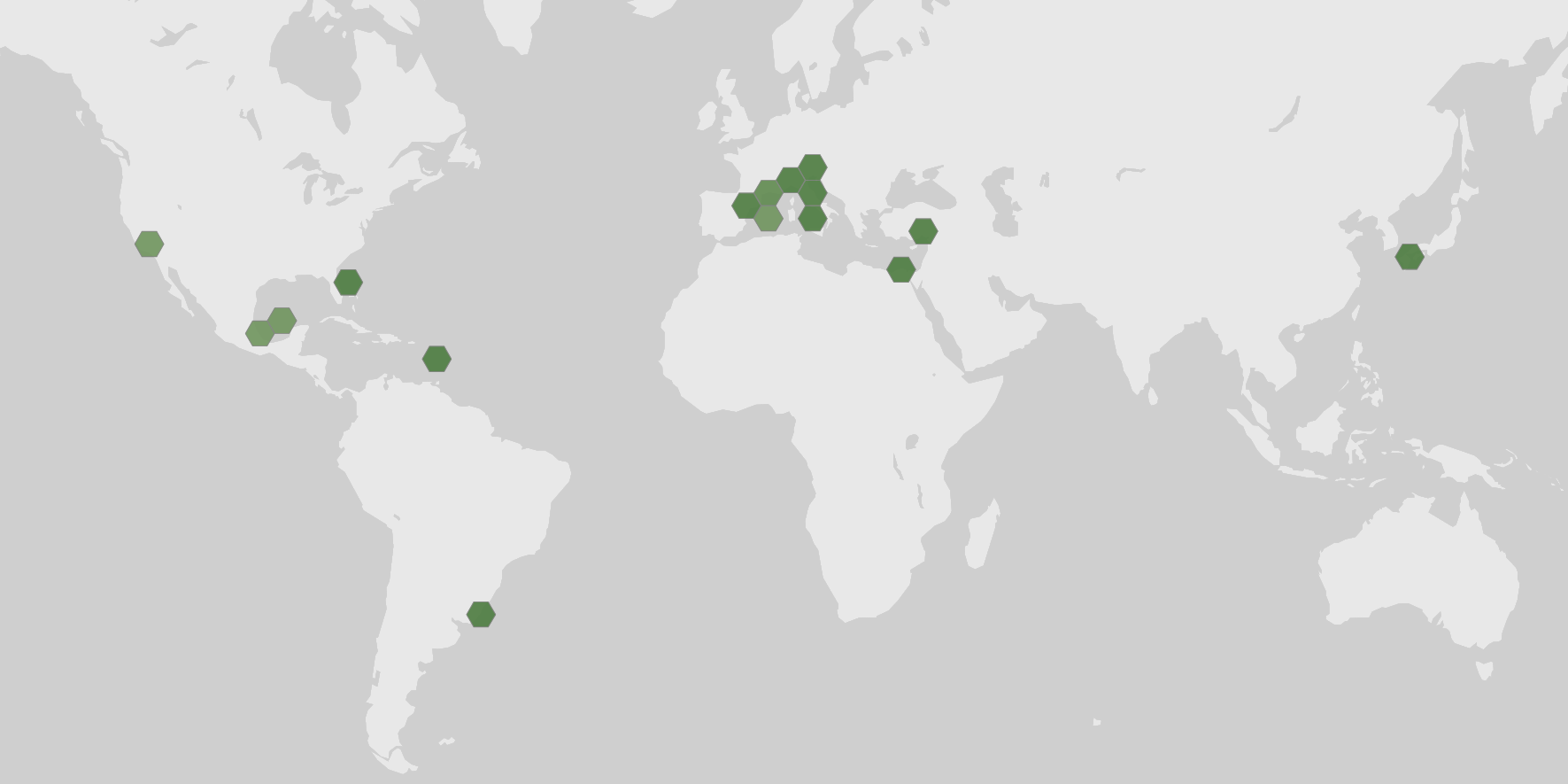
Turritopsis dohrnii is thought to have originated in the Pacific Ocean but has since spread through nearly every ocean basin, likely carried in the ballast water of ships. It was first documented in the Mediterranean Sea and has since turned up worldwide in temperate to tropical waters, a spread so quiet that Smithsonian Tropical Marine Institute scientist Maria Miglietta described it as a "worldwide silent invasion."
The species tolerates a fairly wide salinity range, from polyhaline waters (18–30 PSU) to fully marine, euhaline conditions (30–40 PSU). It turns up in marinas and docks, clinging to vessel hulls, and resting on the ocean floor, habitats that make ship traffic an easy vector for further spread.
Monthly observation records show a sharp rise from summer into a peak in September, with far fewer sightings in winter and early spring. These figures reflect when the tiny medusae are noticed, not how many animals actually exist, so the pattern should be read as a hint of seasonal presence rather than a measure of abundance.
Its resilience helps explain the spread: the species can regress into a cluster of cells to survive starvation or harsh conditions, potentially drifting on currents until conditions improve.
Hunting and Diet
Turritopsis dohrnii hunts by drifting through the water column and trailing its tentacles, which are armed with stinging cells called nematocysts. When zooplankton or other small prey brush against a tentacle, the nematocysts fire and the tentacle flexes to draw the catch toward the mouth.
The bell itself doubles as a feeding tool: as the jellyfish contracts it to swim, the expanding cavity sucks in water and pulls potential prey within reach of the tentacles. This combination of pulsing locomotion and stinging tentacles lets a purely carnivorous animal capture food while barely moving from the current.
Its diet centers on zooplankton, along with fish eggs and small mollusks. Like other jellyfish, it has no separate anus, so waste is expelled back out through the same mouth used for feeding.
Population and Ecological Role
No population counts or trend figures are available for Turritopsis dohrnii, but its ecological role is shaped by extreme vulnerability to predation. Other jellyfish are its most common predators, alongside sea anemones, tuna, sharks, swordfish, sea turtles, and penguins.
That vulnerability traces back to its simple body plan: roughly 95 percent of the animal is water, with the remaining tissue arranged in just three thin layers, an outer epidermis, a jelly-like middle mesoglea, and an inner gastrodermis. This flimsy, low-cost construction likely makes it an easy and abundant food source for a wide range of marine predators, feeding energy from plankton up through the food web wherever it occurs.
Cultural Significance
Online and in popular retellings, the "immortal jellyfish" has become a modern myth of literal eternal life, even though its real trick is narrower: turning back into a juvenile form and starting its life cycle over rather than living forever unchanged. That gap between the myth and the biology is itself part of the species' cultural pull.
Its fame has reached into real-world identity: a perennial Singaporean election candidate legally changed his name to Turritopsis Dohrnii Teo En Ming after the jellyfish, a small but telling sign of how far the animal's reputation for cheating death has traveled beyond marine biology.
Fun Facts
- Turritopsis dohrnii maintains its telomere length through the cellular processes it uses during life-cycle reversal, effectively resetting cellular aging each time it reverts.
- The species reverts through transdifferentiation, a cell-conversion process that has inspired researchers looking for ways to regenerate damaged or dead tissue in humans.
- Marine biologist Maria Miglietta of the Smithsonian Tropical Marine Institute called its global spread a "worldwide silent invasion," since almost no one noticed it happening.
- Its near-invisibility to the naked eye, at only about 4.5 millimeters across, is likely why this global spread went undetected for so long compared to other invasive marine species.
Photos
Photographs from by Dr. Karen J. Osborn via Wikimedia Commons, licensed under CC0 1.0., credited on each photo.
Ecology and classification
Classification
- Phylum
- Cnidaria
- Class
- Hydrozoa
- Order
- Anthoathecata
- Family
- Oceaniidae
- Genus
- Turritopsis
- Species
- Turritopsis dohrnii
Sources
- GBIF Species names and classification
- Wikidata Common names and conservation status
- Wikipedia Summary extract
- Wikimedia Commons Photos