Utricularia vulgaris, the greater bladderwort, is a carnivorous plant that catches prey with underwater traps rather than roots in soil.
Found across Asia and Europe, it belongs to the family Lentibulariaceae and carries a global conservation status of Least Concern. Its combination of rapid growth, an entirely free-floating lifestyle, and small underwater traps makes it one of the more distinctive aquatic plants of the temperate wetlands it inhabits.
Identification and Appearance
The most useful field mark is the plant's finely pinnately divided leaves, each one to eight centimeters long, studded with many small bladder-like traps along their length. These traps are the structures that give bladderworts their name and their carnivorous habit.
The plant produces no roots and floats freely in the water column, with stems capable of reaching over a meter in length by the end of a growing season. Its yellow flowers rise above the water's surface on upright stalks, appearing between April and August, making the bloom period a useful way to spot the species when it is in flower.
In eastern Asia and North America, the closely related Utricularia macrorhiza replaces U. vulgaris, occupying a similar ecological role in those regions.
Distribution and Habitat
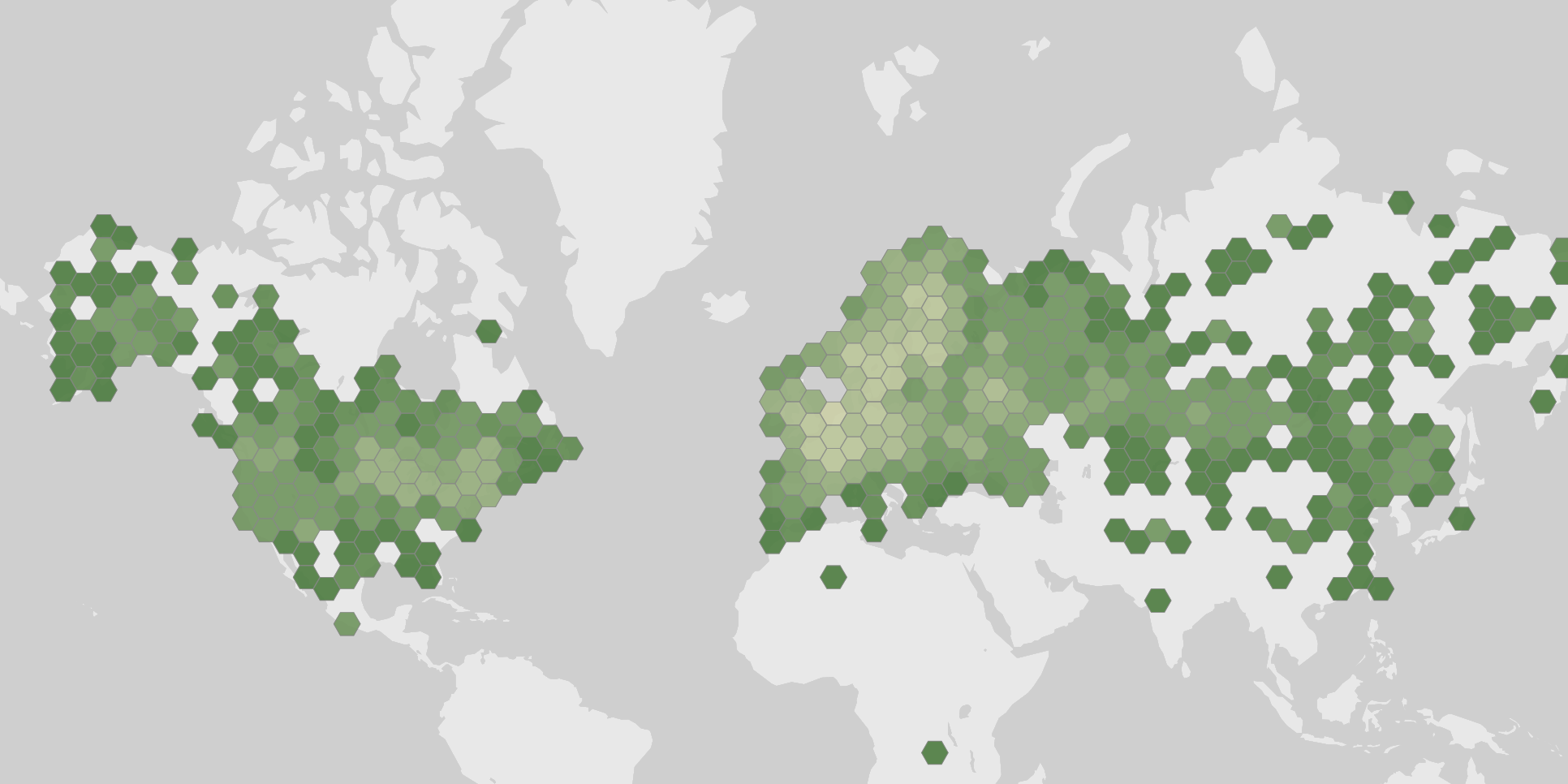
Utricularia vulgaris ranges widely across Europe and Siberia, extending to Tibet and northwest Africa. Its native distribution spans a broad swath of temperate Eurasia, from Great Britain, France, and Germany in the west through Central and Eastern Europe, the Baltic states, and Scandinavia, and on through Russia, Kazakhstan, and Mongolia to Tibet, with outlying populations noted in North Africa (Algeria, Morocco, Tunisia) and even Burundi.
As a free-floating aquatic species, it occupies still or slow-moving freshwater habitats such as ponds, lakes, and wetlands throughout this temperate range.
Observation records through the year show a strong peak in the warmer months, from around May through August, consistent with a period of more visible growth and flowering, tapering off sharply in the cooler months. These presence records reflect when the plant is most often observed rather than its full range or population size.
Growth and Form
Utricularia vulgaris grows as a hydrosubshrub, a free-floating aquatic growth form without roots anchoring it to any substrate. Its stems can extend more than a meter in length within a single growing season, an impressive rate of growth sustained through the warmer months.
As the growing season ends, the plant dies back, forming dense winter buds known as turions. These turions allow the plant to survive the colder months before regrowing when conditions improve.
Uses and Human Relationships
In European folklore, Utricularia vulgaris was regarded as an "enchanted waterweed." Its hidden underwater traps, invisible to casual observers, gave rise to tales of "lake spirits" or "frog snares" among people encountering the plant in ponds and lakes.
The plant's sudden reappearance each spring after disappearing over winter likely reinforced these folkloric associations, as it seemed to vanish and return as if by enchantment.
Fun Facts
- All species of Utricularia are carnivorous, capturing small organisms with bladder-like traps; aquatic species like U. vulgaris have traps adapted for catching prey suspended in open water.
- Trap sizes across the genus Utricularia range from as small as 0.02 centimeters to as large as 1.2 centimeters.
- The species is also commonly known as the "greater bladderwort" or "common bladderwort."
Photos
Photographs from via iNaturalist, licensed under CC0 1.0., by Matt Berger via iNaturalist, licensed under CC BY 4.0., by Sean Frey via iNaturalist, licensed under CC BY 4.0., by Mike Zifkin via iNaturalist, licensed under CC BY 4.0., by Nathan Aaron via iNaturalist, licensed under CC BY 4.0., by JCorven via iNaturalist, licensed under CC BY 4.0., and by Chris Winchell via iNaturalist, licensed under CC BY 4.0., credited on each photo.
Ecology and classification
Habitat
Behavior
- Predator
- Aquatic
Classification
- Phylum
- Tracheophyta
- Class
- Magnoliopsida
- Order
- Lamiales
- Family
- Lentibulariaceae
- Genus
- Utricularia
- Species
- Utricularia vulgaris
Sources
- GBIF Species names and classification
- iNaturalist Photos
- Wikidata Common names and conservation status
- Wikipedia Summary extract
- Plants of the World Online Native range, life form and climate (WCVP)
- GloBI What it eats, what eats it, parasites and pollinators
- trophiCH