Vespa crabro, the European hornet, is the largest eusocial wasp native to Europe, and it is also the only true hornet established in North America, where it has thrived since being introduced from Europe as early as 1840.
It belongs to the family Vespidae within the order Hymenoptera, and it builds intricate paper nests from chewed plant fiber and saliva. Its combination of large size, striking coloration, and complex social behavior makes it one of the more closely studied hornets outside its native range.
Identification and Appearance
The most reliable field mark is the shape of the eyes: they are deeply indented, forming a distinct "C" that separates V. crabro from most other wasps. Workers average around 25 millimeters in length, while queens can reach up to 35 millimeters, making them noticeably larger than common wasps such as Vespula vulgaris but smaller than the Asian giant hornet. Typical body mass runs about 477.5 ± 59.9 milligrams.
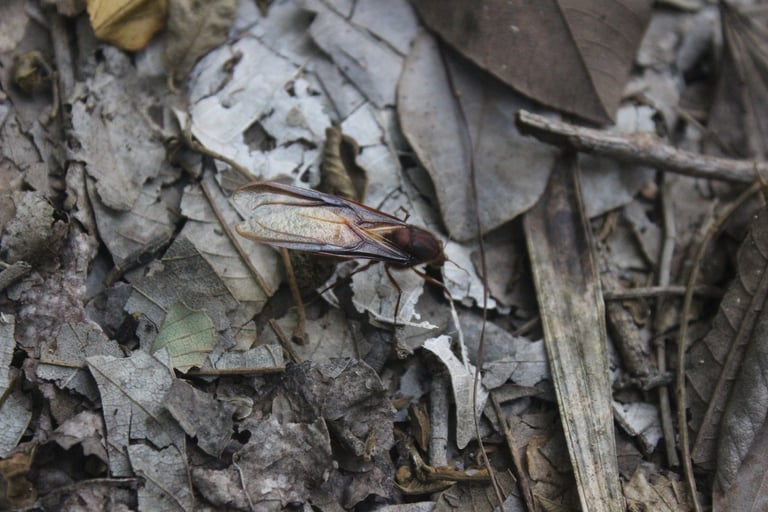
The wings are reddish-orange, and the narrow-waisted, petiolate abdomen carries alternating bands of brown and yellow. The thorax and abdomen bear some hair, though far less than is typical of bees. This coloring and banding pattern is the main reason V. crabro is frequently mistaken for the Asian giant hornet, despite the size difference.
Females are larger and heavier than males and carry six abdominal segments and twelve-segmented antennae, compared to seven abdominal segments and thirteen antennal segments in males. Only females possess a stinger, since it is a modified egg-laying structure (ovipositor); males are physically incapable of stinging.
The nests themselves offer a secondary identification clue. Comb cells measure roughly 8–9 millimeters long and 4–5 millimeters in diameter, and the paper walls often incorporate soil minerals such as titanium, iron, and zirconium, giving them a distinctive texture and composition compared with nests of other social wasps.
Distribution and Habitat
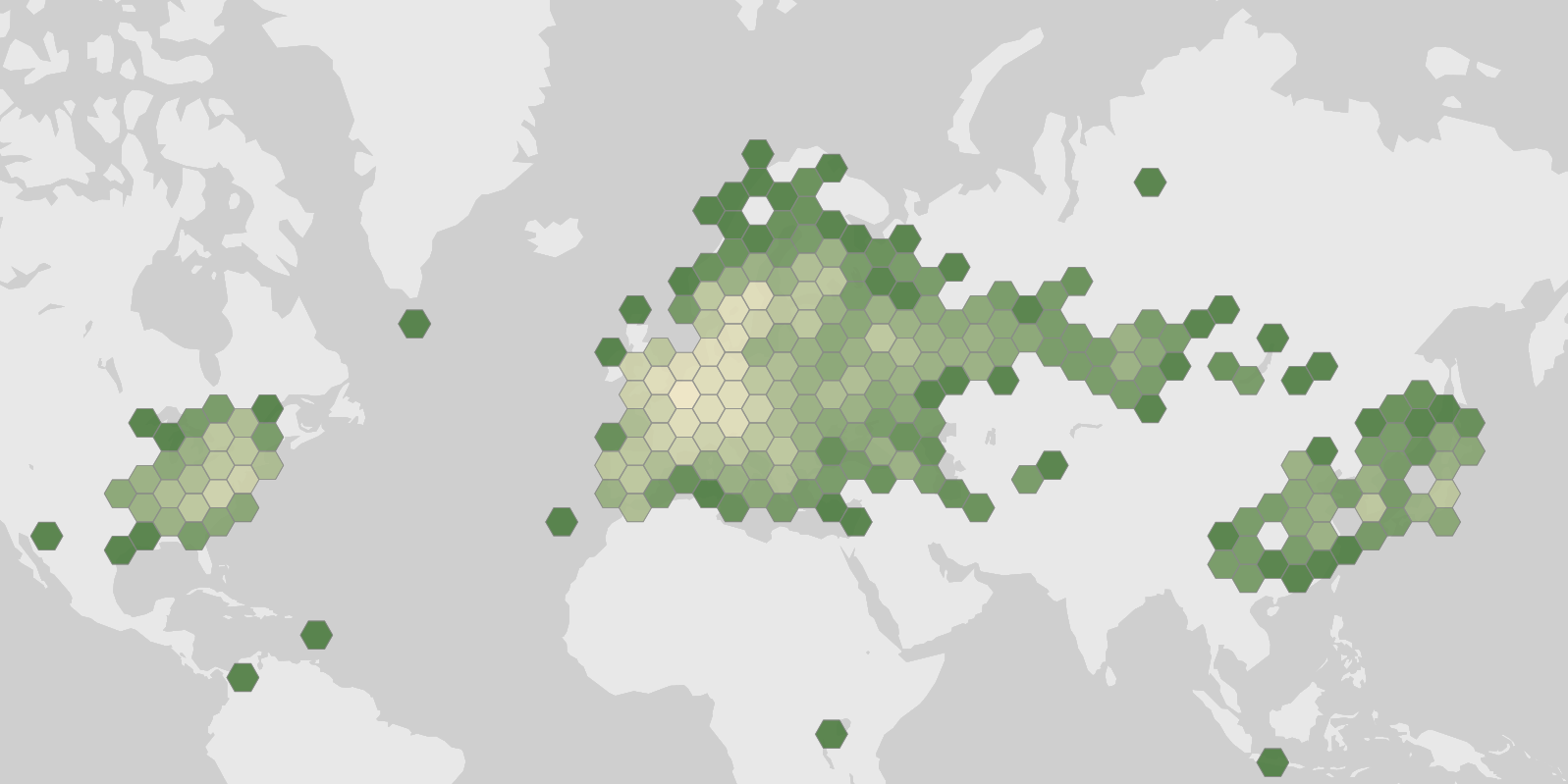
Vespa crabro originated in Eurasia, with historical nest records stretching from Japan to the United Kingdom. It reaches its current North American range through a mid-19th-century introduction, and by 2010 hornets had been documented as far south as Guatemala, in what appear to have been recent, accidental introductions.
The species shows a clear preference for wooded areas, and colonies nest in hollow trees, wall cavities, chimneys, and similar sheltered structures. This mix of forest and human-adjacent sites lets it persist in both wooded landscapes and built-up areas.
Monthly observation counts, which reflect presence records rather than true abundance, rise sharply through spring and peak in August at over 71,000 recorded sightings, with May through September all showing high activity. Counts fall off steeply by November and December, a pattern consistent with a colony cycle that winds down as autumn progresses and the founding queens of the next generation seek shelter for winter.
Behavior and Lifestyle
Colony defense in V. crabro centers on a distinctive alarm dance performed just outside the nest. Hornets buzz persistently, dart in and out of the entrance, and approach or attack whatever has triggered the alarm.
This response is driven chemically: the primary alarm pheromone, 2-methyl-3-butene-2-ol, is stored in and released from internal venom sacs. The venom sacs also contain other pentenols and pentanols, but these do not trigger the same alarm behavior, suggesting they serve a different, still-unclear purpose beyond signaling danger to nestmates.
This pattern of coordinated, pheromone-triggered defense is typical of social hymenopterans, where individual workers act on shared chemical cues rather than independent decisions, allowing the colony to respond to threats as a unit.
Population and Ecological Role
European hornets play an active predatory and opportunistic role in their ecosystems, sometimes at the expense of other predators. In a documented case, a hornet flew into the web of a yellow garden spider (Argiope aurantia), cut free an insect the spider had already captured and wrapped in silk, and flew off with it while the spider made no attempt to interfere. This kleptoparasitism illustrates a broader pattern among vespine wasps of shifting from active hunting toward scavenging as autumn approaches.
V. crabro has also been observed attacking the nests of Polistes nimpha, a paper wasp, putting it in direct competition with other social wasp species for nesting resources or prey.
These interactions position the European hornet as both a predator of other insects and an opportunistic scavenger, a dual role that shapes its relationships with prey species, competing wasps, and even spiders sharing the same habitat.
Conservation and Threats
No global conservation status is established for Vespa crabro in the context available here, but the species faces a specific, well-documented pressure: unwarranted fear leads people to destroy nests on sight, and this has driven local declines to the point where the hornet is considered locally threatened or even endangered in parts of its range.
Some countries have responded with legal protection. In Germany, killing a European hornet or destroying its nest has been illegal since January 1, 1987, with fines of up to €50,000 possible. In practice, enforcement is weak: the highest fine actually levied for killing wasps in Germany was just €45, and experts note that such fines are rarely imposed at all.
Cultural Significance
European hornets have a practical relationship with beekeeping: because they prey on wax moths, some beekeepers in Europe deliberately keep hornets and their nests in specially designed boxes hung on trees, accepting the occasional loss of a honeybee in exchange for that protection. The species does hunt western honeybees (Apis mellifera), but unlike invasive Asian hornets or Asian giant hornets, it does not typically threaten healthy honeybee colonies.
Their foraging habits also leave a physical mark on trees: European hornets tend to girdle branches while gathering material or sap, which can result in dead branches on host trees.
Stings, while usually minor, are taken seriously in rare cases. One documented incident involved a sting victim developing atrial fibrillation with a rapid heartbeat, later resolved with an oral dose of the medication propafenone, underscoring that venom components such as histamine, serotonin, and the neurotoxin apamin can occasionally provoke serious reactions in susceptible individuals.
Fun Facts
- Only female European hornets can sting, since the stinger is a modified egg-laying organ (ovipositor); males lack one entirely.
- Nest walls often contain soil minerals such as titanium, iron, and zirconium, which become incorporated into the paper comb alongside plant fiber and saliva.
- A typical nest weighs about 80.87 grams dry, with individual comb cells only 8 to 9 millimeters long.
- Males carry thirteen antennal segments and seven abdominal segments, while females have twelve antennal segments and six abdominal segments.
- By 2010, hornets had turned up as far south as Guatemala, likely through recent accidental introductions far outside their native Eurasian range.
- Unlike most related wasps, this species controls reproduction among workers through direct policing behavior rather than queen pheromones.
Ecology
Behavior
- Predator
- Social
- Scavenger
Habitat
- Forest
- Woodland
- Urban
Diet
- Insectivore