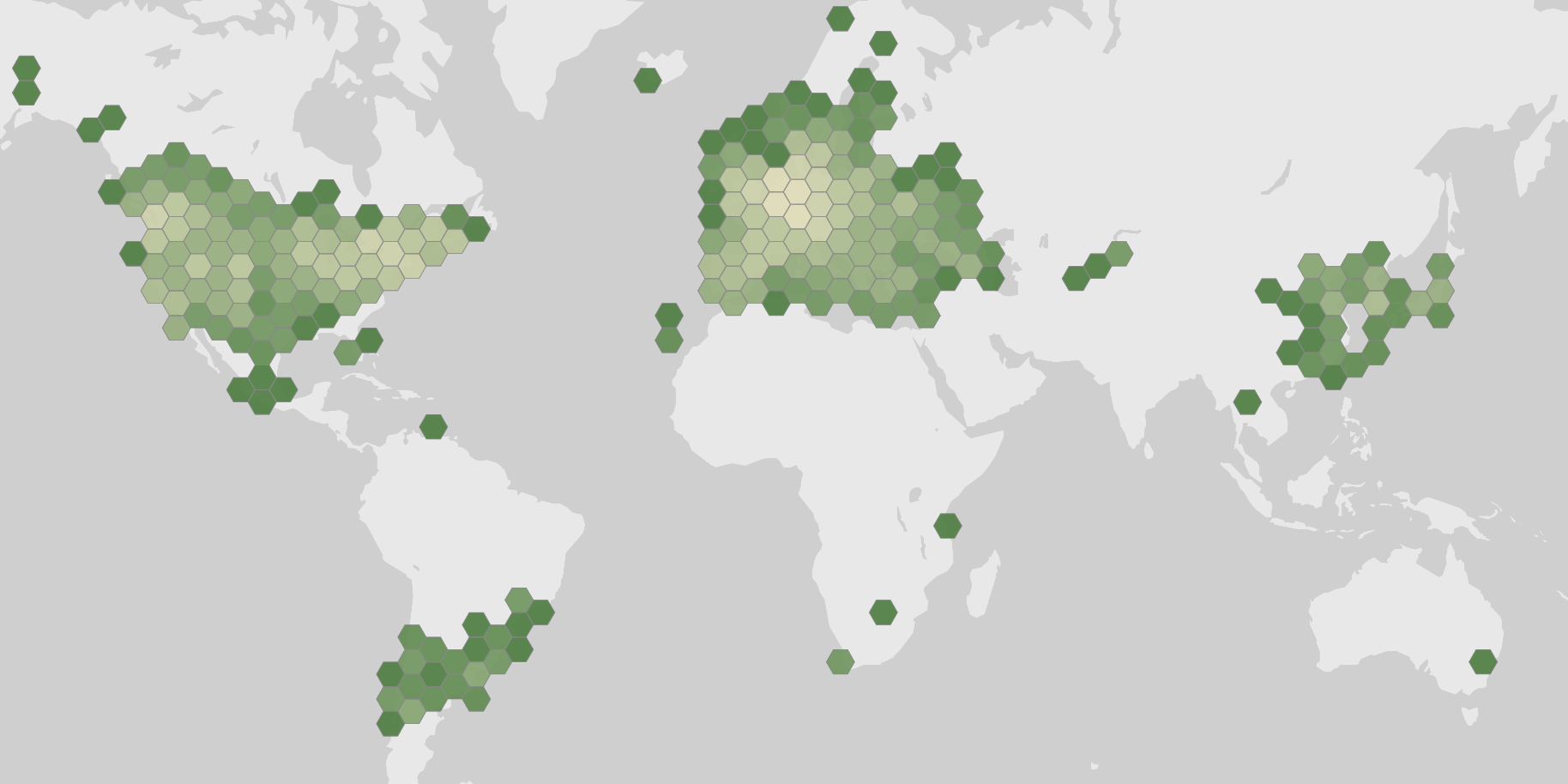
Since 1999, the western conifer seed bug has spread from western North America to Europe, Japan, South America and beyond. This true bug of the family Coreidae is native to the continent west of the Rocky Mountains, where it lives in the temperate and warmer regions of the Pacific coast.
Its range in North America has grown eastward. It now includes Ontario, Québec, New Brunswick, Nova Scotia, Michigan, Maine, Pennsylvania, New York and many other eastern states and provinces. In Europe and Argentina it has become accidentally established in parts of the continent and country.
Its common name can mislead. Despite the nickname pine-beetle, Leptoglossus occidentalis is not a beetle but a true bug, and the actual pine beetle is Dendroctonus ponderosae.
Identification and Appearance
The most useful field mark is the set of alternating light and dark bands that run along the outer wing edges, on the flaring sides of the abdomen. The expanded hind leg tibiae also help set it apart from its close relatives.
Adults average 16–20 millimetres (0.63–0.79 inches) long. Males are smaller than females. The bugs fly readily and make a buzzing sound in the air.
From a distance, the species looks somewhat like the wheel bug Arilus cristatus and other assassin bugs in the family Reduviidae. Assassin bugs can use their proboscis to bite when threatened, while this species has a mouthpart adapted only to sucking plant sap.
Its main defense is an unpleasant-smelling alarm pheromone. If handled roughly, it will stab with its proboscis, but the wound is unlikely to harm people.
Distribution and Habitat
The species is native to the temperate and warmer regions of the Pacific coast of North America. It has steadily expanded eastward, and on its native continent it has been found as far northeast as Nova Scotia.
In Europe, the species was first reported in 1999 from northern Italy, probably introduced with timber. By 2007 it had established itself in the northern Balkans, the Alps, and parts of the Czech Republic, France, Germany and Hungary. A population in Spain was found in 2003, probably from a separate introduction.
Outside Europe, it was first recorded in Tokyo, Japan in 2008. Later records came from Chile in 2017, and it has also been detected in Ukraine, Russia and Finland.
The bugs live in conifer forests, and in the northern parts of their range they move about widely by September to seek crevices for overwintering. Sightings peak in October, when this movement is underway.
Diet and Nutrition
The western conifer seed bug is a herbivore that feeds on plant sap. It pierces developing conifer cones and sucks the sap throughout its life. This feeding causes the developing seeds to wither and misdevelop, so the species is considered a minor tree pest in North America, though it can become more harmful in conifer plantations.
Its main food sources are conifers in the order Pinales. Among the best-established hosts are Pseudotsuga menziesii, Picea abies and Pinus nigra. In its native range it also feeds on ponderosa pine, lodgepole pine and white spruce.
The species is not limited to one host. It can feed on flowering plants if it must, but it seems to prefer resinous plants rich in terpenes, the compounds that plants produce to deter herbivores. Juniper, a conifer in the order Cupressales, is a minor food source.
Its diet changes with place. Outside its native range it also feeds on pines such as eastern white pine and red pine in eastern North America, and on pistachio in Europe.
Population and Ecological Role
In North America the species is considered a minor tree pest, but it can cause greater damage in conifer plantations, where its sap feeding reduces seed development.
Its role in the food web is modest but real. Bush crickets, such as Tettigonia viridissima, and bats prey on the bugs, which makes them part of the diet of these predators.
The bugs also become structural pests in some places. They sometimes enter houses in large numbers in areas with extensive conifer woods, and they can pierce PEX tubing with their mouthparts, causing leaks.
Photos
Photographs from via iNaturalist, licensed under CC0 1.0., by E. A. via iNaturalist, licensed under CC BY 4.0., by a chinstrap penguin via iNaturalist, licensed under CC BY 4.0., by Shirley Zundell via iNaturalist, licensed under CC BY 4.0., by Andrew Sebastian via iNaturalist, licensed under CC BY 4.0., by gab_1 via iNaturalist, licensed under CC BY 4.0., by Stefan Lanz via iNaturalist, licensed under CC BY 4.0., by Michal Honskus via iNaturalist, licensed under CC BY 4.0., by Mike Van Valen via iNaturalist, licensed under CC BY 4.0., by Ken Lange via iNaturalist, licensed under CC BY 4.0., by JCorven via iNaturalist, licensed under CC BY 4.0., by David Anderson via iNaturalist, licensed under CC BY 4.0., by gpete via iNaturalist, licensed under CC BY 4.0., by ahabo via iNaturalist, licensed under CC BY 4.0., by Jernej Polajnar via iNaturalist, licensed under CC BY 4.0., and by James King via iNaturalist, licensed under CC BY 4.0., credited on each photo.
Ecology and classification
Habitat
Diet
- Herbivore
Classification
- Phylum
- Arthropoda
- Class
- Insecta
- Order
- Hemiptera
- Family
- Coreidae
- Genus
- Leptoglossus
- Species
- Leptoglossus occidentalis