The whooper swan is considered among the heaviest flying birds, with some males reaching over 14 kilograms yet still capable of sustained long-distance flight. It is a large swan of the northern hemisphere, the Eurasian counterpart to the North American trumpeter swan, breeding across subarctic Eurosiberia and wintering as far south as southern Europe and eastern Asia.
Classified as Least Concern by the IUCN, the species is a familiar and increasingly tolerant presence near people in winter, drawing crowds who come to hear its resonant, far-carrying calls.
Identification and Appearance
The most reliable field mark is the bill pattern: whooper swans always show more yellow than black on the bill, the reverse of the pattern on the smaller Bewick's swan. Adults measure 140 to 165 centimeters in length with a wingspan of 205 to 275 centimeters, similar in size to the mute swan, and weigh typically between 7.4 and 14.0 kilograms, with males averaging heavier than females.
The head is more angular in shape than a mute swan's, and the plumage is pure white, though the head and neck can become stained rusty-yellow from feeding in water rich in tannins or iron. All ages can be told from mute swans by a shorter, rounded tail rather than the mute swan's longer, pointed tail, a useful clue even when the head is submerged while feeding.
Juveniles up to about a year old are a uniform pale grey to greyish-brown, paler and more even in tone than the blotchy brown-and-white juvenile mute swan, with the same bill pattern as adults but with pink replacing yellow and blackish-grey replacing black.
Distribution and Habitat
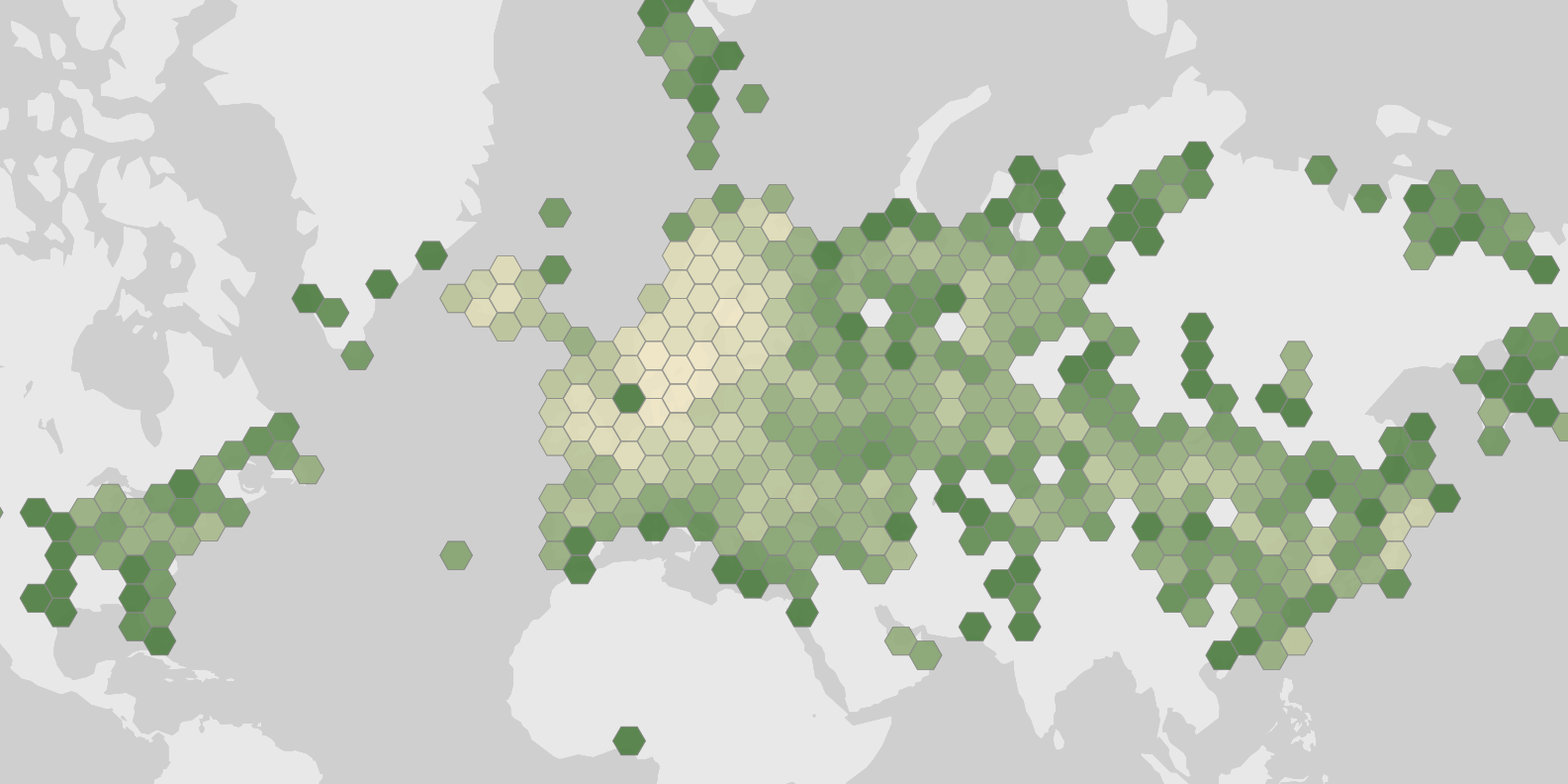
Whooper swans breed across the subarctic taiga zone of Eurosiberia, generally farther south than Bewick's swans, nesting along freshwater lakes, pools, shallow rivers, marshes, bogs and swamps with emergent vegetation for cover. In Iceland they occur from sea level up to 700 meters elevation, and they are rare breeders in northern Scotland, particularly Orkney, with only a handful of pairs recorded in recent years, plus occasional pairs in Ireland.
Outside the breeding season they use a much wider range of habitats than Bewick's swans, including lowland farmland near the coast, flooded fields, mudflats, lakes, ponds and lochs, grazing on farmland through winter. Icelandic breeders migrate to winter in the United Kingdom and Ireland, while other populations travel to wintering grounds in southern Europe and eastern Asia, journeys that can span hundreds or thousands of miles.
Migrating birds typically fly at altitudes of 500 to 1,700 meters when crossing open ocean but prefer lower altitudes with frequent rest stops where possible. Monthly observation records show the highest numbers in late winter and early spring and a low point in mid-summer, a pattern consistent with wintering concentrations rather than breeding-season dispersal, though these counts reflect reporting effort rather than true population size.
Behavior and Lifestyle
Whooper swans shift from territorial breeders in summer to highly social flock members in winter, gathering near wetlands in groups that commonly exceed 40 birds from October to November before settling into smaller flocks of under 30 from January into early spring. Within these flocks a social hierarchy operates, with large families dominant, monogamous pairs in the middle, and unpaired individuals at the bottom; dominant birds secure the longest uninterrupted feeding time, and aggressive males can even push one family above another of similar size.
Breeding pairs generally hold exclusive territories, estimated at roughly 0.7 to 5.7 square kilometers, though in some cases several pairs share a single small water body. As a long-distance migrant, the species usually flies at 50 to 200 meters and speeds up to 100 kilometers per hour, but is capable of far more extreme performance: the Iceland-to-Ireland flock recorded at 8,200 meters used a jet stream tailwind of roughly 180 kilometers per hour to complete the 1,100-kilometer crossing in about seven hours.
Cygnets rarely initiate flight themselves but take part in pre-flight signaling to coordinate with their parents, a behavior tied closely to the species' broader system of visual communication before takeoff.
Communication
Before a flock takes flight, whooper swans build up a chorus of pre-flight signals, including head pumping, four-syllabic calling and wing flapping, with signaling intensity rising to synchronize the group's departure. Swans that signal vigorously in a large group succeed in leading the flock into flight about 61 percent of the time, compared with only 35 percent for those that do not signal, and the initiator is more often a parent than a cygnet.
After landing, birds may perform greeting or triumph ceremonies combining head bobbing, calling and wing flapping, interactions close enough that they can shift quickly into either courtship or aggression. Aggressive encounters involve ground staring with the neck arched and wings spread, bow-spitting with the neck thrust forward, carpal flapping, and in direct conflicts a mutual 'water-boiling' display where both birds spread their wings before attacking.
Vocally, the species is noisy, giving a strident, resonant kloo-kloo-kloo call in groups of three or four, lower-pitched on average than the call of Bewick's swan.
Diet and Nutrition
Whooper swans feed mainly by grazing on aquatic vegetation, using their webbed feet to dig into shallow mud before dipping their heads underwater to reach roots and tubers, with parents stirring the water column to make vegetation more accessible to cygnets. Most individuals rely on freshwater roots, stems and leaves, while a smaller minority feed on mussels in shallow marine waters; cygnets additionally take small insects and invertebrates to meet the high protein demands of rapid growth.
Foraging timing depends on habitat: freshwater feeders peak in the morning and afternoon, while birds in saltwater systems feed mainly in the gap between those periods and rest during high tide, feeding instead at low tide. Terrestrial foraging is shaped by day length, temperature and safety, with swans less active on short, cold, dark days.
In agricultural regions such as Denmark, northern Germany and central Scotland, swans turn to leftover grain in autumn and switch to grazing grass from mid-winter into spring.
Nesting and Breeding
Whooper swans form lifelong monogamous pairs, occasionally finding a new mate if a partner dies, and become territorial during the breeding season, with rivals sometimes fighting savagely using wing-beating, ground staring or head-plunging. Courtship displays can begin in winter but peak in summer, featuring mutual head bobbing, neck-turning with vigorous wing beats, and brief pre-copulation displays of head dipping before a short copulation in which the male grasps the female's nape.
Breeding begins in late April or early May, with the female building the nest from nearby vegetation on a mound near fresh water with sheltering riparian growth. Clutch size ranges from one to eight large, off-white, elliptical eggs, with younger and less experienced pairs typically laying fewer; incubation lasts about 30 to 35 days, carried out mainly by the female while the male guards the nest and territory from within 50 to 100 meters.
Cygnets hatch precocial and downy from June into early July, leave the nest within two to three days, and grow rapidly, reaching roughly 550 to 600 grams by 12 days old. Fledging occurs at about 78 to 96 days in Finland, later at 90 to 105 days in China and Russia, and broods stay together even after fledging; young become independent around one year of age but do not reach sexual maturity until about four years, an unusually long delay for a bird of its kind.
Population and Ecological Role
Whooper swans play a notable ecological role through their feeding on submerged macrophytes: heavy grazing on fennel pondweed removes large amounts of biomass and stimulates its growth at intermediate depths, while a less-favored plant such as clasping-leaf pondweed instead grows at shallow or deep extremes, giving the swans a direct hand in shaping aquatic plant communities. Their nests are also sometimes exploited by brood parasites, with greylag geese and red-crested pochards occasionally laying eggs among whooper swan clutches.
As prey and carrion, whooper swans and their eggs or cygnets draw attention from a range of predators and scavengers, including white-tailed eagles, wolves, red foxes, brown bears, wild boar, ravens, carrion crows, rooks, and storks such as the white stork and black stork.
Conservation and Threats
The whooper swan is assessed as Least Concern by the IUCN, reflecting a species considered secure overall. The main documented threats are hunting, egg poaching and habitat degradation, pressures that conservation efforts have addressed through the protection of key wetland sites stretching from Iceland to China and through hunting bans, including legal protection in Russia.
Cultural Significance
The constellation Cygnus, Latin for swan, takes its outline from a swan in flight with wings spread and neck outstretched, and its brightest star Deneb draws its name from the Arabic for 'tail.' The constellation has been linked to several legendary swans across cultures: in Greek mythology it is tied to the story of Zeus and Leda, in Norse mythology to a Valkyrie's winged steed, and in one East Asian tradition it represents the magpie bridge formed once a year to reunite parted lovers.
Beyond myth, whooper swans have a long history of being hunted by people, yet today they are generally unafraid of humans and will take food directly from an outstretched hand, especially in winter when natural food is scarce. This approachability, combined with their loud whooping calls, has made them a draw for ecotourism and admiring crowds.
Fun Facts
- A flock of whooper swans was once tracked crossing from Iceland to Ireland at 8,200 meters, the highest altitude recorded for any bird over Britain.
- The constellation Cygnus, named for this genus, is linked in one tradition to a bridge of magpies formed once a year to reunite separated lovers.
- Despite their long history of being hunted, whooper swans will often take food directly from a person's hand during winter scarcity.
Photos
Photographs from via iNaturalist, licensed under CC0 1.0., credited on each photo.
Ecology and classification
Classification
- Phylum
- Chordata
- Class
- Aves
- Order
- Anseriformes
- Family
- Anatidae
- Genus
- Cygnus
- Species
- Cygnus cygnus
Sources
- GBIF Species names and classification
- iNaturalist Photos
- Wikidata Common names and conservation status
- Wikipedia Summary extract
- Encyclopedia of Life Habitat, diet and behavior traits
- Animal Diversity Web Animal habitat, behavior and diet
- AnAge Longevity
- AVONET Bird mass, habitat, migration, diet and range size
- GloBI What it eats, what eats it, parasites and pollinators
- trophiCH
- Wardeh et al. 2015 (EID2)
- TETRA-EU