
Polypodiopsida · Polypodiales
Anderson’s Holly Fern
Polystichum andersonii
Also known as: Anderson's Hollyfern, Anderson's hollyfern, Anderson's shield fern, Anderson's sword fern, Vancouver holly fern
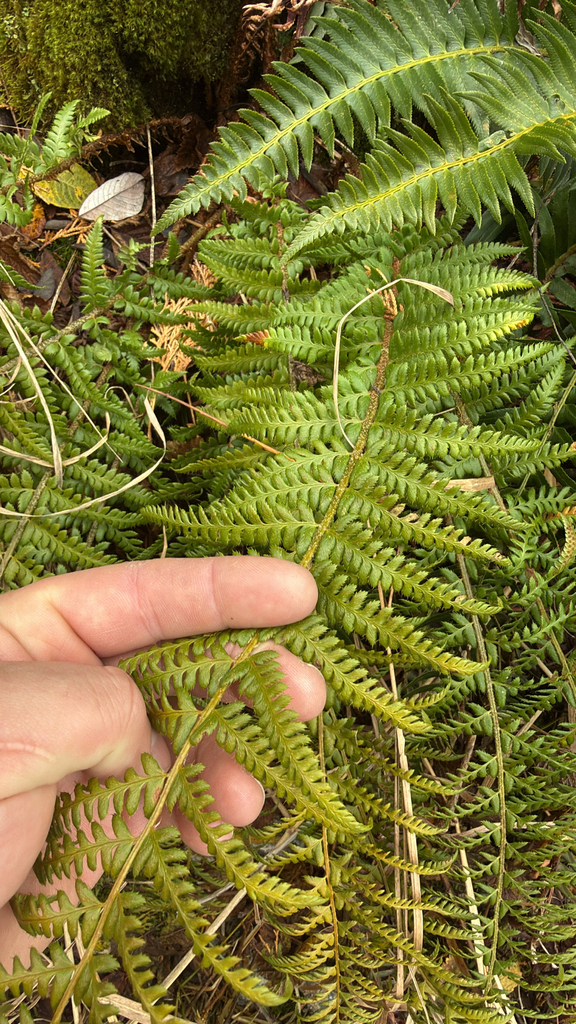
© Noah How · iNaturalist · CC BY 4.0
Scientific Classification & Quick Facts
Classification
Known For
Detailed measurements for this species are still being verified.
Polystichum andersonii, commonly known as Anderson’s Holly Fern, belongs to the diverse family Dryopteridaceae, a group renowned for their robust fronds and distinctive spore-bearing structures. This fern occupies a modest geographic range, occurring in only two countries, which underscores its regional significance rather than widespread distribution. The species remains poorly documented in global conservation assessments, with its IUCN status currently unknown—a reflection of the many ferns that persist in the shadows of botanical knowledge, their ecology and abundance still awaiting systematic study.
Holly ferns of the genus Polystichum are typically characterized by their leathery, compound fronds and prickly pinnules that give them their common name. Anderson’s Holly Fern shares these features while maintaining a specialized niche within its limited range. The scarcity of detailed ecological data makes this species a compelling subject for further investigation, particularly as conservation priorities increasingly focus on ferns—a group that often receives less attention than flowering plants despite their ecological importance and cultural value.
Identification and Appearance
Polystichum andersonii is an evergreen fern that grows from a slowly creeping rootstock forming a distinctive crown. The fronds emerge in a vase-like ring arrangement, typically reaching 30 to 200 centimetres in length. This variation in frond size allows the species to adapt to different growing conditions, with mature plants producing both shorter and elongated fronds within the same crown.
Distinctive Features
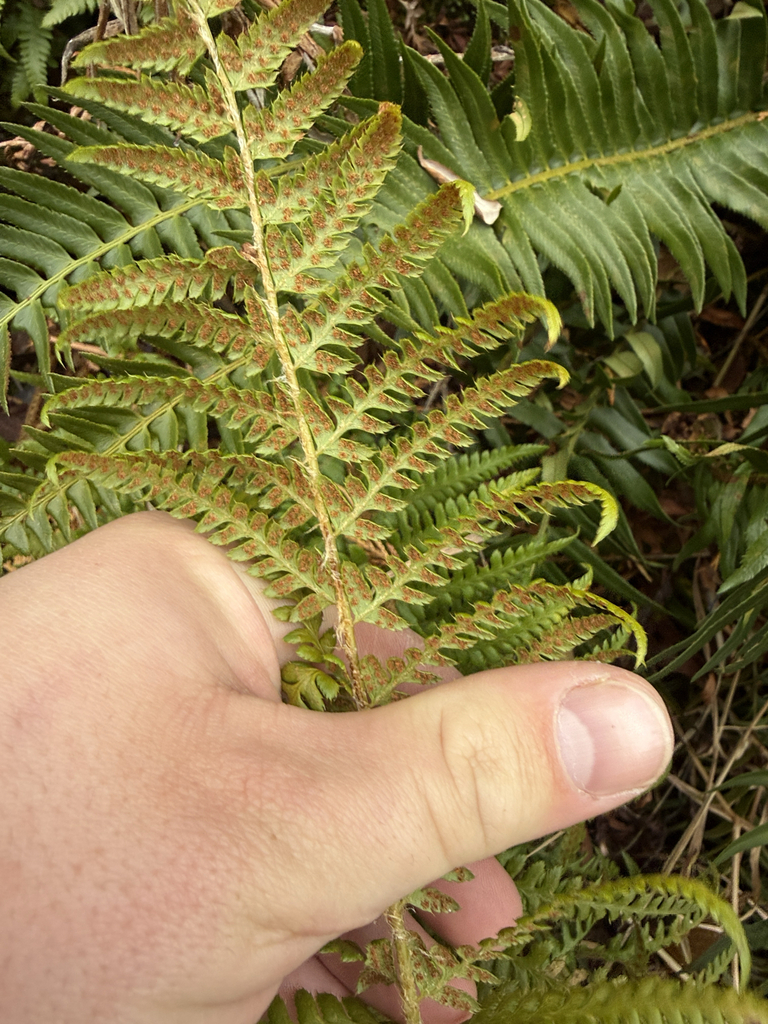
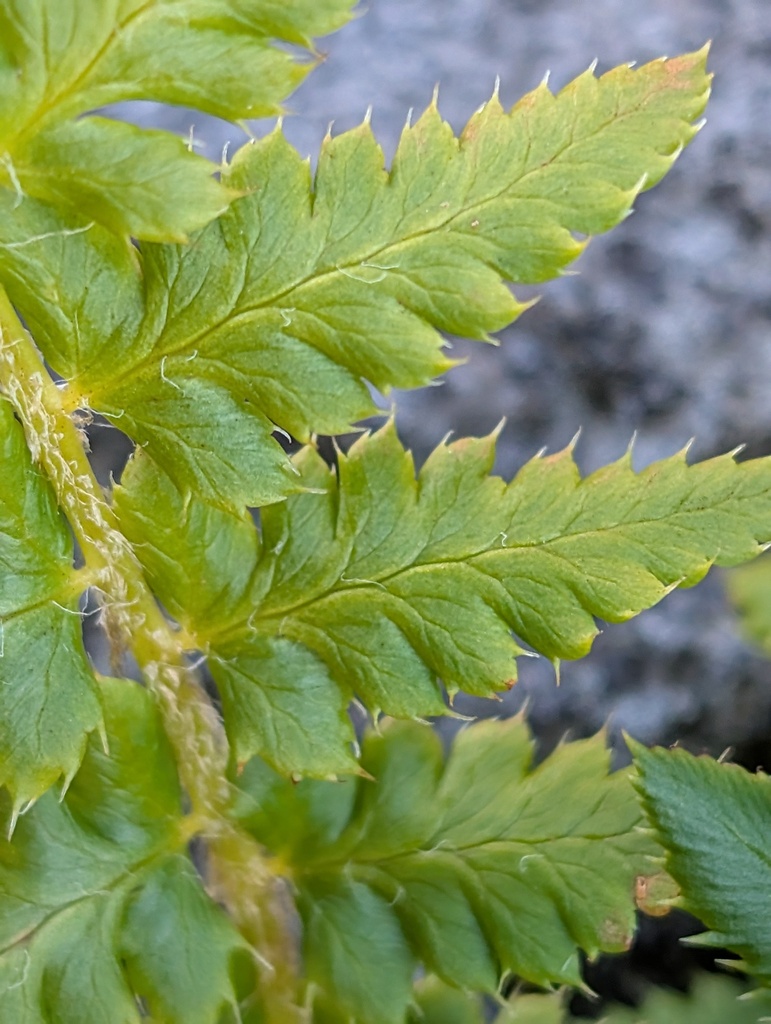
The fronds display the characteristic features of the genus Polystichum. Each leaf segment bears auricles—asymmetrical blade expansions at the base where one side is noticeably longer than the other. The stipes (leaf stalks) are prominently scaled and often carry hair-like cilia, though true hairs are absent. The sori are round with circular indusia, the protective structures that cover the spore-producing tissue on the undersides of the fronds.
These morphological traits distinguish Polystichum andersonii from related genera such as Dryopteris, whose indusia are kidney-shaped rather than circular and whose segments lack the distinctive auricles. The evergreen nature of the fronds means the plant maintains its foliage year-round, providing visual interest and structural presence in the forest understory where it naturally occurs at an average elevation of approximately 1,286 metres.
Distribution and Habitat
Polystichum andersonii, commonly known as Anderson’s Holly Fern, occurs in North America, with records concentrated in two countries: the United States and Canada. The US accounts for 163 documented observations, while Canada contributes 137, indicating a relatively restricted range across the continent’s western regions.
This fern inhabits mid-elevation montane environments, occurring between 1,250 and 1,359 metres altitude, with an average elevation of 1,286 metres. The species shows distinct seasonality in detection patterns, with September representing its peak observational month (81 records). Activity increases notably from May through November, suggesting the fern is most visible during the growing and autumn seasons, with minimal presence recorded in December.
The species demonstrates consistent presence across multiple months, with secondary peaks in June (64 records) and both August and November (33 and 37 records respectively). This extended phenological window indicates that Anderson’s Holly Fern maintains foliage and detectability throughout much of the temperate year, though late autumn and winter months show declining observation frequency.
Biology
Growth
Polystichum andersonii, commonly known as Anderson’s Holly Fern, is an evergreen fern that maintains its fronds year-round. As a member of the Polystichaceae family, it exhibits the characteristic growth pattern of shield ferns, with fronds emerging from a central crown. The plant develops a compact, clumping habit typical of hardy ferns in temperate regions.
Mature specimens form dense rosettes of deeply divided, leathery fronds. The fern grows at a moderate pace, establishing itself gradually in suitable conditions. Its evergreen nature makes it valuable for providing winter structure in woodland and shade gardens where deciduous ferns die back.
Flowering and Fruiting
Like all ferns, Polystichum andersonii does not produce flowers or seeds. Instead, it reproduces via spores, which develop in structures called sori (singular: sorus) located on the undersides of mature fronds. These sporangia release spores when moisture and temperature conditions favour spore dispersal, typically during the growing season. The spores germinate to form gametophytes—small, heart-shaped prothallia—which eventually develop into new ferns under humid conditions.
Cultivation
Anderson’s Holly Fern thrives in partial shade to full shade, making it well-suited to woodland gardens, shaded borders, and understorey planting schemes. It prefers consistently moist but well-drained soil rich in organic matter. While specific soil pH requirements are not documented for this species, ferns in the genus Polystichum generally tolerate neutral to slightly acidic soils.
The fern is cold-hardy and suitable for temperate climates where winter temperatures remain moderate. Once established, it requires regular moisture during the growing season but is more drought-tolerant than many fern species, though extended dry spells should be avoided. Mulching around the base helps retain soil moisture and provides the cool, moist root environment ferns prefer. Minimal maintenance is needed beyond occasional removal of damaged fronds.
Conservation and Threats
Polystichum andersonii, Anderson’s Holly Fern, currently lacks an official IUCN Red List assessment. Without formal evaluation, the conservation status of this species remains undocumented in international databases. The absence of a formal designation does not indicate the species is secure; rather, it reflects limited research attention and data collection efforts directed toward this fern.
Threats
No specific threats have been formally documented for Anderson’s Holly Fern in available scientific literature or conservation databases. The lack of recorded threat data suggests either that the species faces no immediate pressures, or that its ecology and distribution have not been thoroughly surveyed. Like many fern species, potential vulnerabilities may include habitat loss from land conversion, invasive species competition, or changes in forest moisture regimes, but these remain unconfirmed for this particular taxon.
Conservation Efforts
No dedicated conservation programmes or formal legal protections for Polystichum andersonii have been recorded. The species would benefit from baseline ecological surveys to establish population size, distribution range, and habitat requirements. Such information would enable informed conservation planning and guide any future management decisions necessary to protect the species and its forest habitat.
Fun Facts
- Anderson’s Holly Fern belongs to the Polystichum genus, which comprises some of the most cold-hardy ferns on Earth. Several species in this group can survive freezing temperatures that would kill most tropical ferns outright.
- Like all ferns, Polystichum andersonii reproduces via spores rather than seeds, releasing millions of microscopic spores from structures called sori on the undersides of its fronds. A single mature frond can produce enough spores to colonize an entire forest if conditions permit.
- The “holly” in its common name refers to the distinctly spiny leaflets that line its fronds, giving the plant a sharp, defensive appearance that deters herbivores and distinguishes it from softer-textured fern species.
- Ferns in the Polystichum genus have existed largely unchanged for over 100 million years, making them living fossils that survived the mass extinction event that killed the dinosaurs.
- Anderson’s Holly Fern is evergreen, retaining its fronds throughout winter, which allows it to photosynthesize during milder months when deciduous plants around it lie dormant.
- The fronds of holly ferns can persist for multiple years before being shed, creating a dense architectural structure that provides shelter for insects, spiders, and small creatures year-round.
Sources and References
Primary Data Sources
This article draws on information from the following open-access biodiversity databases and reference platforms:
- GBIF — Global Biodiversity Information Facility (gbif.org). Occurrence records, distribution maps, and specimen data for Polystichum andersonii.
- iNaturalist (inaturalist.org). Community observations, photographs, and geographic records contributed by naturalists and researchers.
- Wikidata (wikidata.org). Structured taxonomic and conservation data.
- Wikipedia (wikipedia.org). General species biology and conservation context.
- Encyclopedia of Life — EOL (eol.org). Habitat associations, morphological traits, and ecological information.
- Plants of the World Online — POWO (plantsoftheworldonline.org). Authoritative taxonomic and nomenclatural data maintained by the Royal Botanic Gardens, Kew.
All sources are freely accessible and regularly updated by their respective institutions. Data accuracy depends on the quality and currency of submissions to these platforms.
Ecology
Growing Conditions
Photo Gallery
Noah How · CC BY 4.0
Related Species
Was this profile helpful?