
Amphibia · Caudata
Axolotl
Ambystoma mexicanum
Critically EndangeredAlso known as: Axolote, Mexican Axolotl, Mexican Salamander
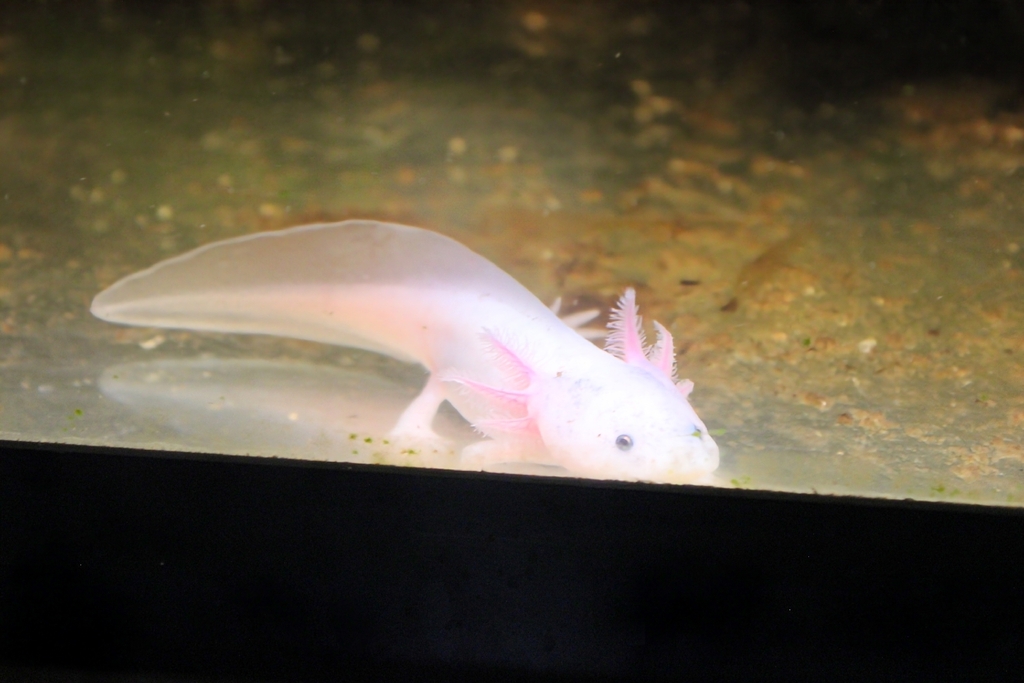
© Julio Cesar Ruiz García · iNaturalist · CC BY 4.0
The axolotl is a peculiar salamander that defies the typical life trajectory of its amphibian relatives. Unlike most of its kind, this Mexican native retains its larval form throughout its life—a phenomenon called neoteny—keeping its feathery external gills, finned tail, and aquatic lifestyle even as a mature adult. Found naturally across just seven countries, the axolotl (Ambystoma mexicanum) is classified as Critically Endangered by the IUCN, its wild populations devastated by habitat loss and water pollution in its native Mexican lakes.
Despite its precarious wild status, the axolotl has become one of the most recognizable amphibians in human care, thriving in captivity and serving as a model organism in laboratories worldwide. This paradox—a species functionally extinct in nature yet thriving in aquariums and research institutions—makes the axolotl a compelling case study in modern conservation challenges and the complex relationship between captive populations and endangered species preservation.
Identification and Appearance
Size and Build
Adult axolotls reach lengths of 15 to 45 centimetres, with most individuals settling around 23 centimetres in typical captive conditions. Specimens exceeding 30 centimetres are uncommon. Sexual maturity occurs between 18 and 27 months of age. The body is stocky and elongated, supported by four short, slender limbs that provide minimal propulsion—the axolotl relies primarily on its powerful tail for swimming.
Distinctive Features
The axolotl retains larval characteristics throughout its life, a phenomenon known as neoteny. Most striking are the feathery external gills that branch from both sides of the head, functioning for aquatic respiration. A prominent caudal fin extends from behind the head to the vent, providing the primary means of locomotion. The head is broad and flattened, with a perpetual smile created by the shape of the mouth. Small eyes lack functional eyelids.
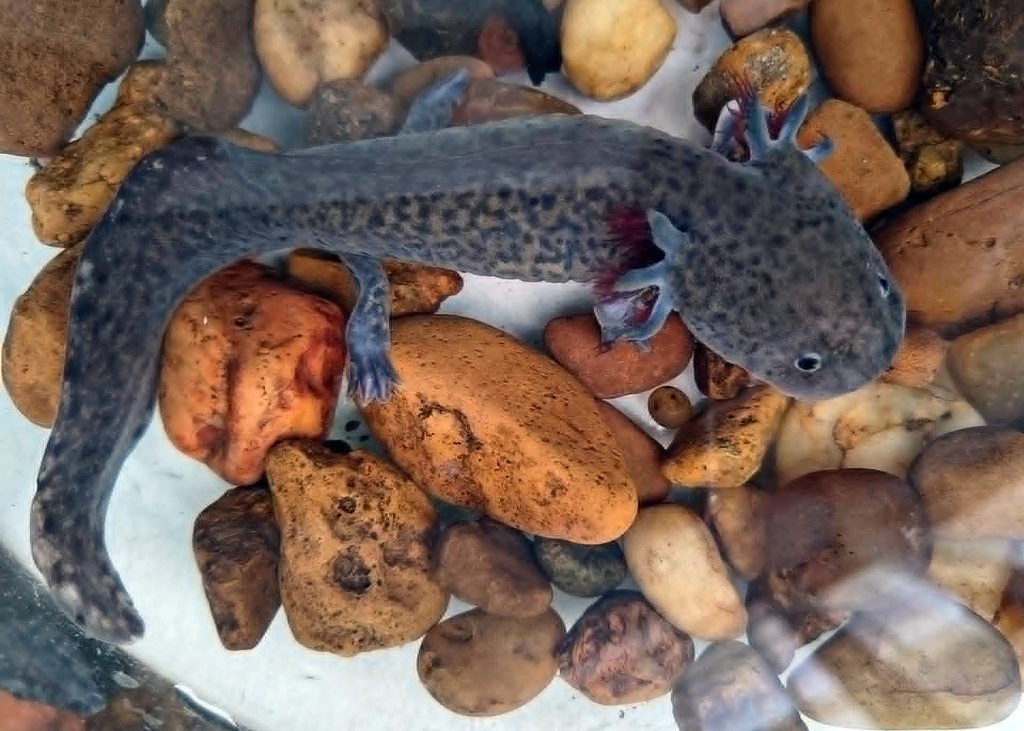
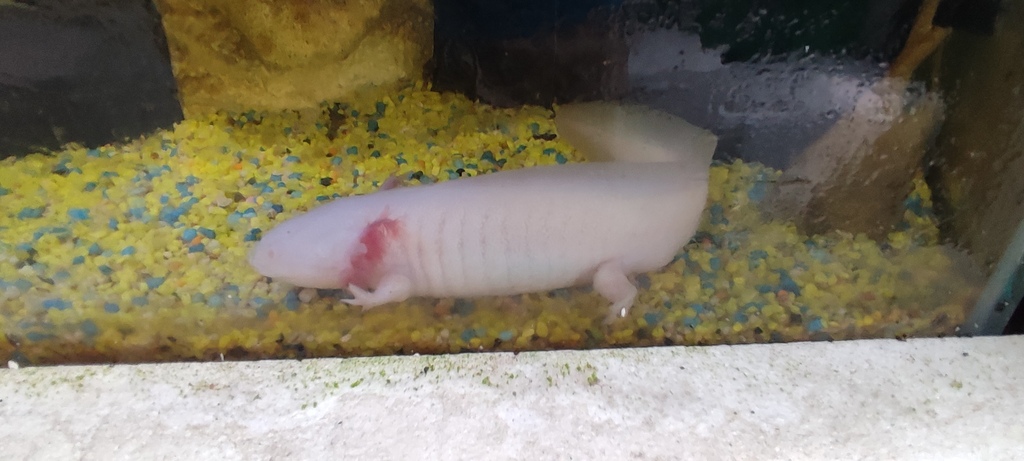
Coloration varies considerably. Wild-type axolotls are typically dark brown or olive with lighter underbellies. Captive-bred specimens display diverse phenotypes: leucistic (pale pink or white body with dark eyes), albino (pink or white with pink eyes), and melanistic (entirely dark or black) forms are common in the pet trade. Some individuals show irregular spotting or mottled patterns. Weight ranges from 60 to 110 grams for healthy adults.
Sexual Dimorphism
Males are generally smaller and more slender than females, with a more pronounced cloaca. Breeding males develop swollen cloacal glands during the reproductive season. Females are noticeably heavier-bodied, particularly when gravid with eggs, and lack the prominent cloacal swelling characteristic of males.
Distribution and Habitat
Ambystoma mexicanum records are concentrated in Mexico, where the species originates. GBIF records show Mexico accounts for the majority of documented specimens (209 records), reflecting the axolotl’s native range in the country’s high-altitude freshwater systems. Beyond its native range, the species has been recorded in six additional countries, with notable presence in the United Kingdom (81 records), Canada (3 records), and smaller numbers in Germany, the United States, New Zealand, and Austria. This geographic spread reflects the axolotl’s popularity in the international pet trade and research communities.
The species inhabits mountainous terrain at elevations ranging from 425 to 2,366 metres, with observations clustering at high altitudes—the average elevation of recorded sightings is 2,255 metres. This preference for cool, high-elevation environments reflects the axolotl’s origin in Mexico’s volcanic lake systems, particularly in the vicinity of Mexico City. The axolotl naturally occurs in freshwater lakes, springs, and associated water bodies characterized by cool temperatures and high oxygen levels.
Seasonal activity shows a pronounced peak in January, with 38 records concentrated in that month. November also registers substantial observations (22 records), while summer months (June through August) show notably lower activity levels, with August recording only 3 sightings. This seasonal pattern likely reflects cooler water temperatures in winter months, which favor axolotl activity and reproduction in their native habitat.
Biology and Behaviour
Behavior
Axolotls are predominantly nocturnal and solitary amphibians, spending much of the day resting on the bottom of their aquatic habitat or among vegetation. They are sedentary hunters that rely on detecting movement and vibrations in the water rather than active pursuit. When disturbed, axolotls can autotomize—shed—their limbs, fins, and tail to escape predators; remarkably, they regenerate these structures completely within weeks. This ability is one of their most distinctive traits and reflects their unusual retention of larval characteristics throughout life.
Axolotls exhibit minimal social interaction. In captivity, individuals tolerate proximity to one another but do not form bonds or hierarchies. They occasionally cannibalize smaller or injured conspecifics, particularly when hungry or stressed. Activity levels increase during feeding times and in response to tank changes or disturbance. Most of their time is spent in low-energy states, moving only to reposition themselves or to feed when prey is nearby.
Diet
Axolotls are carnivorous and benthic feeders, consuming invertebrates, small fish, and amphibian eggs in their native habitat. They feed primarily on aquatic insect larvae, crustaceans, mollusks, and other small aquatic prey. In captivity, they readily eat earthworms, bloodworms, salmon pellets, and small fish. Feeding occurs opportunistically—they are ambush predators that detect prey through lateral line sensitivity and water movement. Juveniles require more frequent feeding than adults and consume proportionally larger quantities relative to body size.
Reproduction
Axolotls breed year-round in captivity but show seasonal patterns in the wild, with peaks during cooler months. Reproduction is entirely aquatic. Males produce spermatophores—small gelatinous packets containing sperm—which females collect and internalize. Courtship involves ritualized movements: the male leads the female in a loop while releasing spermatophores along the substrate, which she then picks up with her cloaca. Fertilization is internal.
Females lay between 300 and 1,000 eggs, depending on size and condition, attaching them singly or in small clusters to plants, rocks, or other submerged surfaces. Incubation lasts 10–14 days at standard aquarium temperatures (around 20 °C). Upon hatching, larvae are independent immediately and receive no parental care. Juveniles reach sexual maturity between 12 and 18 months of age. The species shows remarkable reproductive plasticity and will breed repeatedly throughout its life, with a typical lifespan of approximately 17 years in captivity.
Conservation and Threats
Ambystoma mexicanum, the axolotl, is classified as Critically Endangered on the IUCN Red List. This designation reflects the species’ extremely restricted range and the severe degradation of its native habitat in Mexico. The axolotl survives today almost exclusively in captivity; wild populations in Lake Xochimilco near Mexico City have been reduced to remnant numbers, making the species one of the most threatened amphibians globally.
Threats
The primary threat to wild axolotls is habitat destruction and pollution. Lake Xochimilco, the species’ sole natural refuge, has undergone dramatic environmental degradation due to urbanization, water extraction, and industrial contamination. The lake’s water quality has deteriorated substantially, and its surface area has shrunk over decades as the surrounding city of Mexico City expanded.
Invasive fish species pose a direct biological threat. The introduction of Nile tilapia and common carp into Lake Xochimilco has created intense predation pressure on axolotls. These exotic fish reduce axolotl activity levels, severely impairing their foraging and mating opportunities—behavioral impacts that directly threaten survival and reproduction. Although the chytrid fungus Batrachochytrium dendrobatidis has been detected in axolotls, the species displays natural resistance to this pathogen and to B. salamandrivorans, meaning fungal disease is not considered a major threat at present.
Conservation Efforts
Captive-bred axolotls represent a critical reservoir for the species. Conservation programmes have explored returning captive individuals to unpolluted bodies of water or to Lake Xochimilco itself. However, successful reintroduction faces severe obstacles: the lake’s ongoing pollution, the established invasive fish populations, and continued urbanization of the surrounding region mean that translocated axolotls could face the same ecological pressures that decimated wild populations. Any reintroduction strategy must address these environmental conditions to have meaningful long-term success.
Cultural Significance
The axolotl holds profound significance in Mexican heritage, rooted in Aztec mythology and pre-Columbian traditions. The species’ scientific name reflects its cultural importance—Ambystoma mexicanum acknowledges both its taxonomic classification and its origin in the freshwater lakes of Mexico. In its native range, particularly in remnant populations around Mexico City, the axolotl has become a symbol of Mexico’s unique biodiversity and ecological legacy.
Today, the axolotl’s cultural relevance extends far beyond Mexico. The species has become one of the most recognizable amphibians in scientific research, education, and popular culture worldwide. Its distinctive appearance—feathery external gills, perpetual smile, and neotenic (juvenile) form—has made it an iconic figure in aquaculture and the exotic pet trade. This global popularity, however, stands in stark contrast to the species’ desperate situation in the wild.
The contrast between the axolotl’s thriving presence in captivity and its vanishing wild populations underscores a paradox in modern conservation: a species that has become familiar to millions through pet ownership and laboratory use remains functionally extinct in nature. This disconnect highlights the urgent need to protect remaining wild populations and their fragmented lake ecosystems in Mexico, where the species’ cultural and evolutionary significance originated.
Fun Facts
- Axolotls are neotenic, meaning they reach sexual maturity and can reproduce without ever undergoing metamorphosis—a biological trick that keeps them in their juvenile form throughout their entire lives.
- Adult axolotls retain obvious external gills that look like delicate feathered branches sprouting from the sides of their heads, allowing them to breathe directly from the water rather than developing lungs as most salamanders do.
- Because axolotls never leave the water and keep their larval features, they are nearly impossible to distinguish from the aquatic larvae of tiger salamanders at first glance—a resemblance that has confused naturalists and researchers for centuries.
- Axolotls possess an extraordinary capacity for regeneration, capable of regrowing lost limbs, eyes, spinal cord tissue, and even portions of their brain with nearly perfect functionality restored.
- In the wild, axolotls are endemic to Mexico and historically inhabited only the lakes surrounding Mexico City, making them one of the world’s most geographically restricted amphibians.
- The species name mexicanum comes from the Aztec deity Xolotl, the god of fire and the underworld, reflecting the cultural significance of these creatures in pre-Columbian Mesoamerica.
- Axolotls can live 10–15 years in captivity, far outlasting most other salamanders, and they have become one of the most popular exotic pets and laboratory animals worldwide.
Ecology
Diet
Conservation Status
LC · NT · VU · EN · CR (Critically Endangered) · EW · EX
Photo Gallery
Julio Cesar Ruiz García · CC BY 4.0
Related Species
Was this profile helpful?