
Amphibia · Caudata
Spotted Salamander
Ambystoma maculatum
Least ConcernAlso known as: Yellow-spotted Salamander
© naturalist charlie · iNaturalist · CC BY 4.0
The Spotted Salamander is a stocky, dark-bodied amphibian marked by bright yellow or orange spots that run in two rows down its back—a striking advertisement of caution to potential predators. Found across eastern North America, this member of the mole salamander family spends most of its life hidden beneath logs, leaf litter, and soil, emerging only during breeding season when heavy rains trigger mass migrations to vernal pools. With populations present in two countries and listed as Least Concern by the IUCN, Ambystoma maculatum remains one of the more abundant salamanders in its range.
What makes this species particularly compelling is its dual life strategy: a cryptic terrestrial existence punctuated by explosive breeding events that transform quiet wetlands into amphibian nurseries overnight. Its dependence on intact vernal pool networks and unfragmented forest corridors highlights the often-invisible threats facing woodland species in developed regions.
Identification and Appearance
Ambystoma maculatum is a medium-sized mole salamander measuring 15–25 cm in total length, including the tail. The body is stout and robust, with a notably wide snout that is characteristic of the mole salamander group. The species exhibits little variation in basic body proportions, though females tend to reach larger sizes than males.
Coloration and Markings
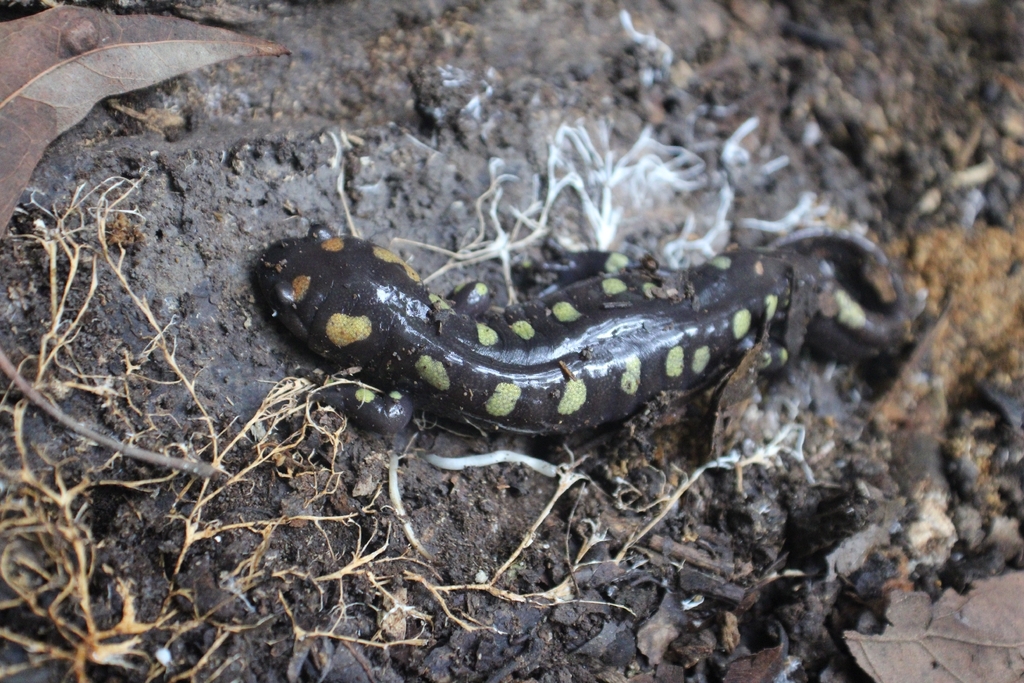
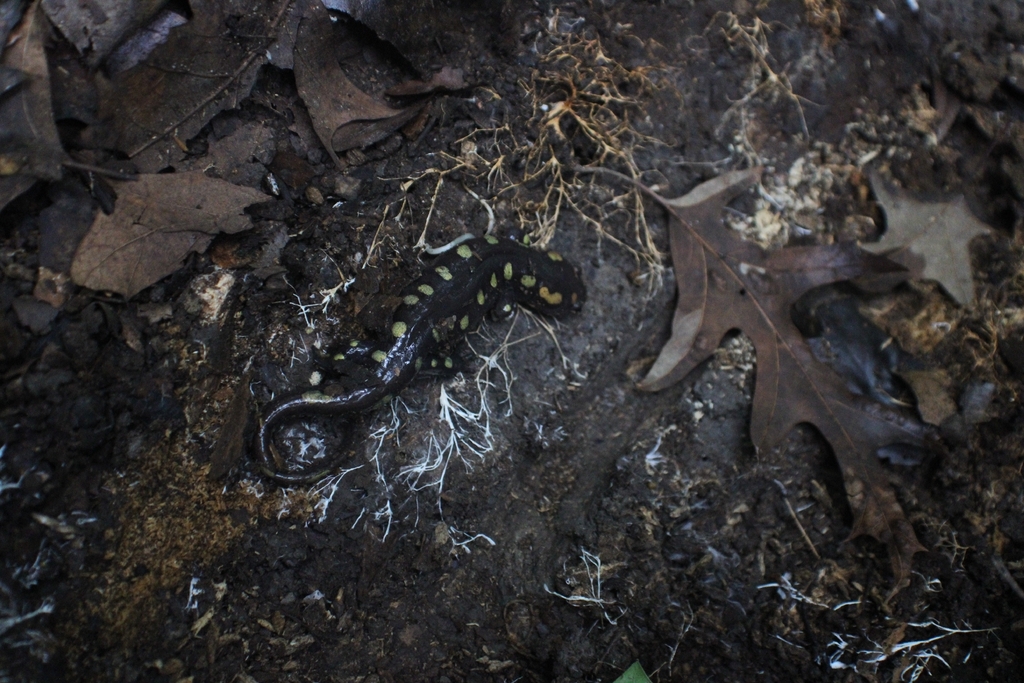
The spotted salamander’s base coloration is black, though individuals may display bluish-black, dark gray, dark green, or dark brown hues instead. The most distinctive feature is a pair of uneven longitudinal rows of yellowish-orange spots that run from the top of the head near the eyes all the way to the tip of the tail along the dorso-lateral surface. These spots are highly variable in size and arrangement between individuals, making them useful for individual identification but not always reliable for quick field recognition of younger specimens.
The ventral surface is typically darker and less boldly marked than the dorsal side. During the breeding season, males may develop slightly swollen cloacal regions, but this is a subtle distinction. Juveniles resemble adults in pattern but are proportionally smaller, with spots that may appear less vivid until the salamander reaches maturity.
Distribution and Habitat
Ambystoma maculatum, the Spotted Salamander, occurs across a limited geographic range in North America. GBIF records show the species is predominantly found in the United States, with 298 documented observations, and has a minor presence in Canada with 2 records. The distribution spans two countries total, reflecting the species’ restricted breeding range in eastern and central portions of the continent.
The Spotted Salamander demonstrates a pronounced seasonal occurrence pattern centered on late winter and early spring. February represents the peak activity month with 234 GBIF records, followed by January with 66 records. This narrow temporal window corresponds to the species’ reproductive season, when adults migrate to breeding ponds. No observations were recorded during the remaining ten months, indicating that individuals are either inactive, concealed in woodland refugia, or not actively documented during the warmer months.
Specific elevation data is not currently available in distribution records for this species. The salamander inhabits deciduous and mixed forests across its range, favoring areas with temporary wetlands, ephemeral ponds, and vernal pools that serve as breeding grounds. Adults spend much of the year in moist woodlands and leaf litter, emerging only during the spring breeding season to travel to aquatic breeding sites.
Biology and Behavior
Behavior
Spotted salamanders are nocturnal and spend most of their time underground in burrows, leaf litter, and beneath logs. They emerge primarily during wet weather, particularly on warm, rainy nights in spring when breeding migrations occur. These salamanders are solitary outside of the breeding season and show minimal social interaction with other individuals. They move slowly across the forest floor, relying on moisture to keep their skin hydrated and permeable for oxygen absorption.
A distinctive feature of Ambystoma maculatum is its ability to form a mutualistic relationship with the green alga Oophila amblystomatis. The alga lives within the salamander’s egg capsules and provides oxygen through photosynthesis while receiving shelter and nutrients in return. This symbiosis is particularly important in oxygen-poor pond environments during larval development.
Diet
Spotted salamanders are carnivorous and feed primarily on small invertebrates found in soil and leaf litter. Their diet includes earthworms, insects, insect larvae, millipedes, centipedes, and small arthropods. They are ambush predators that use minimal movement and rely on their sensitive lateral line system to detect vibrations and prey movement in their dark underground habitat.
Reproduction
Breeding occurs in early spring, typically between late February and April, triggered by warming temperatures and heavy rains. Males and females migrate to breeding ponds, often traveling considerable distances from their terrestrial habitats. Males deposit spermatophores on the pond bottom, which females pick up with their cloaca during complex courtship encounters. A single female lays 100 to 300 eggs in gelatinous masses attached to submerged vegetation or debris.
Eggs hatch within 3 to 12 weeks depending on water temperature and light availability. Larvae remain aquatic for 2 to 8 months, feeding on small crustaceans, insects, and tadpoles before metamorphosing into terrestrial juveniles. Sexual maturity is reached at 5 to 7 years of age. Spotted salamanders can live up to 32 years in the wild, making them among the longest-lived salamanders in North America.
Conservation and Threats
Ambystoma maculatum, the Spotted Salamander, holds a conservation status of Least Concern according to the IUCN Red List. This designation reflects a species with a broad geographic range across eastern North America and no documented severe decline in overall population numbers. However, the species remains vulnerable to localized habitat loss and fragmentation, particularly in regions undergoing rapid urbanization and agricultural development.
Threats
The primary threat to Spotted Salamanders is the loss and degradation of breeding wetlands. These amphibians depend on temporary and permanent ponds for their larval development, and the draining of such habitats—whether for development, agriculture, or other land use changes—directly reduces breeding opportunities. Road mortality poses a secondary but significant threat, particularly during spring migration when large numbers of adults travel to breeding sites and cross roadways with heavy traffic.
Forest fragmentation also impacts Spotted Salamander populations by isolating breeding ponds from surrounding woodlands where adults spend most of the year. This disconnection limits gene flow between populations and makes it difficult for individuals to locate suitable breeding habitat. Additionally, pollution of breeding waters—from agricultural runoff, road salt, and industrial discharge—can compromise water quality and affect salamander development.
Conservation Efforts
In regions where Spotted Salamanders occur, several conservation strategies have been implemented. Many states and provinces protect breeding wetlands through environmental legislation, and some jurisdictions have established amphibian-friendly road crossing protocols during peak migration periods. Land conservation organizations work to preserve intact forest-wetland complexes that maintain viable Spotted Salamander populations.
Cultural Significance
The Spotted Salamander has emerged as a conservation icon in North America, transcending its role as a mere amphibian to become a symbol of environmental stewardship and habitat protection. This prominence reflects broader cultural shifts toward recognizing the intrinsic value of small, often overlooked creatures and the ecosystems they inhabit. The species’ distinctive appearance—dark body with bright yellow or orange spots—has made it visually memorable, helping it feature in educational materials and public awareness campaigns about amphibian conservation.
Unlike many salamander species with folklore associations or medicinal uses in traditional cultures, Ambystoma maculatum poses no known adverse effects on humans, making it a benign presence in ecosystems where people and wildlife coexist. This absence of conflict has allowed the species to be appreciated primarily for its ecological significance rather than feared or exploited. In contemporary culture, the Spotted Salamander has gained particular attention as a focal point for vernal pool conservation efforts, with citizen science initiatives and community-led habitat restoration projects using the species as an umbrella organism to protect entire woodland-pool ecosystems.
Fun Facts
The spotted salamander is one of North America’s most extraordinary amphibians, combining remarkable biology with surprising cultural significance. Here are some of the most compelling facts about this secretive creature.
- The spotted salamander harbors symbiotic algae that live inside and around its embryos, providing oxygen and nutrients while the salamander supplies the algae with nitrogen and a protected environment—a partnership unique among all vertebrates.
- This species is the state amphibian of two U.S. states: Ohio and South Carolina, reflecting its ecological and cultural importance across its broad North American range.
- Spotted salamanders range from Nova Scotia and Lake Superior in the north to southern Georgia and Texas in the south, spanning one of the largest distributions of any mole salamander species.
- Members of the mole salamander family Ambystomatidae, spotted salamanders are highly fossorial, spending most of their lives buried in soil and leaf litter where they hunt invertebrates.
- During spring migrations to breed, spotted salamanders travel from their underground burrows to vernal pools—ephemeral wetlands that fill with water only seasonally—sometimes traveling over 1 kilometre to reach breeding sites.
- Larval spotted salamanders develop rapidly in vernal pools, often completing metamorphosis before the pools dry up, ensuring they return to terrestrial life before their aquatic nursery vanishes.
Conservation Status
LC (Least Concern) · NT · VU · EN · CR · EW · EX
Photo Gallery
naturalist charlie · CC BY 4.0
Related Species
Was this profile helpful?