
Agaricomycetes · Agaricales
Fly Agaric
Amanita muscaria
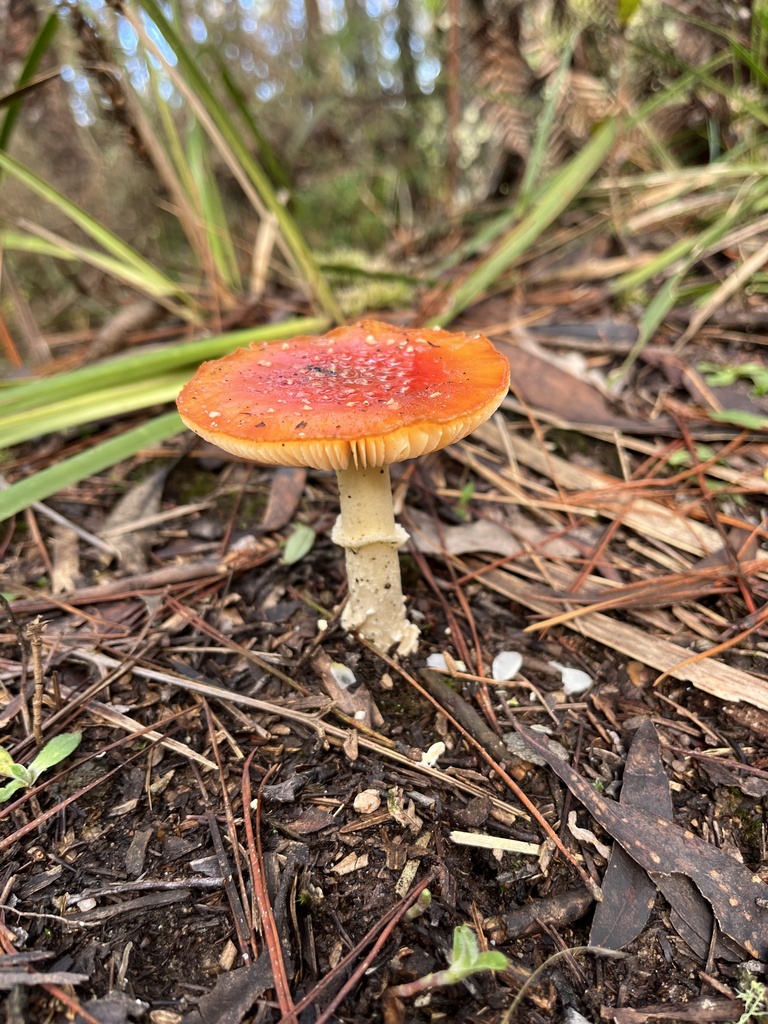
© Todd Huang · iNaturalist · CC BY 4.0
Scientific Classification & Quick Facts
Classification
Known For
Detailed measurements for this species are still being verified.
The fly agaric is one of the most recognizable fungi on Earth—a scarlet cap dotted with white warts, conjured in fairy tales and fantasy art so persistently that many people encounter its image before they ever see the real thing. Amanita muscaria is a basidiomycete fungus distributed across at least 7 countries, primarily in the Northern Hemisphere, where it forms symbiotic relationships with tree roots in temperate and boreal forests. Its conservation status remains unknown, reflecting how little we understand about the population dynamics of many fungal species despite their ecological importance.
What makes this fungus especially notable is the gap between its iconic status and its genuine biology. Few people know that fly agaric is toxic to humans, containing ibotenic acid and muscimol, compounds that affect the nervous system and have made it a subject of both ethnobotanical interest and serious poisoning cases. Yet it thrives in forests across much of the temperate world, playing an essential role as a mycorrhizal partner—a relationship that may be far more important to forest health than its human associations suggest.
Identification and Appearance
Amanita muscaria is a large, highly conspicuous mushroom that grows singly or in groups with fruiting bodies at various stages of development. The fungus is unmistakable in appearance and among the most recognisable mushroom species worldwide.
Cap and Colour
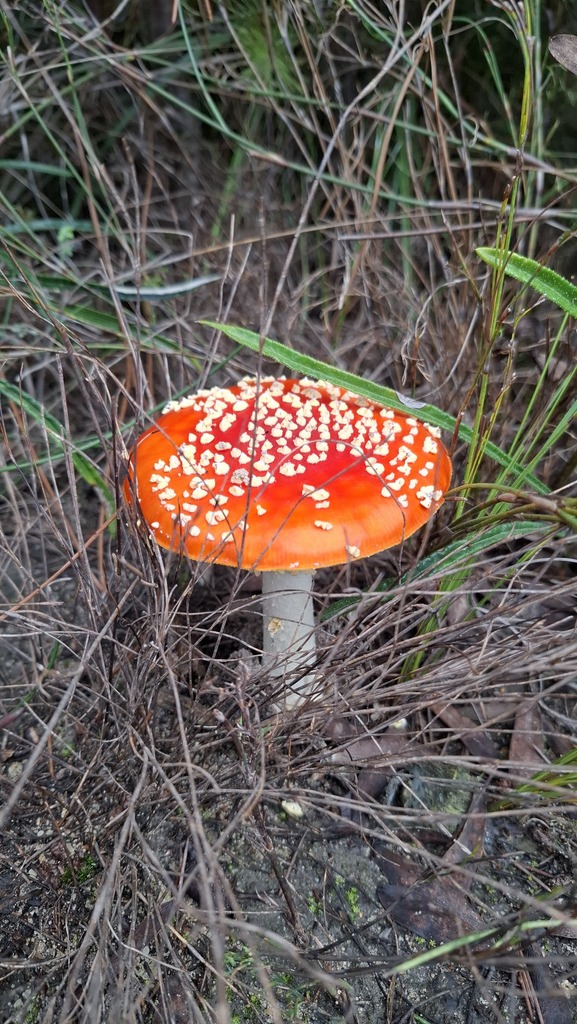
Young fruiting bodies emerge from the soil enclosed in a white, egg-like universal veil. As the mushroom breaks through this membrane and expands, a vibrant red or orange-red cap becomes visible. The cap surface bears small white to yellow pyramid-shaped warts that are remnants of the universal veil. These warts do not increase in size as the mushroom matures; instead, they become proportionally less prominent as the cap expands. Dissecting young specimens reveals a characteristic yellowish layer of skin beneath the veil, which aids identification.
Stem and Base
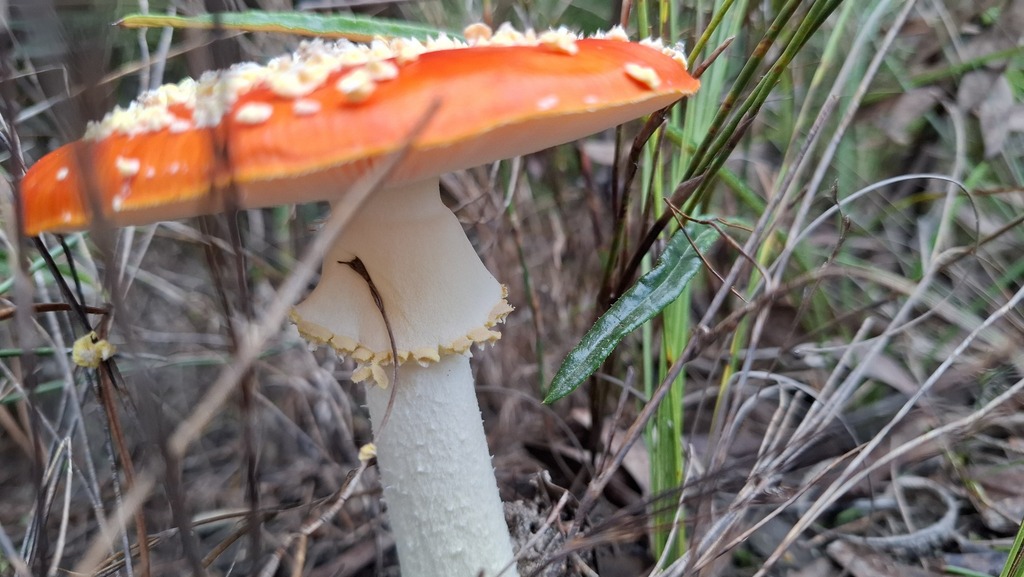
The stem is white and cylindrical, typically with a bulbous or cup-like base. A prominent white ring (annulus) circles the upper portion of the stem, another remnant of the universal veil. The base is often surrounded by one or more white cup-shaped structures (volva) that are fragments of the veil’s lower portion. These basal features are diagnostic and essential for accurate field identification.
Distribution and Habitat
Amanita muscaria has a wide but uneven global distribution, with the strongest documented presence in the United States, where over 220 records have been compiled. New Zealand follows with 51 records, Portugal with 21, and smaller populations recorded in Colombia, Spain, Great Britain, and Chile. The species appears to be established across multiple continents, though observational data suggests concentrations in temperate and subtropical regions.
Occurrence data shows a sharp seasonal pattern, with the overwhelming majority of observations concentrated in January (300 records), while all other months record zero documented sightings in the compiled dataset. This strongly suggests that Amanita muscaria fruiting is highly seasonal and peaks during the Northern Hemisphere winter or Southern Hemisphere summer—a pattern consistent with the species’ mycology in temperate forests. Elevation data is not currently available for this species.
The specific habitat preferences for this fungus remain incompletely documented in the current dataset. Traditionally, Amanita muscaria forms ectomycorrhizal associations with conifers and hardwoods in cool, moist forest environments. Its presence across geographically isolated regions—from North American temperate forests to New Zealand’s mixed woodlands—suggests ecological flexibility within similar climate zones, though localised habitat requirements likely vary by region and host tree availability.
Ecology and Lifecycle
Lifecycle
Amanita muscaria follows the typical fungal lifecycle of a basidiomycete, beginning with vegetative mycelium that colonizes soil and organic matter. The mycelium remains dormant underground for extended periods, drawing nutrients from decaying plant material and forming associations with host plants. When environmental conditions align—typically autumn moisture and moderate temperatures—the fungus directs energy toward fruiting body formation.
The iconic red-capped mushroom emerges from a universal veil, breaking through the soil surface over several days. Beneath the cap, gills develop and mature, eventually producing millions of microscopic spores. These spores are released into the air and dispersed by wind, traveling considerable distances before settling in new locations. A single fruiting body can release enough spores to establish infection across multiple hectares of suitable habitat.
Ecological Role
Amanita muscaria forms ectomycorrhizal relationships with numerous tree species, particularly birches, conifers, and willows. The fungal partner colonizes the fine root tips of these plants, extending its hyphal network into the soil to absorb water and mineral nutrients—especially nitrogen and phosphorus—which it transfers to the host plant. In exchange, the tree provides carbohydrates produced through photosynthesis, creating a mutually beneficial arrangement essential to forest nutrient cycling.
Beyond this symbiotic role, the fruiting bodies contribute to forest ecology by supporting invertebrate fauna. Insects and other arthropods consume the mushroom tissue and lay eggs within it, while small mammals and birds may feed on the fruiting bodies themselves. The decomposition of spent fruiting bodies returns nutrients to the soil, completing the nutrient loop within forest ecosystems.
Uses
Amanita muscaria has held cultural significance across Eurasia for centuries, appearing in shamanic and religious rituals in Siberia and other regions. Historically, some communities used preparations of the mushroom for its psychoactive compounds—ibotenic acid and muscimol—in spiritual or ceremonial contexts. However, modern scientific understanding and widespread toxicity awareness have made such use rare outside strictly controlled anthropological or ethnobotanical research contexts.
Conservation and Threats
Amanita muscaria, the fly agaric, has not been formally assessed by the International Union for Conservation of Nature (IUCN) and therefore lacks an official Red List status. This absence of formal evaluation does not indicate rarity or stability; rather, it reflects the practical reality that many fungal species—even widespread and well-known ones—remain outside the scope of routine conservation assessment. The species shows an increasing population trend across much of its native and introduced range, suggesting it faces no immediate threat to its global survival.
Threats
No major threats to Amanita muscaria have been documented. The species is highly adaptable, establishing itself readily in disturbed habitats, gardens, and forests across multiple continents. Its mycorrhizal relationship with birch and other trees allows it to persist in diverse ecosystems, and its prolific spore dispersal ensures effective reproduction and range expansion. Unlike many fungal species dependent on old-growth forest or specialized host plants, fly agaric thrives in conditions favourable to human activity.
Conservation Efforts
Formal conservation programmes do not exist for this species, as none are necessary. Amanita muscaria is not subject to harvesting restrictions or international trade regulations in most jurisdictions. Some regions discourage or regulate collection to prevent accidental human poisoning, particularly where the species grows in proximity to residential areas or is confused with edible mushrooms by inexperienced foragers. In countries where wild mushroom harvesting is controlled, fly agaric collection may be limited by general fungal protection laws that aim to preserve fungal diversity and ecosystem function.
Cultural Significance
The fly agaric’s distinctive red-and-white spotted appearance has secured its place as one of the most recognizable fungi in Western culture. The toadstool features prominently in children’s literature and decorative arts, particularly in depictions of gnomes and fairies—from garden ornaments to the Smurfs franchise, where the mushroom serves as both seat and dwelling. Its presence in visual art extends back centuries: it appears subtly in Hieronymus Bosch’s The Garden of Earthly Delights (left panel) and became a central motif during the Victorian era, when fairy painters made it a focal point of their work. Moritz von Schwind’s 1851 painting of Rübezahl exemplifies this romantic fascination. Two modern cultural touchstones—the Super Mushroom power-ups and platforms in the Mario video game franchise, and the dancing mushroom sequence in Disney’s 1940 film Fantasia—have cemented the fly agaric as a globally recognized symbol.
Descriptions of fly agaric intoxication have influenced literary depictions of altered perception for over two centuries. Oliver Goldsmith’s 1762 novel The Citizen of the World documented the practice of consuming the urine of those who had eaten the mushroom—a method recorded among Siberian peoples by Philip von Strahlenberg in accounts published in English in 1736. Naturalists including Mordecai Cubitt Cooke recorded the characteristic distortions of object size experienced during intoxication, observations widely believed to have inspired the transformative effects in Lewis Carroll’s 1865 Alice’s Adventures in Wonderland. Charles Kingsley’s 1866 novel Hereward the Wake featured a hallucinogenic scarlet toadstool from Lapland as a plot device. More recently, Thomas Pynchon’s 1973 Gravity’s Rainbow includes detailed descriptions of A. muscaria preparation, and Alan Garner’s 2003 novel Thursbitch explores fly agaric shamanism in the context of a surviving Dionysian cult in the Peak District.
Fun Facts
Amanita muscaria, the fly agaric, is one of the world’s most recognizable fungi—yet its biology and history reveal layers of complexity that defy its iconic image. From its use as a pesticide to its unexpected success as an invader, this mushroom has shaped human culture and ecosystems in ways that extend far beyond its striking red and white appearance.
- Its common name likely stems from its historical use as a fly poison—the mushroom was crushed and mixed with milk to kill household flies and other insects, a practice documented across Europe for centuries.
- The fly agaric is a mycorrhizal fungus that forms symbiotic partnerships with tree roots, particularly birches and conifers, trading nutrients from the soil for sugars produced by the tree’s photosynthesis.
- Originally native only to the Northern Hemisphere, fly agaric has become naturalized across the Southern Hemisphere, including Australia and New Zealand, where it now grows in planted forests of introduced trees.
- In some regions where it has spread beyond its native range, fly agaric behaves as an invasive species, outcompeting local fungi and altering forest mycorrhizal communities.
- The distinctive white warts covering its crimson cap are remnants of the universal veil—a protective membrane that enclosed the young mushroom during development and breaks apart as the fruiting body expands.
- Its toxic compounds, principally ibotenic acid and muscimol, affect the nervous system rather than the digestive system, producing effects ranging from euphoria to hallucinations to severe poisoning depending on dose and individual response.
- Archaeological and ethnobotanical evidence suggests fly agaric may have been used in shamanic and ritualistic contexts by Siberian peoples for thousands of years, making it one of humanity’s oldest documented psychoactive substances.
Ecology
Habitats
Behavior
Edibility
Photo Gallery
Todd Huang · CC BY 4.0
Related Species
Was this profile helpful?