
Insecta · Hymenoptera
Fourmi Céphalote
Atta cephalotes
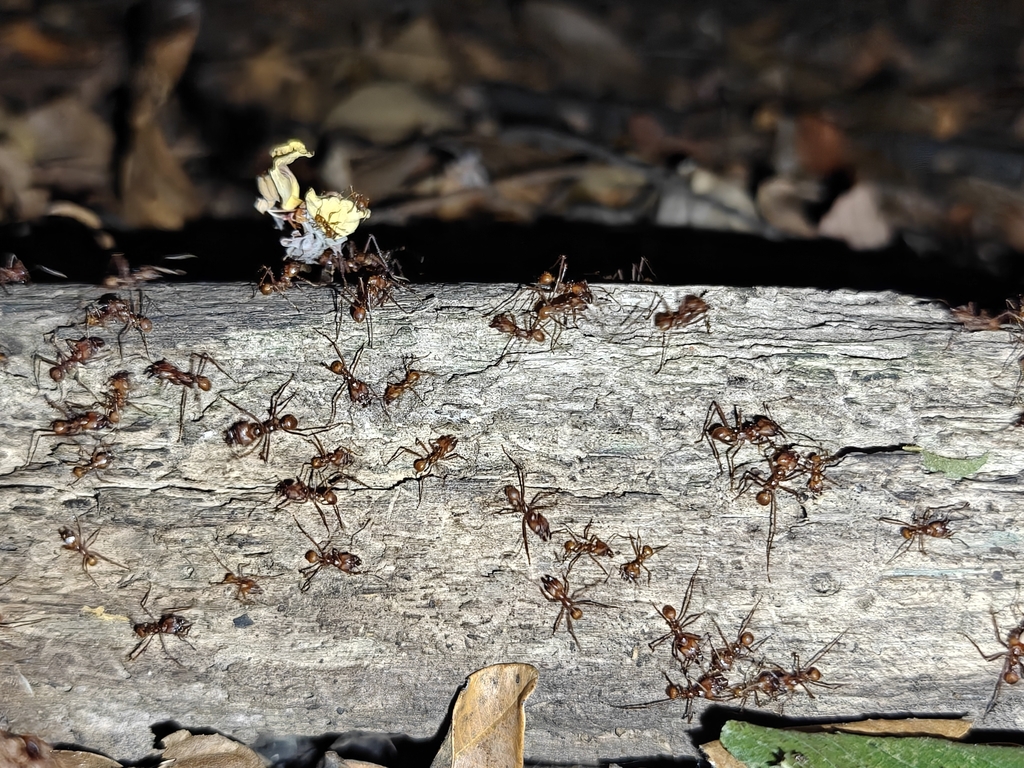
© Ansil B.R. · iNaturalist · CC BY 4.0
Scientific Classification & Quick Facts
Classification
At a Glance
Atta cephalotes, the Fourmi Céphalote, is a leafcutter ant whose colonies operate as sophisticated agricultural societies, cultivating fungal gardens beneath the forest floor across the neotropics. These insects do not consume the leaves they harvest; instead, they use them as substrate to farm fungi, their sole food source. This behavior—farming on a scale that rivals human agriculture in efficiency and organization—places them among the most complex non-human societies on Earth.
Found across 16 countries in Central and South America, Atta cephalotes remains widely distributed throughout its range, though its conservation status is currently unknown. Colony sizes can exceed five million individuals, each with specialized roles determined by body size and developmental stage. The largest workers, called soldiers, defend the nest and cut leaves; intermediate workers transport fragments; and the smallest workers tend the fungal gardens with meticulous care.
What makes this species particularly compelling is the sheer scale and precision of its social organization: a single mature colony excavates underground chambers spanning hundreds of square meters and processes up to 20 kilograms of fresh vegetation annually. Understanding how Atta cephalotes coordinates labor, manages disease, and maintains fungal cultivation offers insights into the evolution of complex behavior and resource management in insects.
Identification and Appearance
General Description
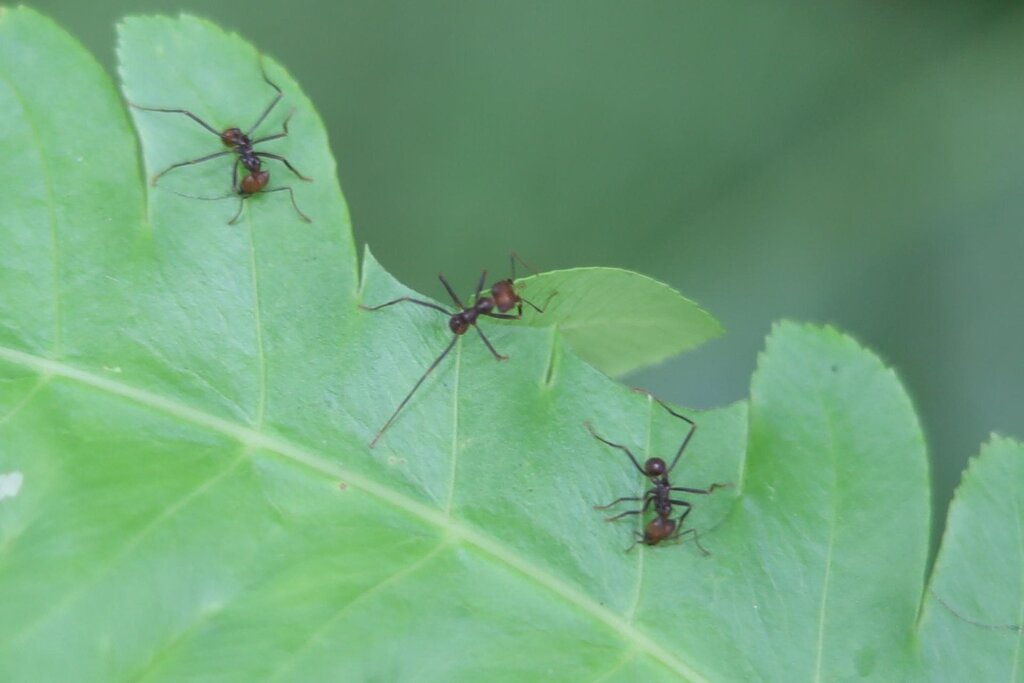
Atta cephalotes, commonly known as the Fourmi Céphalote or leafcutter ant, is a polymorphic species exhibiting dramatic size variation across colony castes. Unlike monomorphic ant species with uniform worker sizes, this species displays distinct size classes that correlate directly with task specialization within the colony. The largest individuals—major workers or soldiers—possess proportionally oversized heads relative to their bodies, a feature that gives the species its distinctive common name. Smaller minor workers handle delicate fungal cultivation work, while intermediate workers perform general labor and foraging.
The body color ranges from reddish-brown to dark brown, with cuticles that vary slightly in luster depending on caste and age. All castes possess the characteristic ant body plan: a distinct head with large compound eyes (more prominent in winged reproductives), prominent mandibles suited for cutting vegetation, a narrow petiole connecting thorax to gaster, and six jointed legs. The antennae are segmented and used extensively for chemical communication within colonies. Queens, which can reach notably larger sizes than workers, are darker and more heavily sclerotized than their sterile sisters.
Sexual Dimorphism and Caste Variation
Males and females exhibit pronounced differences typical of eusocial Hymenoptera. Virgin queens and males possess wings, though workers are wingless. Male reproductives are substantially smaller than queens and possess elongated bodies with simplified mouthparts unsuited for feeding. Queens retain functional compound eyes and larger ocelli compared to workers. The worker caste itself spans a continuous size spectrum, with majors performing defensive and structural tasks, while minors—sometimes called “gardeners”—tend the fungal gardens with precision that larger individuals cannot achieve.
Distribution and Habitat
Atta cephalotes occurs across Central and South America, with its primary range concentrated in the tropical regions of the continent. GBIF records document the species in 16 countries, with Costa Rica and Colombia hosting the largest documented populations (123 and 100 records respectively). The species also maintains established populations in Ecuador, Honduras, Mexico, Belize, Panama, Peru, Guatemala, and Nicaragua, with smaller presences in other parts of its range.
The geographic distribution spans from southern Mexico through Central America and into northern South America, reflecting the species’ adaptation to lowland and mid-elevation tropical environments. Costa Rica emerges as a particular stronghold, accounting for a significant proportion of all observations. Colombia’s substantial record count indicates the species thrives across multiple habitat zones within that country’s diverse geography.
Activity patterns show strong seasonality in the documented range. February represents the peak month for observations, with 129 records, followed by January with 106 records. This concentration in the early months of the year suggests heightened activity or visibility during this period, with observations dropping sharply from April onward and disappearing entirely from May through December. This marked seasonality may reflect breeding cycles, foraging intensity, or observation effort rather than actual absence during remaining months.
Biology
Behavior
Atta cephalotes is a highly social fungus-farming ant that organizes its colonies into distinct castes, each specialized for different tasks. The largest individuals, called soldier ants, defend the colony and help cut vegetation, while smaller workers transport leaves and tend the fungal gardens. These ants are primarily diurnal foragers, with activity peaks in early morning and late afternoon when humidity is favorable and predation risk is lower.
Colonies communicate through chemical signals and tactile interactions, allowing thousands of individuals to coordinate leaf harvesting with remarkable efficiency. Foraging trails can extend over 100 meters from the nest, with ants following established pathways marked by pheromones. A single colony may contain millions of workers and can occupy a territory larger than a football field, with multiple underground chambers dedicated to fungal cultivation.
Diet
Atta cephalotes does not consume the leaves it harvests directly. Instead, workers cut fresh vegetation and transport it to underground gardens where they chew it into a fine pulp. This substrate supports the growth of a specialized fungus—a mutualistic partner that the ants depend on entirely for nutrition. The ants have maintained this farming relationship for millions of years, with some fungal strains passed down through successive colonies.
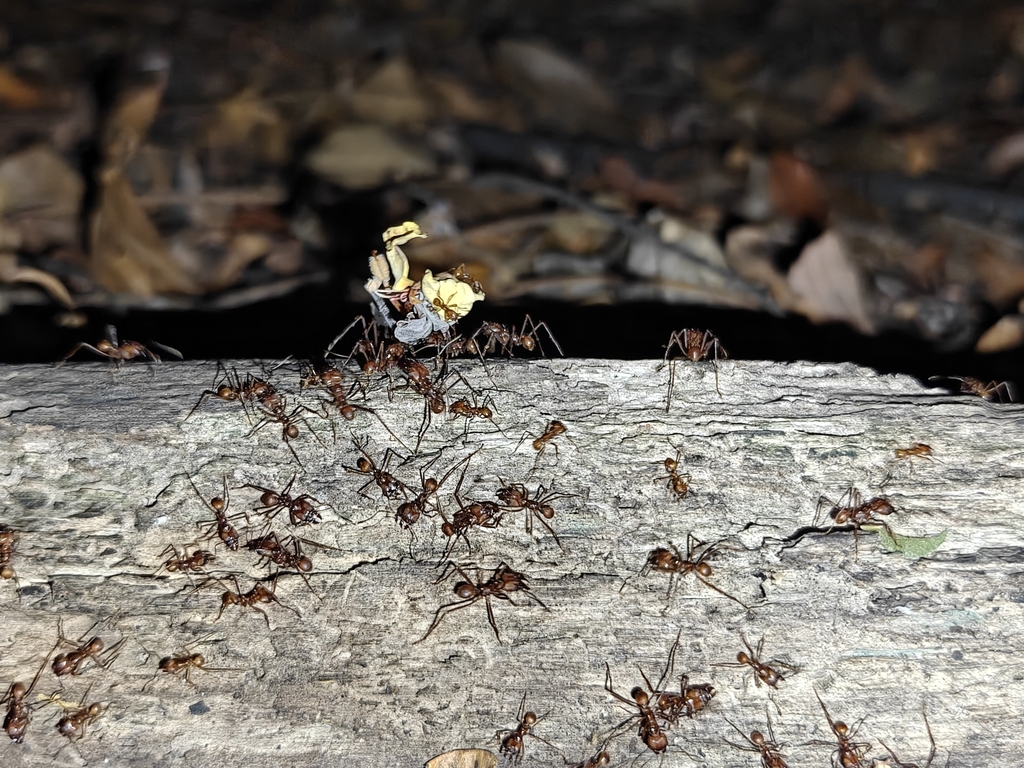
Leaf preference varies seasonally and by availability, though the ants favor tender young leaves and flowers when possible. They avoid certain plant species that contain toxic compounds or fungicides, demonstrating selective foraging behavior. This dietary specialization on farmed fungus makes Atta cephalotes one of the few non-human herbivores that practices agriculture.
Reproduction
Colonies reproduce through nuptial flights when environmental conditions align—typically following heavy rainfall during the wet season. Winged males and virgin queens take flight at dusk, mate in the air, and females land to found new colonies. A newly mated queen sheds her wings, burrows into soil, and produces workers from her first clutch of eggs while living off stored body reserves.
Queen lifespan can exceed 25 years, during which she lays millions of eggs in pulses throughout her life. Worker development from egg to adult takes approximately 60 days under optimal conditions. Males are short-lived, dying within weeks of mating, while workers are sterile females that serve the colony for several years. Parental care is minimal after the founding phase—the queen simply lays eggs, and workers instinctively tend and feed developing larvae with regurgitated fungal material.
Conservation and Threats
Atta cephalotes has not been formally evaluated by the International Union for Conservation of Nature (IUCN), meaning no official Red List classification exists for this species. Without such an assessment, the global conservation status and population dynamics of the leafcutter ant remain undocumented at an international level. This lack of formal evaluation reflects the broader challenge of monitoring insect populations, particularly for arthropod species that are not flagged as economically critical or endangered.
Threats
No documented threats have been formally recorded for Atta cephalotes in scientific literature or conservation databases. The species occurs across a wide geographic range throughout tropical and subtropical regions of Central and South America, where it occupies diverse forest habitats. Its success as a generalist forager and ability to establish colonies in various environments may buffer it against localized environmental pressures.
However, large-scale habitat conversion—particularly deforestation and agricultural intensification in the Americas—poses potential indirect risks to leafcutter ant populations by reducing foraging areas and host plant availability. The species may also face pesticide exposure in agricultural zones, though this impact has not been systematically quantified.
Conservation Efforts
No specific conservation programmes or legal protections targeting Atta cephalotes have been documented. The species is not listed in international wildlife trade regulations or protected under regional conservation legislation in its native range. Given that leafcutter ants are sometimes viewed as agricultural pests when colonies encroach on crops, management efforts have historically focused on control rather than protection. Conservation attention for this and similar ant species would benefit from population monitoring schemes and research into their ecological roles in tropical forest ecosystems.
Fun Facts
- Atta cephalotes are farmers, not foragers. They cut leaves not to eat them directly, but to cultivate underground fungal gardens that serve as their actual food source.
- A single colony can contain up to 5 million workers, all descended from a single queen that may live for 15–20 years and lay millions of eggs throughout her lifetime.
- Worker ants in this species display extreme size variation—soldiers can be 30 times heavier than the smallest workers—allowing the colony to assign individuals to specialized tasks based on their body size.
- The fungus these ants farm is not found in nature; it exists only in ant colonies and has evolved alongside the ants for millions of years in an obligate mutualistic partnership.
- An active leaf-cutting colony can harvest and process up to 30 kilograms of fresh vegetation per day, with some foraging trails containing thousands of ants moving in continuous two-way traffic.
- When a leaf-cutter ant finds a food source, she marks it with a pheromone trail that can recruit nestmates within minutes—the chemical signal is so precise that followers can identify profitable plants even in darkness.
- Male ants in this species live only a few weeks after mating, whereas females can survive for decades, making the reproductive biology highly skewed toward the long-lived female castes.
Sources and References
Data Sources
The information in this article draws from the following open-access biodiversity databases and reference resources:
- GBIF — Global Biodiversity Information Facility (gbif.org). Provides occurrence records, distribution data, and occurrence counts for Atta cephalotes across geographic regions.
- iNaturalist (inaturalist.org). Community-contributed observations, photographs, and sightings of the species in its natural habitats.
- Wikipedia (wikipedia.org). General biological information, natural history, and conservation context.
- Encyclopedia of Life — EOL (eol.org). Habitat descriptions, diet, behavior traits, and species ecology.
These sources represent peer-reviewed aggregations and community-verified data curated by international scientific networks. Users seeking detailed specimen data, collection locations, or original observations are encouraged to consult the primary databases directly.
Ecology
Diet
Behavior
Photo Gallery
Ansil B.R. · CC BY 4.0
Related Species
Was this profile helpful?