
Eurotatoria · Ploima
Lepadella Monodactyla
Lepadella monodactyla

Scientific Classification & Quick Facts
Classification
Known For
Full profile in progress — check back soon.
Lepadella monodactyla is a microscopic rotifer—a tiny freshwater animal so small that it inhabits the spaces between water molecules in aquatic environments worldwide. Despite its diminutive size, this species has colonized freshwater ecosystems across at least five countries, demonstrating the remarkable ability of rotifers to thrive in conditions that would challenge most other animals. Its conservation status remains unknown, a reflection of how little is understood about the biology and distribution of these ubiquitous but largely overlooked creatures.
The genus Lepadella belongs to the family Lepadellidae within the phylum Rotifera, a group whose members are defined by a wheel-like corona of cilia that draws water and food particles into their mouths. Lepadella monodactyla occupies an important ecological niche as a consumer of bacteria, algae, and organic detritus in freshwater systems, playing a subtle but crucial role in nutrient cycling. Its presence in multiple continents suggests both adaptability to diverse conditions and—likely—widespread but undetected distributions in regions where freshwater habitats have never been systematically surveyed for microorganisms.
Identification and Appearance
Lepadella monodactyla is a microscopic rotifer belonging to the family Lepadellidae. Like all rotifers, it is an aquatic microorganism visible only under magnification, requiring a compound microscope to observe its anatomical details and distinguish it from related species.
Morphological Features
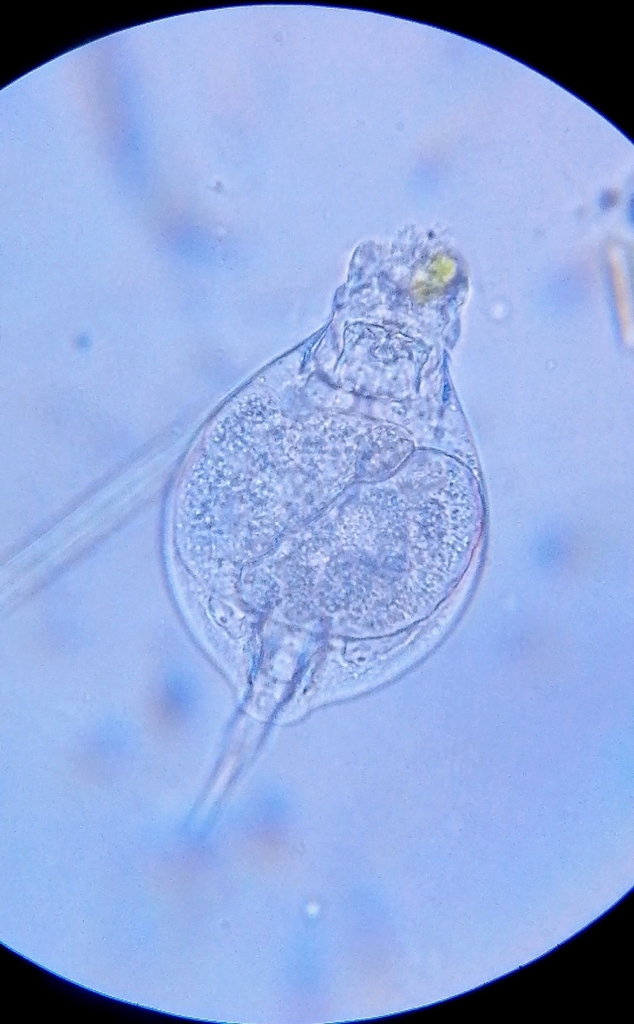
The genus Lepadella is characterized by a distinctive lorica—a rigid, transparent, or translucent outer case that encloses the body. L. monodactyla exhibits the typical rotifer body plan, with a corona (a ring of cilia used for feeding and locomotion) at the anterior end and a posterior foot region. The species name “monodactyla” refers to a single digit or finger-like extension, which is a key diagnostic feature distinguishing it from related Lepadella species that may possess multiple digits or different foot morphologies.
The lorica provides structural support and protection, and its precise shape, ornamentation, and the configuration of posterior projections are critical for taxonomic identification at the species level. The internal anatomy includes a mastax (pharyngeal apparatus), digestive system, and reproductive organs typical of the phylum Rotifera. Coloration in rotifers is generally absent or minimal due to their microscopic size and transparency, though internal organs may appear faintly visible under high magnification.
Distribution and Habitat
Lepadella monodactyla is a rotifer with a documented range across five countries, primarily concentrated in Africa and South America. Madagascar holds the highest number of recorded observations with three records, followed by the Democratic Republic of the Congo, Nigeria, and Brazil with two records each. Cameroon accounts for one additional record, extending the species’ known presence across the African continent and into the neotropics.
The geographic distribution of this microscopic organism spans tropical and subtropical regions, reflecting the typical habitat preferences of rotifers. However, specific elevation data and detailed habitat classifications are not yet established for this species. The presence of L. monodactyla across geographically distant regions—from West-Central Africa to South America—suggests tolerance for diverse freshwater environments, though further sampling and characterization of microhabitats would clarify its ecological preferences and potential for wider distribution.
Seasonal occurrence patterns remain undocumented for this species, as collection data do not indicate a pronounced peak month. Additional field observations and systematic monitoring across its range would help establish whether L. monodactyla exhibits temporal variation in abundance or if records reflect sporadic sampling effort rather than genuine seasonal patterns.
Biology and Behavior
Behavior
Lepadella monodactyla is a microscopic rotifer that inhabits freshwater environments. As a member of the bdelloid rotifers, this species exhibits the characteristic cilia-driven locomotion typical of its group, propelling itself through water columns and across substrate surfaces. The organism is primarily benthic or periphytic in habit, dwelling among sediments, detritus, and biofilms where it can access food and shelter from larger predators.
Like other rotifers, L. monodactyla displays limited behavioral complexity relative to larger animals, though it responds to environmental stimuli including chemical gradients, light, and mechanical disturbance. Daily activity involves foraging within the immediate microhabitat, with movement patterns influenced by local food availability and water chemistry. The species is solitary and shows no evidence of social aggregation or cooperative behavior.
Diet
Lepadella monodactyla is a detritivore and microphagous filter feeder. The species consumes bacteria, microalgae, organic detritus, and other microscopic particles suspended in water or lodged within sediments and biofilms. Its corona of cilia generates feeding currents that draw food particles toward the buccal cavity, where a muscular pharynx processes ingested material.
Reproduction
As a bdelloid rotifer, L. monodactyla reproduces exclusively through asexual parthenogenesis—females produce genetically identical clones without requiring males. Reproduction occurs continuously under favorable environmental conditions, with females producing eggs that develop into juvenile rotifers. The entire life cycle, from egg to reproductive maturity, typically spans days to weeks depending on temperature and food availability.
Population growth in L. monodactyla can be rapid under optimal conditions, allowing the species to exploit ephemeral microhabitats and respond quickly to resource pulses. When environmental stress occurs—such as desiccation, extreme temperature, or starvation—the species enters a state of cryptobiosis, suspending metabolism and development until favorable conditions return. This adaptation enables survival in seasonally unstable freshwater systems.
Conservation and Threats
Lepadella monodactyla has not been formally assessed by the IUCN Red List. No official conservation status designation or population trend data is currently available for this rotifer species. The lack of assessment reflects a broader gap in global monitoring of microscopic invertebrates, which rarely receive the systematic evaluation applied to larger organisms.
Threats and Conservation Efforts
Specific threats to Lepadella monodactyla have not been formally documented in conservation literature. As a freshwater rotifer with a cosmopolitan distribution, this species likely faces the same broad pressures that affect freshwater microinvertebrate communities worldwide: habitat degradation, water pollution, eutrophication, and climate-driven changes to freshwater systems. The species’ microscopic size and widespread occurrence mean it is seldom the focus of targeted threat assessment or monitoring programmes.
No dedicated conservation programmes or legal protections currently exist for Lepadella monodactyla. Conservation efforts for this species, if any occur, are indirect—through general freshwater habitat protection, water quality management, and initiatives that safeguard biodiversity in ponds, lakes, and streams. The best pathway to long-term preservation lies in maintaining healthy freshwater ecosystems and reducing anthropogenic pollution across aquatic environments.
Cultural Significance
Lepadella monodactyla occupies a specialized niche in scientific research rather than in traditional human culture. As a microscopic rotifer, this species has minimal direct presence in mythology, folklore, cuisine, or medicine. Instead, its significance emerges through its utility in laboratory and ecological studies, where it contributes to our understanding of broader biological principles.
The species belongs to a group of microorganisms prized by researchers for specific practical advantages. Its small size and rapid reproduction make it suitable for microaquarium cultivation and microfluidic chip studies, where scientists can observe its behavior in controlled environments. These laboratory applications reflect how certain microscopic organisms gain cultural importance not through traditional human interaction, but through their role in advancing scientific knowledge and technological innovation.
Beyond its laboratory applications, Lepadella monodactyla exemplifies how behavioral ecology and the study of microorganisms inform conservation biology. The insights gained from observing small organisms like rotifers contribute to management strategies for larger taxa and ecosystems. This indirect cultural significance—as a model for understanding ecological principles applicable across diverse species—positions the organism within modern scientific practice and environmental stewardship rather than historical or artistic traditions.
Fun Facts
Lepadella monodactyla is a microscopic rotifer—a animal so small that thousands could fit on the head of a pin. Despite their diminutive size, these creatures play a vital ecological role in freshwater and brackish ecosystems worldwide.
- Rotifers like Lepadella monodactyla have been found in every freshwater habitat on Earth, from mountain streams to swamps, making them among the most successful microorganisms in aquatic environments.
- The name “monodactyla” refers to the rotifer’s single, finger-like foot structure—a distinctive feature used to anchor itself to algae, detritus, or sediment particles while filter feeding.
- These animals are detritivores that consume bacteria, algae, and organic particles suspended in water, effectively recycling nutrients and keeping aquatic ecosystems clean.
- Rotifers possess a remarkable organ called the corona—a crown of cilia that creates feeding currents and propels them through water with choreographed precision.
- Lepadella monodactyla reproduces through both sexual and asexual reproduction, allowing populations to adapt rapidly to changing environmental conditions.
- These microscopic animals can enter a state called cryptobiosis, where they lose 95 percent of their body water and enter a death-like dormancy, surviving extreme drought and temperature fluctuations for years.
- Rotifers have been used as model organisms in scientific research to study aging, reproduction, and environmental toxicology because of their transparent bodies and short life cycles.
Related Species
Was this profile helpful?