
Pinopsida · Pinales
Yew
Taxus baccata
Least ConcernAlso known as: Canada Yew, Common Yew, English Yew, European Yew, Irish Yew
© Jens-Christian Svenning · iNaturalist · CC BY 4.0
The yew is a tree that demands respect. Dark, dense, and long-lived, Taxus baccata has stood in European churchyards and ancient forests for thousands of years, its evergreen needles and blood-red berries a fixture of myth, medicine, and memento mori. From the Atlantic coast of Ireland to the Mediterranean slopes of Turkey, this conifer spans 24 countries across a range that reflects both its ecological resilience and its cultural significance. Listed as Least Concern by the IUCN, the yew remains widespread and stable across its native range, yet its history—both ecological and human—marks it as far more than an ordinary tree.
What makes the yew exceptional is the convergence of extremes it embodies. It is simultaneously one of Europe’s most poisonous plants and one of its most medicinally valuable; one of the slowest-growing trees and one of the longest-lived, with individual specimens reaching ages exceeding 2,000 years. Its ability to regenerate from within its own hollow heartwood—creating what appears to be a ghost tree reborn—has given it an almost supernatural presence in folklore. For those who study ancient forests, rare growth forms, or the intersection of human culture and plant evolution, the yew offers an unparalleled window into how a single species can shape landscapes, traditions, and science across millennia.
Identification and Appearance
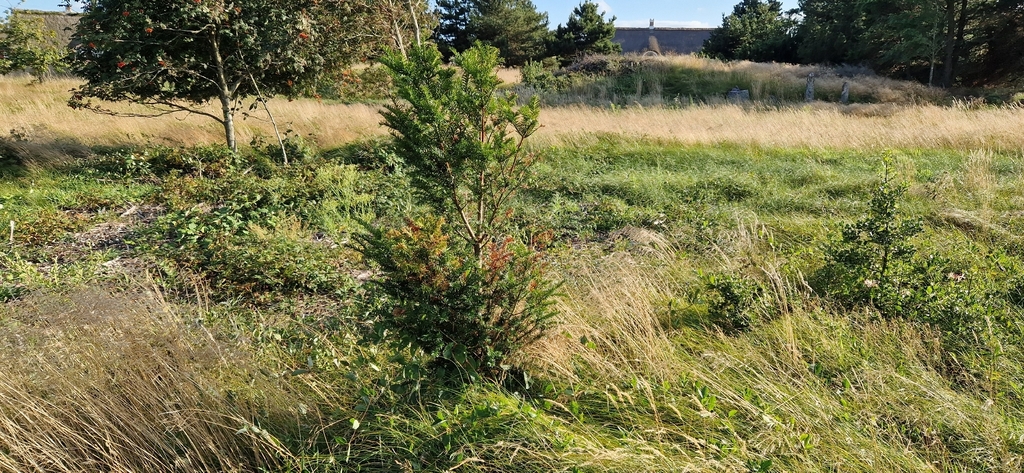
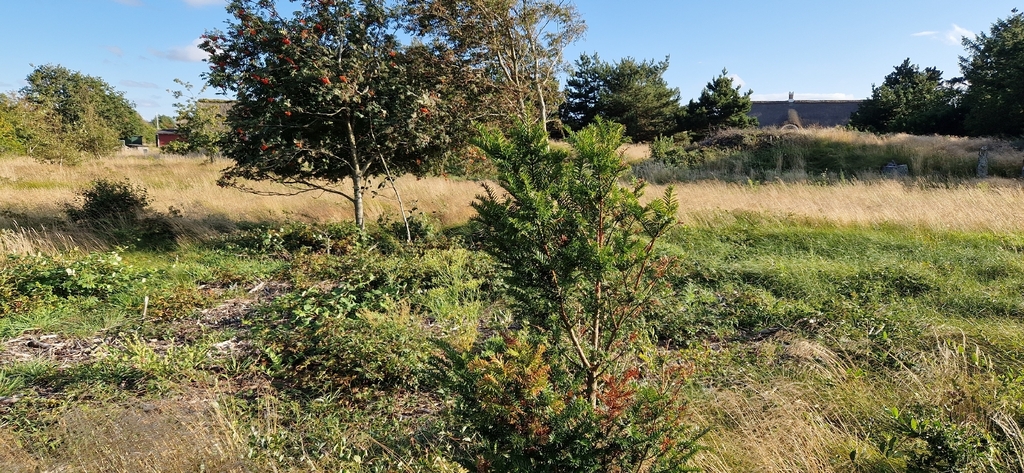
Taxus baccata, the Yew, is a small to medium-sized evergreen tree that typically reaches 10–20 metres in height, though exceptional specimens may grow to 28 metres. The trunk is robust, generally up to 2 metres in diameter, with some ancient trees displaying diameters exceeding 4 metres. The bark is thin and scaly, reddish-brown in colour, and characteristically peels away in small flakes that align with the stem’s direction.
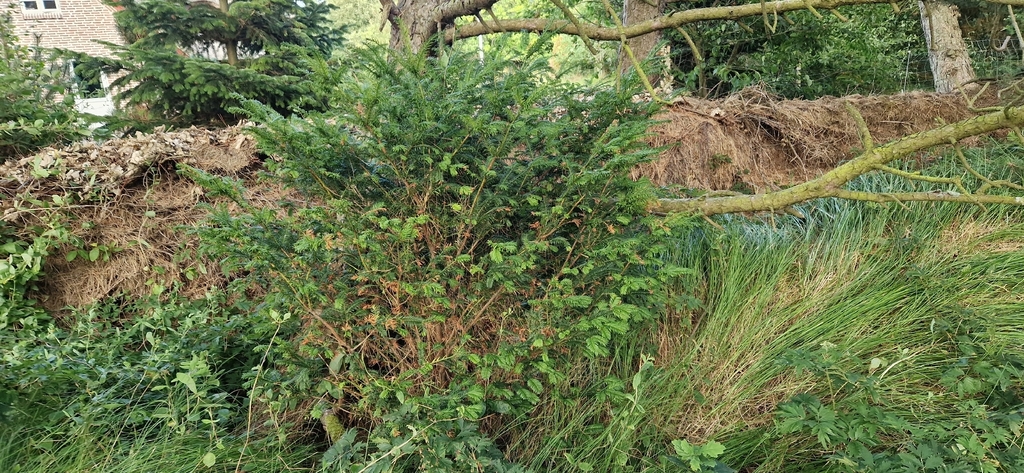
The foliage is the yew’s most immediately recognizable feature. Leaves are flat and dark green, measuring 1–4 centimetres in length and 2–3 millimetres across. Although leaves are arranged spirally on the stem, their bases are twisted so that they lie flat in two distinct rows on either side of the shoot, giving the tree a feathery, two-ranked appearance. This distinctive arrangement is most evident in the main canopy, though erect leading shoots display the true spiral pattern more openly. The overall effect is of a dense, darkly foliaged crown with a somewhat columnar or irregular branching form.
Yews are dioecious, meaning individual trees are either male or female. Female trees produce fleshy, berry-like arils—bright red cup-shaped structures each containing a single hard seed—which ripen in autumn and persist into winter. Male trees produce inconspicuous pollen cones. This sexual dimorphism is particularly valuable for identification: the presence of red arils confirms a tree is female, while their absence indicates a male specimen or a young tree that has not yet reached reproductive maturity.
Distribution and Habitat
Taxus baccata, the common yew, is predominantly distributed across northern and central Europe. GBIF records show the species occurs in 24 countries, with the United Kingdom holding by far the largest concentration of observations (132 records), followed by Norway (49), Germany (34), France (16), and Denmark, Sweden, and Switzerland (10 each). Austria, Belgium, and Spain contribute smaller but confirmed populations to the broader range.
The species favours temperate elevations between 326 and 990 metres, with an average occurrence at 647.5 metres. This range reflects the yew’s preference for cool, stable microclimates in lowland and submontane zones across its European stronghold. Within this vertical band, the tree typically establishes in sheltered woodland settings and on limestone or chalky soils, though habitat data remains limited in current distribution databases.
Occurrence data shows a pronounced seasonal pattern, with GBIF records concentrated in January (300 observations) and no records reported in the remaining months. This clustering likely reflects survey methodology and the timing of winter botanical fieldwork rather than genuine seasonal presence, as Taxus baccata is an evergreen perennial present year-round across its range.
Growth and Cultivation
Growth
Taxus baccata, the common yew, is a slow-growing evergreen conifer with a dense, compact habit. It develops into a columnar or spreading tree depending on variety and growing conditions, typically reaching heights of 10–20 metres, though some specimens exceed 25 metres over centuries. The foliage is dark green and needle-like, arranged in flat sprays, and the bark is reddish-brown to grey, becoming fissured with age. Yew is renowned for its longevity—many individual trees in Britain and Europe are over 1,000 years old, making it one of the longest-lived trees in temperate regions.
Growth rate is notably slow, especially in young plants. Yew responds well to pruning and shaping, which has made it a traditional choice for topiary and hedging throughout Europe. The wood is extremely hard and flexible, prized historically for longbow manufacture and still valued for ornamental woodwork.
Flowering and Fruiting
Yew is dioecious—male and female flowers develop on separate plants. Male flowers are inconspicuous yellow structures that release pollen in early spring; female flowers are similarly modest, developing into a distinctive fleshy, berry-like structure called an arillus. This red arillus matures in autumn and is the only non-toxic part of the plant; it attracts birds that consume and disperse the seed within. The seed itself is hard and poisonous, though birds swallow it whole without harm.
Cultivation
Yew is exceptionally tolerant of poor, shallow, and chalky soils, thriving in a wide pH range from acidic to highly alkaline. It grows in full sun to deep shade, making it one of the few conifers suited to understory planting beneath deciduous trees. Once established, yew is drought-tolerant and requires minimal supplementary watering except during prolonged dry spells in the growing season. Young plants benefit from consistent moisture until roots are well-developed.
Hardy across temperate regions, yew is suitable for USDA hardiness zones 5–9 and equivalent European zones. It prefers cool winters and performs poorly in hot, humid climates. Plant in autumn or spring in well-draining soil; avoid waterlogged sites. Yew requires little feeding on fertile ground but responds to a light balanced fertiliser in spring. It is extremely slow to establish—expect modest growth in the first 5–10 years—but becomes increasingly vigorous once the root system matures.
Conservation and Threats
Taxus baccata, the common yew, holds a conservation status of Least Concern on the IUCN Red List. This designation reflects a species with a wide geographic range and stable to increasing populations across much of its native range in Europe and western Asia. The upward population trend indicates that current conservation measures and natural resilience are sustaining viable populations, though localized declines in specific regions warrant ongoing attention.
Threats
Although Taxus baccata faces no imminent extinction risk, the species encounters several pressures across its range. Habitat loss through woodland conversion and urban development fragments yew populations, particularly in lowland forests where the tree historically flourished. Overgrazing by livestock, especially deer and sheep, prevents natural regeneration in many stands by consuming seedlings and young shoots before they can establish. In some regions, illegal or unsustainable harvesting for ornamental purposes and traditional medicine compounds these pressures, though enforcement of protections has improved in recent decades.
Conservation Efforts and Legal Protections
Yew benefits from legal protections in several European nations. In the United Kingdom and Ireland, ancient and veteran yews are recognized as heritage trees, and felling is restricted or prohibited in many locations. The species is included in European biodiversity directives and protected within designated conservation areas across its range. Active management in some reserves focuses on reducing browsing pressure through deer control and fencing seedlings to encourage regeneration. Population monitoring through forest inventories and citizen science initiatives helps track trends and identify populations requiring intervention.
Cultural Significance
Ornamental Horticulture
Yew holds a prominent place in ornamental gardening and landscape design. Its dense, dark green mature foliage and exceptional tolerance of severe pruning make it the preferred choice for formal hedges and topiary work. Gardeners and landscape architects have relied on this species for centuries to create structured, geometric forms that define formal garden aesthetics.
The species’ relatively slow growth rate offers practical advantages in maintenance. Once established, yew hedges and topiary require clipping only once per year, typically in late summer, making them economical to maintain compared to faster-growing alternatives. Its remarkable adaptability to diverse growing conditions—including shallow chalk soils and shade—allows it to thrive in a wide range of garden situations, further cementing its status as a cornerstone of European ornamental horticulture.
Fun Facts
- All parts of the yew tree are poisonous except for the fleshy red aril (the berry-like coating around the seed), making it one of the few plants where consuming only the fruit flesh is safe while the seed itself is lethal.
- Yew toxins can enter the body through three different pathways—ingestion, inhalation, and direct skin absorption—an unusually broad danger profile that makes this tree exceptionally hazardous compared to most poisonous plants that rely on a single exposure route.
- Despite thriving in temperate woodlands where deciduous trees dominate, the common yew is evergreen and keeps its needle-like foliage year-round, giving it a distinctive appearance even in winter when surrounding forests turn bare.
- The common yew has one of the widest geographic ranges of any yew species, native across much of Eurasia and Northwest Africa—a distribution spanning three continents that reflects its remarkable adaptability to different climates and soils.
- Yew wood is extremely dense and durable, historically prized for making longbows in medieval England; a single yew tree can take 500 years or more to reach timber-harvesting size.
- Individual yew trees can live for over 4,000 years, making them among the longest-lived trees in Europe and creating living connections to prehistoric times.
Ecology
Habitats
Growing Conditions
Edibility
Conservation Status
LC (Least Concern) · NT · VU · EN · CR · EW · EX
Photo Gallery
Jens-Christian Svenning · CC BY 4.0
Related Species
Was this profile helpful?